
While searching for a particular book upstairs at Chop Suey several months ago, an idea entered my mind. Standing alone amidst the quiet whispers of hundreds of well-loved titles, I paused to appreciate the sensations that surrounded me–the smell of the pages mixed with the vibrant artwork of the hundreds of book jackets, the sunlight streaming into the room as it lingered across the old worn hardwood floor. “You’d never get this on Amazon.com, nor in the West End,” I thought to myself, and then dove back into the stacks to find more treasures to take back home with me.
Over the next few months, I weighed the convenience of technological innovations vs. the tangible essence of the small business. I reflected back on my afternoon at Chop Suey; the delight I had experienced when I stumbled across exactly what I needed, as well as the joy of finding more wonderful books that I didn’t know I needed until I found them. I realized that this magical feeling was not entirely coincidence, but rather the result of the long hours that the Chop Suey folks dedicate to intentionally creating this spark of virtue at a very reasonable price.
My quiet pondering led me to notice other iconic Richmond small businesses that are still conducting business as usual while others around them throw in the towel, blaming their demise on “the internet” in “this economy.” My curiosity got the best of me, so I decided to visit the actual owners of these small businesses to get the truth on how technology affects their operations, if it does at all.
The most logical place to start is always at the beginning, so, I reached out to Ward Tefft, the owner of Chop Suey Tuey. As he was traveling, we both agreed to communicate through the technology of email:
While searching for a particular book upstairs at Chop Suey several months ago, an idea entered my mind. Standing alone amidst the quiet whispers of hundreds of well-loved titles, I paused to appreciate the sensations that surrounded me–the smell of the pages mixed with the vibrant artwork of the hundreds of book jackets, the sunlight streaming into the room as it lingered across the old worn hardwood floor. “You’d never get this on Amazon.com, nor in the West End,” I thought to myself, and then dove back into the stacks to find more treasures to take back home with me.
Over the next few months, I weighed the convenience of technological innovations vs. the tangible essence of the small business. I reflected back on my afternoon at Chop Suey; the delight I had experienced when I stumbled across exactly what I needed, as well as the joy of finding more wonderful books that I didn’t know I needed until I found them. I realized that this magical feeling was not entirely coincidence, but rather the result of the long hours that the Chop Suey folks dedicate to intentionally creating this spark of virtue at a very reasonable price.
My quiet pondering led me to notice other iconic Richmond small businesses that are still conducting business as usual while others around them throw in the towel, blaming their demise on “the internet” in “this economy.” My curiosity got the best of me, so I decided to visit the actual owners of these small businesses to get the truth on how technology affects their operations, if it does at all.
The most logical place to start is always at the beginning, so, I reached out to Ward Tefft, the owner of Chop Suey Tuey. As he was traveling, we both agreed to communicate through the technology of email:

Jaime Turko: The idea for my series on technology and the small business owner with a focus on creative small businesses here in Richmond first came to me one Friday when I was shopping at Chop Suey, which is always such a fantastic experience for me. There’s a life there that you can’t find at Barnes and Noble or at other chain stores. No matter what book is on my mind, I always stumble upon it, which then leads me to new discoveries. It’s always a feeling of Christmas Day when I leave with more books that I thought would fit my budget, and I always look forward to going back. So, to start, could you describe a bit of how your business has changed (grown or adapted) since you first opened the doors of the Cary Street store? Also, what decisions have you made in both the utilization of technology, as well as choices to maybe not adapt to technological advancements, that have helped make your business what it is today?
Ward Tefft: I think the first thing to do is to identify the two major technological changes that have taken place in the world of books: the internet as a marketplace to buy and sell books, and the eBook. Each of these technological “advances” have had a huge impact on booksellers, and while our response to each is not unique, it certainly isn’t seen much.
Since the mid-1990s, booksellers have been offered the opportunity to sell books online through sites like Abebooks, Amazon, Alibris, Ebay, and countless others. This widening of the marketplace has had many affects on bookselling, from helping determine the price of books to opening up the “occupation” of bookseller to anyone who has a book to sell, but I think the saddest change comes from the low overhead involved in selling online. Because the fee you pay to list your books on these sites is so low, many used bookstores have opted to close their brick and mortar shops and to sell exclusively online. While it makes solid financial sense, the idea of only selling books to customers over the internet depresses me. The whole social interaction of retail sales disappears, and you might as well be selling bricks or hubcaps. Chop Suey Books has always sold books online, but we only list about 5% of our inventory, and those things we do list are priced much lower in the store. We do this to encourage customers to keep coming to the store, and to appreciate the personal experience of shopping in a store, not online. As you mentioned, browsing through a bookstore will often lead you to find something you didn’t know you were looking for. As opposed to strictly online sellers, who list books through a database, we act as curators who develop and maintain an environment meant for anyone who likes to read.
The other technological advancement is newer, but looms much greater over the world of books: the much loved, hated, and feared eBook. If you have paid the slightest attention to the financial news of Borders or Amazon, you will know that this is probably the most talked about phenomena in the world of books. Personally, not a week goes by that someone doesn’t ask if I’m afraid of the Kindle, or if we are going to have to close the store. In fact, the demise of Borders is largely blamed on their inability to adapt to eReaders, and many smaller bookstores have changed their business model to enable them to sell eBooks.
Unlike the birth of the internet, this sea change has taken place during the lifetime of Chop Suey, and our response has been short and sweet: we have done nothing new. As we sell both new and used books, we are able to offer great books at prices even lower than eBooks, and books which, due to their age and design, are collectible as objects. In this, I believe we are safe from the looming eBook. Like CD stores who have had to go back to selling records (with much success, I might add), used bookstores will continue to operate outside of these digital advances, as we are selling objects as much as information.
But I am not totally convinced of the power of the eBook. Chop Suey began selling new books along with used in 2006, and each year the sales for new books has gone up for us. This is due in part to us being curators and offering a unique collection, to our having a symbiotic relationship with the community, and to our hosting various literary and art events, but I also think that the eReader is more of a bugaboo now than an actual threat. I am not totally convinced that eBooks are the wave of the future, or that they will ever replace the comfort and ease of reading a book. This may change with each generation, but I tend to think that within my lifetime, the book as an object will live on.

JT: Your comments on books as objects makes so much sense. The books that I find myself holding onto throughout the moves of life all definitely have a nostalgic component for me–either in the tactile sense with the feel of the pages, in the visual aspect of collecting the hard to find cover, in the smell of the book itself if it’s particularly old, even where I was in life when I first read it or where I am now as I choose to read it again. There’s something very magical about how a book can signify solitude as well as community.
Taking a moment to further discuss the eBook: how often, as curators, does Chop Suey find customers coming into the store to purchase the actual book after they have read it on an eReader? And on the topic of community, do you feel that the eBook is making the written word more accessible worldwide? What are your thoughts on books impacting the community, and how is that changing with the eBook/eReader?
WT: Aside from someone occasionally apologizing to me for having bought one (which is always a funny thing, since nobody apologizes for buying a DVD player or going to a movie or just watching TV, or any of the millions of other things they could be doing besides shopping at Chop Suey; plus, I have never had a former customer apologize for getting one), I don’t really have an idea of how popular they actually are. The only things that people have told me that make sense are that you can adjust the screen for larger type (older people have told me this, and it seems like a great selling point), and the ease of traveling with one, since you can have a wide assortment of reading material in one small carrying case.
Actually, now that I think of it, the people who make a point of apologizing for owning eReaders are similar to those who once apologized for “not being a reader.” I’m wondering how much of eReader sales are based on people fetishizing new technology, as opposed to those switching formats for actual reading.

To answer another of your questions, I’m not really sure how eReaders will be different from books in impacting a community, or society at large. Even though literature can bind different groups together, whether it is through book clubs, through political tracts, or even just the simple act of discussing a favorite book, reading is almost always a solitary act. Whether one is reading a book or an eReader wouldn’t, in my opinion, make much of a difference.
Sorry not to have any well formed ideas on the eReader. It isn’t something I actually try to avoid talking about, and certainly nothing I have a personal grudge against. Basically, it has about as much impact on my life as the new version of AutoCAD.
JT: How has the utilization of social networking avenues affected your business, if at all? For instance, do you see that sales have increased since utilizing avenues such as Facebook as a means of communication?
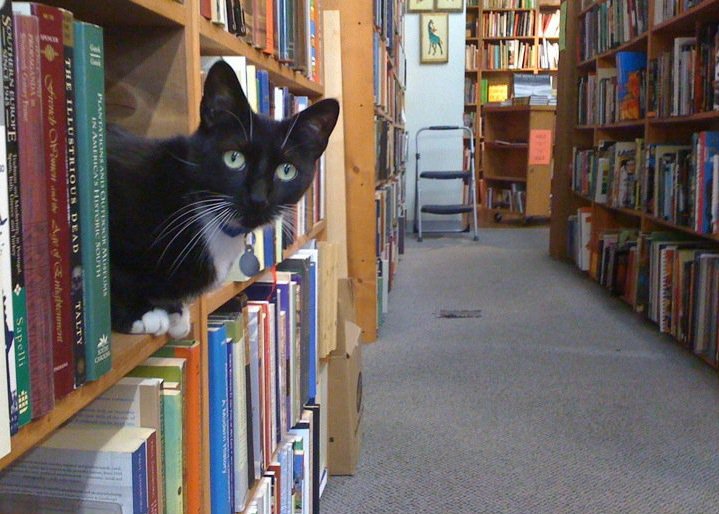
WT: As you know, we are up on Facebook every week with Caturday photographs of WonTon, our store cat, and in between with news about sales, hour changes, new books, etc. This has definitely helped us in some aspects–like when we were open when it snowed and we offered a Facebook discount to anyone who came in–but I really can’t tell if it helps business more than that. We mostly use it to have fun and to create an image of Chop Suey as a cool, laid back place that is fun to visit even if you don’t buy anything. If people see us that way, then Facebook has done its job!

JT: Now, just one last question: What’s the one book that you find yourself revisiting throughout your life? When was the first time you read it? Any thoughts you have on why you keep revisiting it?
WT: I definitely have books that I go back to, and then a lot more that I mean to go back to, but I’m not one to be definitive on my Number 1 pick, or even a top 5. I just reread The Phantom Tollbooth, a book that I read and really enjoyed when I was in 3rd or 4th grade. And Kurt Vonnegut is someone I will go back to every few years; I think he is the one who saved reading for me after having boring “classics” forced on me throughout high school and my first year of college. The thing I like about him is that he is deceptively easy to read; his books are totally accessible, they are fun and read very smoothly. But there is a whole subtext that exists beyond this, so if you want a deeper, more complicated, sardonic read that is both pessimistic and optimistic at the same time, he is the best.
I would keep listing other favorites, but each time I name one, I feel guilty for not naming 5 others who should be on the list. So for right now, let’s keep it at Kurt as a solid favorite.