
Editor’s Note: This is a companion piece to our preview of Songs of Truth, the new musical inspired by the life of Sojourner Truth. This essay from Christian Detres takes a closer look at the woman behind the legend and the enduring relevance of her story.
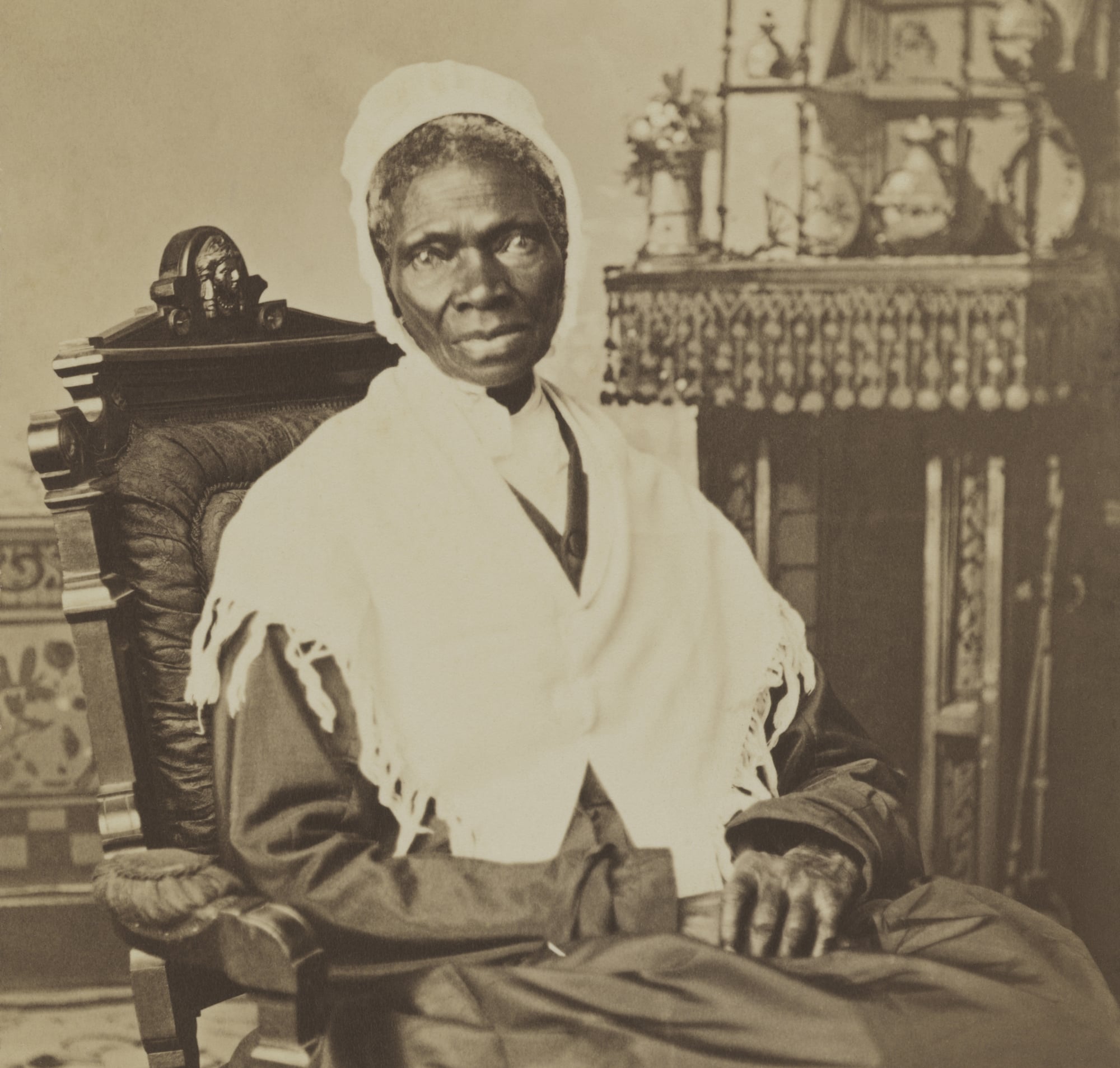
Sojourner Truth is an integral personality to the concept of “American spirit.” She is more than a pioneer. She’s an anachronism. She embodies what we, as a nation, most cherish about our aspirational collective character. She was brash, clever, imbued with music, and fearless in the face of tyranny. She stood six feet tall and was fierce in every way that mattered. She was also kind to all who needed her. She was loved and admired by statesmen, presidents, freedmen and women, and the generations of intersectional Civil Rights activists she’d come to inspire.
The hardest thing to swallow is that I’ll bet most of you recognize her name, but can’t place her deeds. That, to me, is unacceptable.
Before you head over to my write-up on Songs of Truth, coming to the Hippodrome on June 20 (HERE), let me remind you who Sojourner Truth is. Not was. Because her story is as relevant today as it was in 1883, when we were finally deprived of her physical presence. Some said she was over 100 years old when she died, but journalism in the 19th century often preferred drama to reality. Raise your hand if that sounds familiar.
The going agreement is that she was born Isabella Baumfree, a slave in the Hudson Valley of New York in 1797. Just twenty-one years had passed since our Declaration of Independence. George Washington was ending his second term as President when she came into the world. In many ways, the nation had only the foundational intentions of liberty handled at the time, and was clumsily managing it at that.
In many depictions of her on stage and screen, she is played with that common Southern ‘mammy’ patois audiences have coded to “slave.” Let’s unlearn that. Her first language was Dutch. By the time she learned English, after being sold to an English-speaking slaver at age 9, she spoke with a low-country Dutch accent. She was eloquent and boomed with a famously robust voice. Before she turned 18, she had been bought and sold numerous times. She was forced to marry and bear children upon command.
In the North, there was a phasing out of slavery. Culturally, the institution had soured in the consciences of the people, notably in the Quaker communities that had populated the region. It found its end in New York in 1827. She had been promised early release in 1826, but was betrayed.
She decided to leave her servitude on her own terms. One dawn, she took her infant daughter in her arms and simply walked out. She had nothing but a small bag of clothes and a baby to her name. She evaded capture with the help of abolitionist neighbors and moved to New York City. Just before the official end of slavery in New York, the animal that caged her and her family illegally sold her 8-year-old son down South, where he would never hope to be free.
This is the moment most people recall when her name is brought up.
She sued the guy. She demanded the return of her child and won in court. A completely white court. She is the first black woman to sue a white man in this country, and she came out victorious. She exerted her newfound place as a citizen with rights under the law, and was rewarded for her bravery. She provided a template for the oppressed, that justice under this new system applied to them as well. Her son wore the scars of the inevitable torture his captors unleashed on him, but he was set free. By her hand. By her voice.
She spent the 1830’s working as a domestic servant to wealthy white New Yorkers in Manhattan. She tried to find faith in some local personality cults for a time, but was shaken awake by another betrayal. It sounds crazy, but a white couple in her ‘congregation’ accused her of murder and financial fraud as the commune collapsed around them. She sued them, too. For slander. And won.
In the 1840s, she became Sojourner Truth in name and in mission. She took to the dusty roads traveling the country with her songs and her head held high, preaching gospel and civility (which shouldn’t be two separate things). Her legend grew. She started drawing crowds and earning speaking invitations from academic institutions. She became a celebrity, a headlining draw on the anti-slavery lecture circuit. She joined the Northampton Association of Education and Industry in Massachusetts and became colleagues with Frederick Douglass and William Lloyd Garrison.
Her famous 1851 speech to the Ohio Women’s Rights Convention is a cinematic moment, but had been sensationalized for white audiences over time. An 1863 version of the speech, published a white female activist, is where the “Ain’t I a Woman?” quote comes from. Apocryphal, but note perfect to her mission, if not her actual words or likely colloquialisms. What seems to be the most accurate was an eyewitness account by Marcus Robinson that emphasized her audience’s exuberance and her clear oratory, giving one of the most famous treatises on equality.
During the Civil War, she led the charge to recruit black soldiers to the Union Army in Michigan. She moved to Washington DC after Emancipation and helped freed slaves find homes and jobs, shepherding their transition to citizens of the United States of America. In 1864, she was invited to have an audience with Abraham Lincoln at the White House. It became a highlight of both their lives. While in DC, she also led the desegregation of public “buses” (being horse-drawn carriages at the time) and got that done as well.
If that wasn’t enough, after the war she went toe to toe with differing factions of suffragists. On one side the Frederick Douglass camp that fought for the vote of the black male, and on the other the Susan B. Anthonys that only considered the rights of white women. Her words on the plight of the black woman as vulnerable to either mission were scathing. She nearly invented the idea of intersectionality, a philosophy that emphasizes that none of us are free until ALL of us are free.
I consider that her greatest achievement. The expansiveness of empathy for all. The drive to fight for the rights of every being with breath. I see Sojourner Truth in the eyes of so many black women, achieving against all odds, maintaining families by their own sheer will, thrilling in the arts and sciences, suffering still but no longer in silence. Their grasp on the rusty rungs they have climbed is adamantine, and woe to the soul that tries to deny them their progress.
On June 20, we get to watch Desiree Roots channel Isabella Baumfree, better known to history as Sojourner Truth, at the Hippodrome Theatre. Tickets on sale HERE
Read the write up on Songs of Truth: The Awakening HERE
TRUTH is an original musical theater project inspired by the true life story and spiritual mission of SOJOURNER TRUTH, a woman once-enslaved in New York’s Hudson Valley, who grew up to take her own freedom, free her son, and become a pioneering champion of emancipation and women’s rights in America.
Support RVA Magazine. Support Independent Media in Richmond.
At a time when media ownership is increasingly concentrated among corporations and the wealthy, RVA Magazine has remained one of Richmond’s few independent voices. Since 2005, the magazine has provided grassroots coverage of the city’s artists, musicians, and communities, documenting the culture that defines Richmond beyond the headlines.
But we can’t do this without you. A small donation, even as little as $2, one-time or recurring, helps us continue to produce honest, local coverage free from outside interference. Every dollar makes a difference. Your support keeps us going and keeps RVA’s creative spirit alive. Thank you for standing with independent media. DONATE HERE.
We’ve got merch HERE
Subscribe to the Substack HERE
And Reddit HERE
And YouTube HERE