
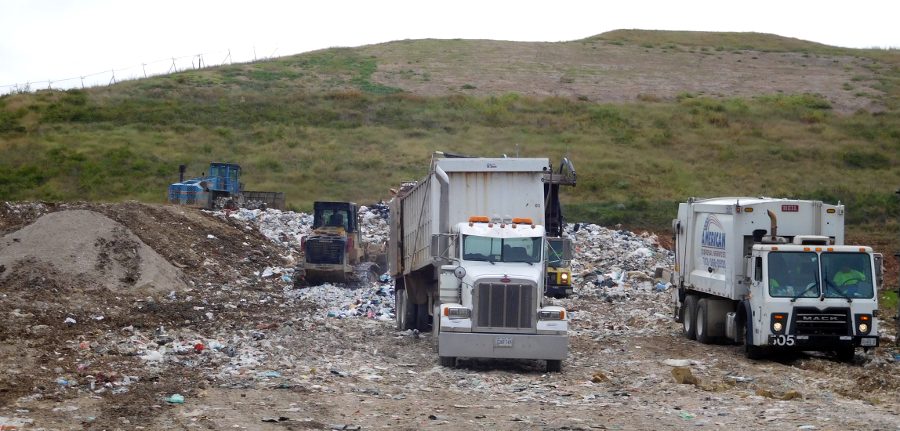
Roughly 170,000 tons of trash incinerator ash is disposed of at Henrico’s Old Dominion Landfill every year. The landfill is located on Charles City Road in a populated area at the border of Richmond’s east end, just past city limits.
Incinerator ash contains toxic heavy metals like lead and mercury, as well as furans and dioxins that pose significant health risks to waste management workers at the landfill, and to the surrounding community.
“The landfill workers are on the frontline dealing with it, but the people living in the community around it probably have longer term exposures,” activist Mike Ewall said. Ewall is the director of Energy Justice Network, an environmental activist organization based in Pennsylvania.
The toxic ash is used as daily cover for the facility’s sanitary waste. Everyday, six to 12 inches of ash is piled on top of the waste in order to diminish the amount of landfill gas emitted into the air. The ash is then buried beneath more waste as it comes into the landfill, and is covered again with ash.
Howard Kassman, CFO of 1st Response Rail Services, said that the ash is also used to build roads within the landfill. 1st Response Rail Service is responsible for transporting the incinerator ash to the landfill by train from an incineration facility in Montgomery County, Maryland.
According to Ewall, using incinerator ash for road-building creates a heightened risk of exposure to incinerator ash as waste-carrying trucks drive to and from the facility throughout the day, kicking ash into the air as they drive over the roads.
“Not only are they using it for daily cover, which means more toxic things blowing into the community, but the fact they’re running trucks over it all the time, that’s got to be far worse for the community,” Ewall said.
Old Dominion Landfill could not be reached for comment.
Landfills are required by law to cover waste with soil in order to keep landfill gas and odors from spreading into neighboring areas. They’re permitted to use alternate daily cover like incinerator ash if it meets the safety guidelines set forth by the U.S. Environmental Protection Agency (EPA). Road-building with waste is also permitted, and is largely seen as a way of recycling.
“Landfills learned years ago that they could save money by not paying to put fresh dirt on the landfill every day … Instead they can get paid to dispose of waste and call it alternative daily cover, and ironically they end up using things that are worse than the normal trash,” Ewall said.

Incinerator ash dumped at Old Dominion Landfill is also at risk of contaminating the groundwater in the area. Old Dominion Landfill is a lined landfill, and has leachate collection and removal systems on-site, but landfill liners have been known to leak as they get older. The facility was built in 1994.
The incinerator ash delivered to the landfill is produced at a trash incineration facility in Dickinson, Maryland. Two types of ash are produced in the waste incineration process: bottom ash and fly ash. The bottom ash is a coarse material that contains large chunks of debris, and is caught by the grates beneath the incinerator. Fly ash is the fine ash that is caught by the air pollution control devices at the end of the incineration process.
The incinerator creates about one ton of ash for every four tons of trash burned, and produces about ten times as much bottom ash as fly ash.
Bottom ash and fly ash both contain toxic heavy metals, but fly ash is especially toxic. In Germany and Switzerland, fly ash is sealed in nylon bags and deposited in salt mines. In Japan, the fly ash is vitrified to create a glass-like substance to ensure that it won’t leach into the groundwater once it reaches a landfill.
“In Europe the attitude has been to look for uses for bottom ash, often in road building, and accept that the fly ash is toxic, in fact, so toxic that they don’t bother to test it,” author and activist Paul Connett said.
In the United States, bottom ash and fly ash are combined and deposited in monofills, or used as daily cover for landfills. It is considered non-hazardous by the EPA as long as it passes a test called the Toxicity Characteristic Leaching Procedure (TCLP).
The incinerator industry has gotten around the TCLP test by combining the fly ash with the bottom ash before testing, which dilutes the the toxicity of the fly ash. As a result, the combined ash passes the test and incinerator facilities in the United States avoid depositing the fly ash in costly hazardous waste landfills.
The TCLP only tests for the leaching potential of the ash, and doesn’t test for its overall toxicity. Connett said that this should be a concern for people living near the landfill, and for workers at the landfill, who may be unaware of toxicity of the ash.
“The leachate test doesn’t tell you anything about the absolute levels of toxics in the ash, and what the absolute toxicity of the ash is if you were exposed,” Connett said. “All that is just not accounted for.”