
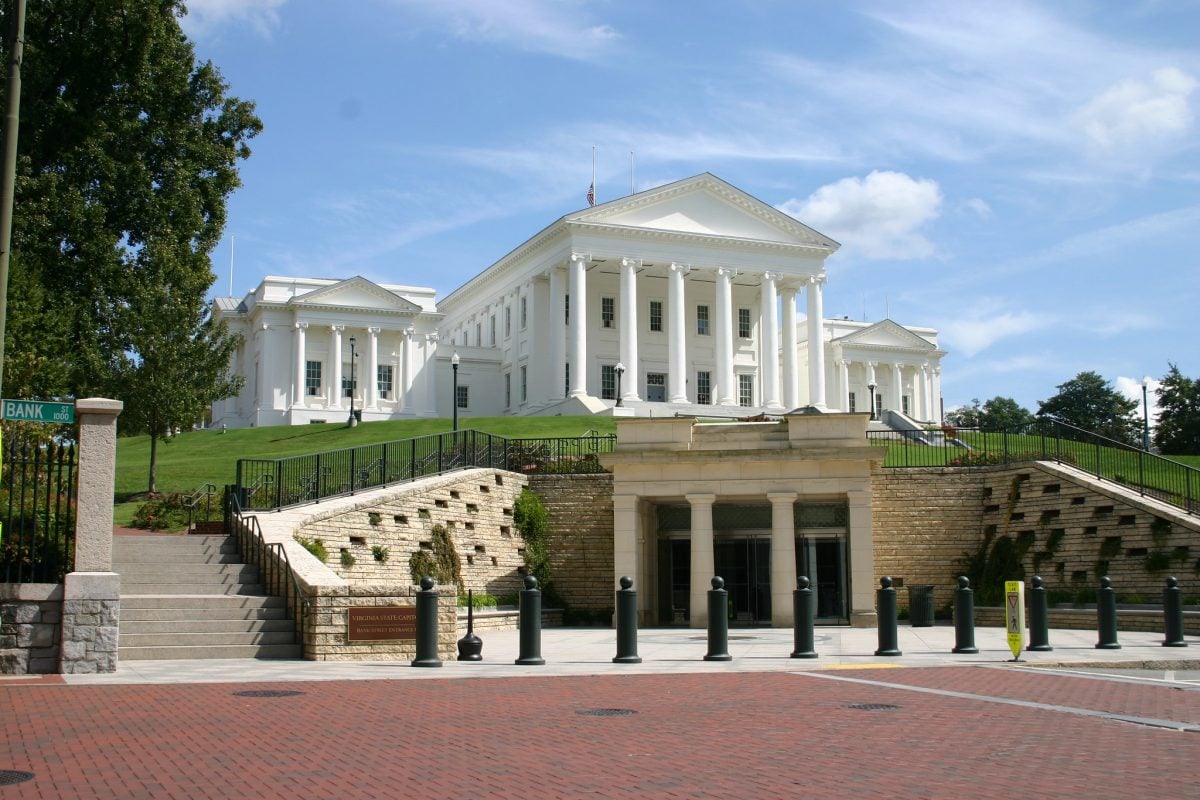
Governor Northam has voiced his support for abolishing the death penalty in Virginia, and now both houses of the General Assembly have voted in favor of abolishing it as well.
After over 400 years of conducting more executions than any other state, Virginia may become the first Southern state to abolish the death penalty.
The Virginia Senate and the House of Delegates each passed identical bills this week to abolish the death penalty. Virginia would become the 23rd state to abolish capital punishment if either bill advances in the other’s chamber and is signed by the governor.
Under current state law, an offender convicted of a Class 1 felony who is at least 18 years of age at the time of the offense and without an intellectual disability faces a sentence of life imprisonment or death.
The House and Senate bills eliminate death from the list of possible punishments for a Class 1 felony. The bills do not allow the possibility of parole, good conduct allowance, or earned sentence credits. Judges are able to suspend part of life sentences, with the exception of the murder of a law enforcement officer.
Senate Bill 1165, introduced by Sen. Scott Surovell, D-Fairfax, passed the Senate on a 21-17 vote. House Bill 2263, introduced by Del. Mike Mullin, D-Newport News, passed the House Friday on a 57-41 vote. Three Republicans supported the House measure.
Any person previously sentenced to death by July 1 will have their sentence changed to life imprisonment without eligibility for parole, good conduct allowance, or earned sentence credits. According to the House bill’s impact statement, there are two Virginia inmates on death row, but no execution date has been set for these inmates as of December.
In a floor hearing earlier this week, Mullin discussed how the measure would ultimately save money, as the death penalty is a “huge financial burden on the commonwealth.” Virginia spends approximately $3.9 million annually to maintain four capital defender offices, which only handles capital cases, according to the House bill’s fiscal impact statement. The measure will likely eliminate the need for these offices.
“If we keep the death penalty in place, we are prolonging an expensive, ineffective, and flawed system,” Mullin said.

Mullin said Virginia has a dark history of extreme racial bias and occasional false convictions within the judicial system.
Referencing the 1985 case of Earl Washington, Mullin argued the commonwealth “knows the risks of killing an innocent person very well.” Washington, a wrongfully convicted death row inmate, came within nine days of his execution.
“Perhaps the strongest argument for abolishing the death penalty is that a justice system without the death penalty allows us the possibility of being wrong,” Mullin said.
In a debate during Friday’s House vote, defenders of the death penalty called attention to the victims of capital cases. Del. Jason S. Miyares, R-Virginia Beach, told his colleagues that “these victims are begging not to be forgotten.” He argued that executing those who commit the “ultimate crimes” is justice, not vengeance.
“That’s what the death penalty is … it’s not revenge, it’s not eye for an eye, it’s our society, our civilization, holding someone accountable for their actions, allowing our juries to decide about the ultimate punishment,” Miyares said.
Del. Mark H. Levine, D-Alexandria, a supporter of the bill, concluded the debate by speaking of his own painful experience. Speaking of his sister’s murder, Levine argued that the bill isn’t about him, his sister, or the victims, but about the state’s potential to kill innocent people.
“I’ve seen evil, I’ve looked it in the face,” Levine said. “I know evil exists, there is no dispute about that. But taking an innocent person’s life — that’s evil, and it would be evil to be done by this General Assembly.”
Gov. Ralph Northam said in a press release earlier this week that he looks forward to signing the bill into law.
“The practice is fundamentally inequitable,” Northam said. “It is inhumane. It is ineffective. And we know that in some cases, people on death row have been found innocent.”
Written by Christina Amano Dolan, Capital News Service. Top Photo courtesy of the Virginia General Assembly website.