
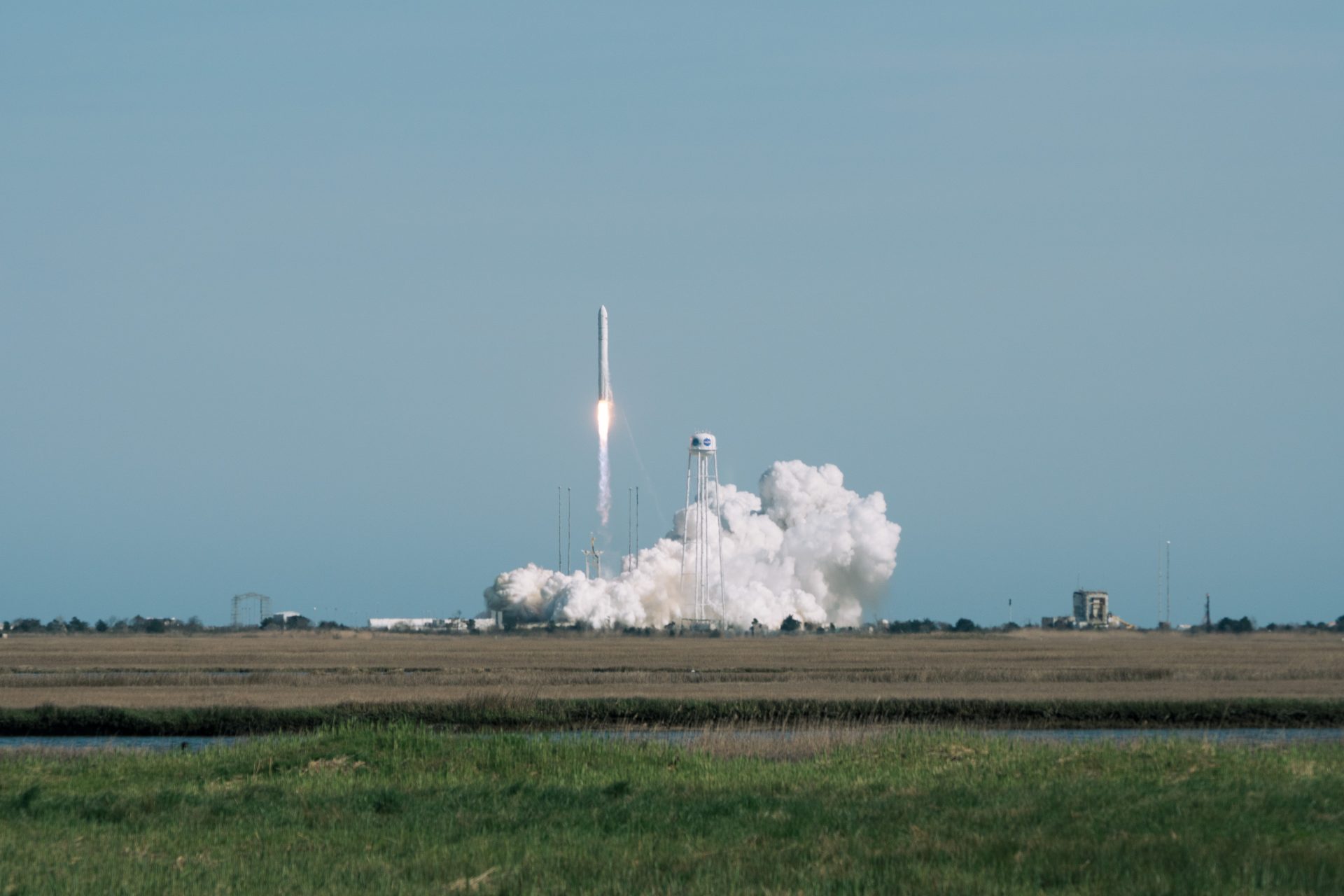
On Wednesday afternoon, the space freighter Antares launched from NASA’s spaceport on Virginia’s Eastern Shore. RVA Magazine was on the scene.
At 4:46 PM on Wednesday, April 17, wildflowers folded, and the waves rolling onto the Eastern Shore were parried back to sea as the 69-foot space freighter, Antares, launched from Virginia Space’s Mid-Atlantic Regional Spaceport (MARS) at NASA’s Wallops Flight Facility. It left through the dusty stratosphere, leaving a thin vein of smoke in the sky, stock-still.
Swathes of families and aeronautics fanatics alike flocked to the visitor center to see the launch.
Though NASA has renewed its contract with the aerospace company and is set for further launches to begin in the fall, the NG-11 Antares is the 11th and final unmanned shuttle currently contracted under the Northrop Commercial Resupply Services (CRS)-1. The vessel transported nearly four tons of supply and research material. Biological samples, anti-aging antidotes, three free-flying Astrobee robots, 40 brave mice, and nano-samples intended for producing biological cures were sent to the International Space Station to bolster continuing efforts in pertinent research.
Given the nature of microgravity in space, many samples that are difficult to research on Earth prove easier in space.

“The size reduction of nanoparticles created in microgravity vastly increases surface area for uptake and delivery, reducing the required dose per treatment and increasing production value by decreasing cost per dose,” states a NASA press release.
Astronauts aboard the space station will study several samples, one of which could potentially cure Alzheimer’s Disease. Using their Green SuperFluids Technology (STaARS BioScience-11) boarded alongside the samples, they will test targeted nanoparticles “that may arrest the progression of or cure Alzheimer’s Disease.”
Alzheimer’s affects more than 4.5 million Americans and more than 10 million people worldwide, and scientists hope this research can provide an answer for not just one but several diseases.
“This investigation may lead to additional studies about the efficacy of precision-manufactured nanosomes targeting additional diseases as well as developing simple and effective methods for testing these therapies,” wrote NASA. “This project focuses on Alzheimer’s disease, but its methods for studying the effectiveness of nanosomes can be applied to other cell types and other diseases such as cancers, HIV, multiple sclerosis, Parkinson’s disease and other chronic disorders.”
Richard L. Hughson, head research chair in Vascular Aging and Brain Health and senior director of research at the University of Waterloo, discussed the Vascular Aging investigation, which analyzes ultrasounds of the arteries and wearable sensors of the space station crew members, in a press briefing on Tuesday.

In his 2016 study on “Sex-differences in the Cardio-metabolic and Hormonal Responses to Long-duration Spaceflight,” Hughson and colleagues found that the “Carotid artery distensibility coefficient was reduced [nearly] 20 percent after spaceflight with no sex differences, but carotid artery beta-stiffness index increased more in women.”
In summary, the elliptical alone won’t cut it. After spending six months in space, astronauts tend to show “accelerated arterial stiffening, thicker artery walls, and signs associated with the development of insulin resistance.”
“Astronauts return to Earth with carotid arteries that are 20 to 30 years ‘older’ than when they launched,” NASA said. “This dramatic change in carotid artery ‘aging’ was unrecognized prior to the Vascular and Vessel Imaging investigations.”
But not all packages came in some variation of goo. NASA also sent three of the newly developed Astrobees, a free-flying rubik’s cube designed to assist scientists and engineers in developing and testing microgravity tech, as well as with routine chores. The three “Tesseract”-looking bots will also be used as testing platforms for microgravity research, replacing the previous bowling ball shaped SPHERES bots.
“A crew can’t be depended on to do everything necessary to maintain a spacecraft,” Astrobee Program Manager Jose Benavides told CNBC at the NASA Ames Research Center in Silicon Valley. “Astrobee is a step in advancing that type of technology.”
Astrobee’s design was inspired by the “training remote” in Star Wars, according to news reports.
The three auton-amigos are named Honey, Queen, and Bumble. Powered by fans and sporting a small perching arm, these drones can send groundbreaking research for potential cures to ground control, wash your space dishes, and float by themselves to the docking station for charging, all in the same day. They’re sure to be science’s new best friend.
The SS Roger Chaffee (the Cygnus craft shelled within the Antares rocket) arrived at ISS around 5:00 AM on Friday, April 19. It was then guided to its berth on the space station’s Unity module, and officially installed at 7:31 AM.
The Cygnus will remain at the space station until its departure on July 23, where it will continue in orbit until December in order to make a trash dump before its fiery, destructive reentry into Earth’s atmosphere. Keep watching the skies.
Photos by Branden Wilson