
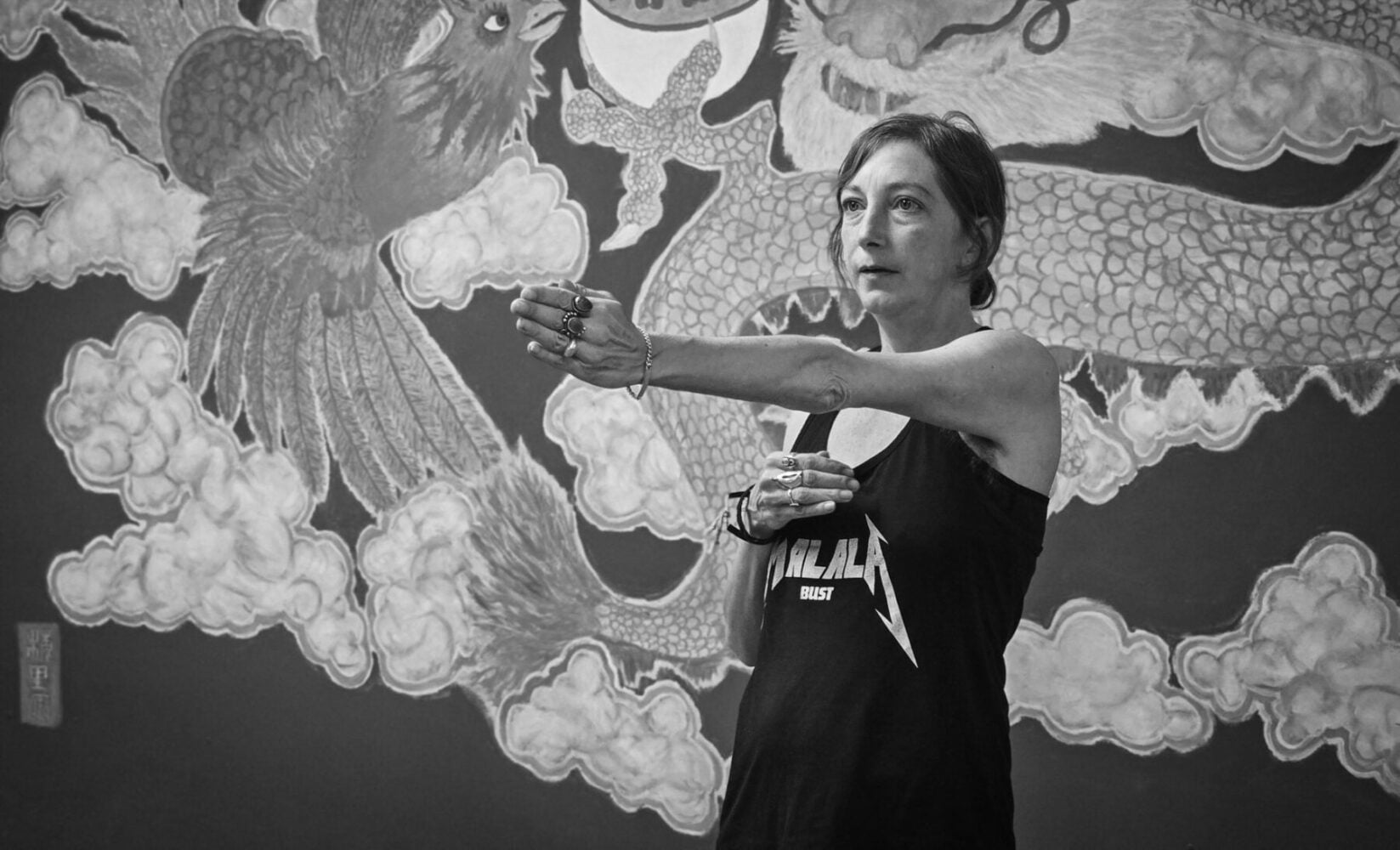
Inside Richmond’s Moy Yat Kung Fu Academy, where women are learning Wing Chun, confidence, and practical self-defense rooted in centuries of martial arts tradition
It took me a long time to write this article because I just kept diving deep into the story of Ng Mui, the kung fu nun. She was a baddie supreme.
What I thought was going to be an article on self-defense for women ended up a deep history dive about real ass homies.
I recently visited Richmond’s Moy Yat Kung Fu Academy to take a women’s intro class in Wing Chun kung fu and chat with Ryan Marsh, one of their sifus (teachers), about the benefits of this system of kung fu and its bad ass bitch history. I went in to learn some self-defense, but I also developed a deep fascination with the woman that created the art form.
Ng Mui was a noble in the Ming dynasty. When the Manchu warriors took over the Ming in 1644, Mui was only 18 years old. Her entire family was killed, but she escaped into the woods, and it was there she studied nature and how different animals fought, most famously a snake vs. a crane.
Based on those observations, she began to develop a fighting style designed for smaller opponents to take down larger ones. She eventually made her way to the Shaolin Temple (yes, the one Wu-Tang shouts out). This was not any monastery. These were warrior monks. The temple also served as a camp for Ming loyalists who were extremely trained fighters. The temple would become the birthplace of martial arts, and they welcomed Mui to the temple.
Before long, she was sparring with the most skilled warrior at the temple and, over time, became one of the five masters of the Shaolin Temple. It was there that she perfected her style, which consisted of rapid, constant, and specific attacks that used the least amount of effort. This would give the smaller opponent the ability to strike more frequently without tiring out.
One night, the temple was set on fire and attacked by the Manchu. Almost all the monks were killed, while the masters were able to escape, but not before Mui saw her sparring partner with the Manchu. He was a traitor.
She vowed revenge, as one does.
She trained harder, perfecting her technique and working with the other masters to practice their specialties. She tracked down the traitor and they battled while balancing on top of tall poles over spikes. This fight sounds insane. And, of course, she murks him.
So where did the name Wing Chun come from?
Marsh tells me the second part of the origin story, the part where women hold it the fuck down for other women.
“Yim Wing-chun was a young lady that was in China near the Shaolin Temple. And when a local warlord wanted to force her into marriage, she consulted a local nun, Ng Mui. Mui trained Wing-chun on how to use her balance and center of gravity so well that when the warlord came back to fight, she was able to keep him from even getting close. Like, he couldn’t touch her. In fact, he fell down a few times and then just left because it was too much trouble for him.”
Before this, the practice was a secret, with only Mui being a full master. Through training Wing-chun, she would ensure the practice would continue, and so she named it after her protégé.
The practice was passed down quietly for decades and eventually found its way to the big screen with Bruce Lee and then eventually to Richmond.
“Wing-chun married Leung Bok Chau, and their son, Leung Lan Kwai, taught a group of people who traveled around on the Red Boat Opera. That would have been the 1800s. And then by the end of the 1800s, we have Yip Man, Bruce Lee’s teacher, who is the most famous [martial artist] in history.”
Man began training as a young child in the 1890s and moved to Hong Kong right after World War II and is credited with bringing Wing Chun to the public. And then Moy Yat brought it from Hong Kong to New York. Anthony Moy Tung brought it from New York to Richmond and opened Moy Yat in 1986.
During our lesson, Marsh dives into the importance of the new generation knowing the history and traditions of Wing Chun. They want the students to not just learn the techniques, but also how they developed and why.
“It’s a technique of being traditional. The kung fu is not coming from me being good at it. It’s coming from 500 years of practice. And people preserving the work there. That’s a big important integrity point, the lineage, being able to say not only do you know where it comes from, but it means the way you’ll learn how to clap and hit the arm today is gonna feel the same way the sifus’ arm feels. So you’re only one or two heartbeats away from being connected to the guy that taught Bruce Lee. And so that’s also a very important idea of kung fu transmission, is that you physically feel what the teachers feel like.”
So now that we have some of the history, how exactly does the technique allow smaller people to defend themselves against larger attackers?
“In general, if you try to overpower someone who is bigger, you will not be able to, right? But then we look at what we call the fulcrum, like the way they moved rocks for the pyramids, by finding the center of gravity. What Wing Chun does is it allows a person to be rooted, and as an attack comes in, you intercept the line, meaning you go straight forward when other people make a circular motion.”
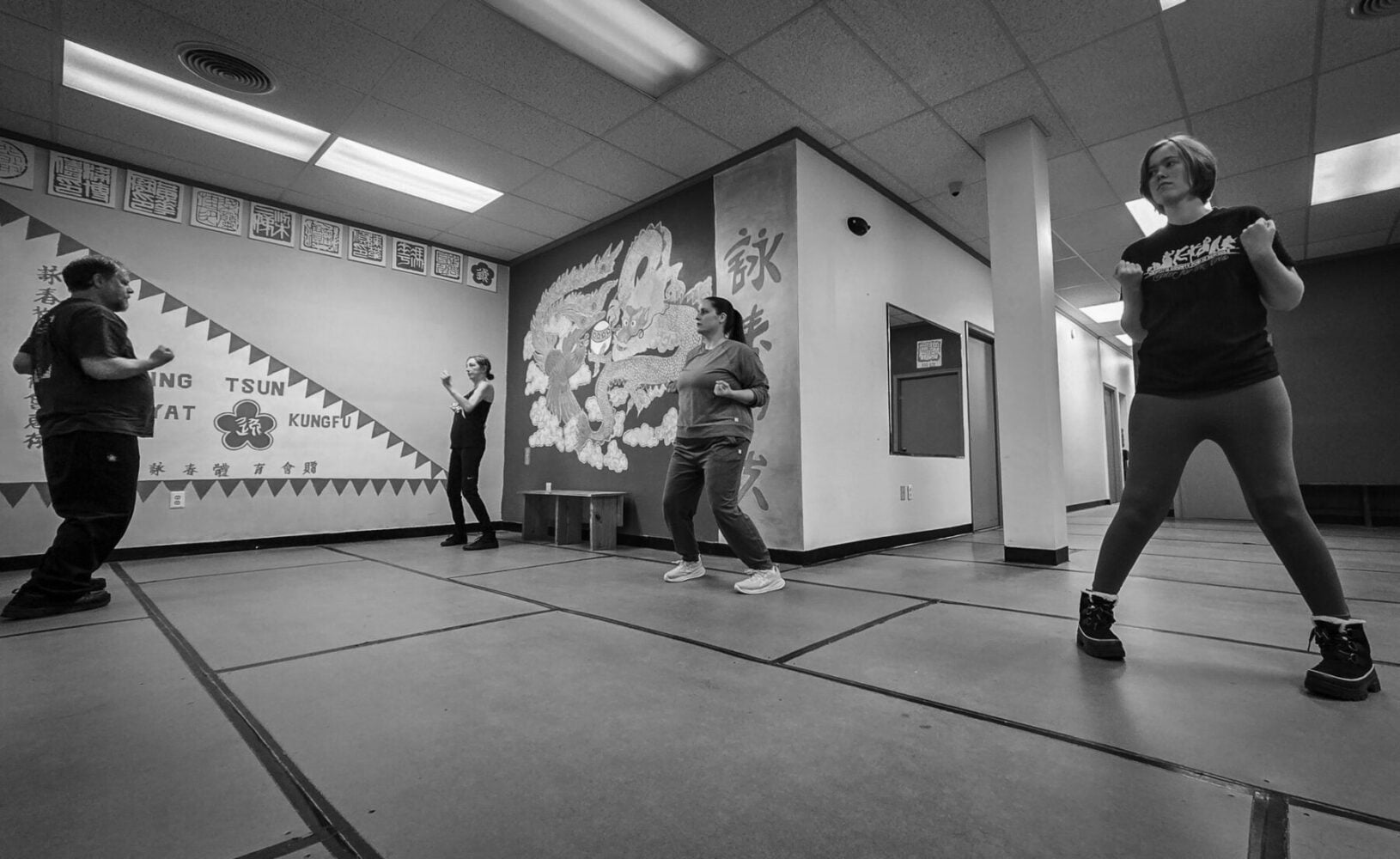
One of the most important things to learn is how to stand.
“Really, the biggest thing I think that we do with Wing Chun is we’re using what we call a horse stance, and we’re chambering our fists, pulling our fists back. It naturally makes your body have more of a V shape.”
Not only does this help you maintain your center, but it also serves as a deterrent.
“When people see you, you’re not curled up into a ball. You can project confidence so that if someone comes near you, they know that you will scream loudly, you will call the police, you will claw, jab, do whatever it is to give that person a very hard time.
Whereas if someone is trying to be kind of polite, headphones on, head down, not paying attention to their environment, then they’re prey. People who have a predatory nature are gonna go for people who look like it’s easy.”
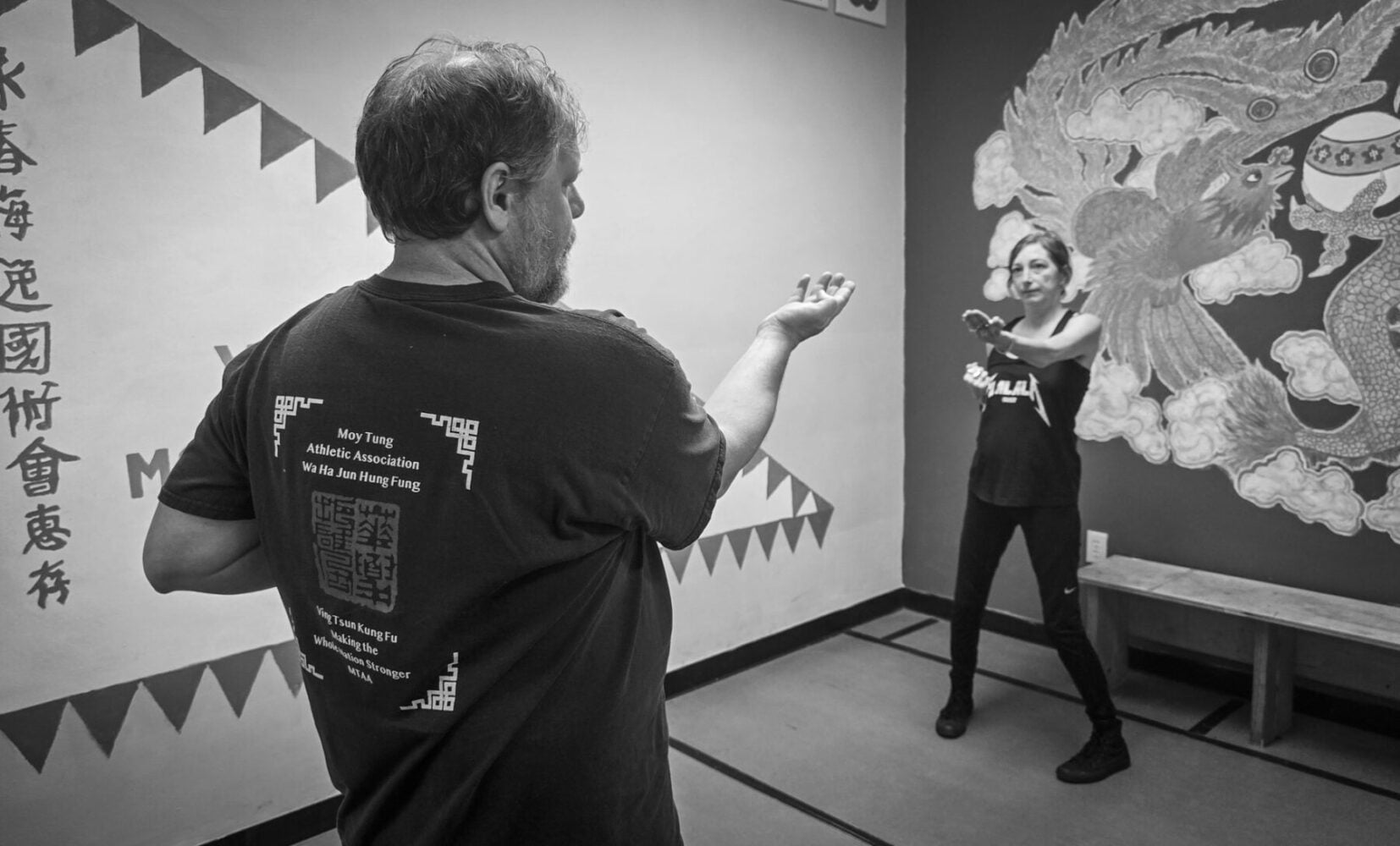
The key to the style is to focus on how the body works.
“We want to work on the idea of human nature, the human body, the anatomy. And then there are the physics involved. There’s gravity, and there’s all these angles and ways that we collide. So Wing Chun allows you to hold the middle and protect what’s important.”
How your hands are held, what parts you hit with, and where you aim are all based on how the body is built. He shows me how rotating your wrist a certain way can make the strike stronger.
“One of the things with the Wing Chun punch is that when it’s fully extended, the knuckle bones and the wrist bones and the elbow line up in a way that it’s like a piston and an engine. There’s a lot of power when you throw that fist and hit somebody in the jaw. It will knock them out. So everything is based on how your body works and what can hurt another body.”
But just because you can hurt someone absolutely does not mean you should, if you can avoid it.
“Obviously, we only want to do that for good reason, not because of anger or bullying or anything like that.”
According to Marsh, just knowing that you can throw a strong striking punch can give you enough confidence that you don’t need to actually use it.
“When you know that you can hit somebody [like that], then you relax because you’re not living in a ‘what if’ scenario where you’re paralyzed by the fear or the anxiety of someone overcoming you. You can sort of cut out the nonsense of deciding whether or not you’ll need to use [the punch] because you’re already empowered.”
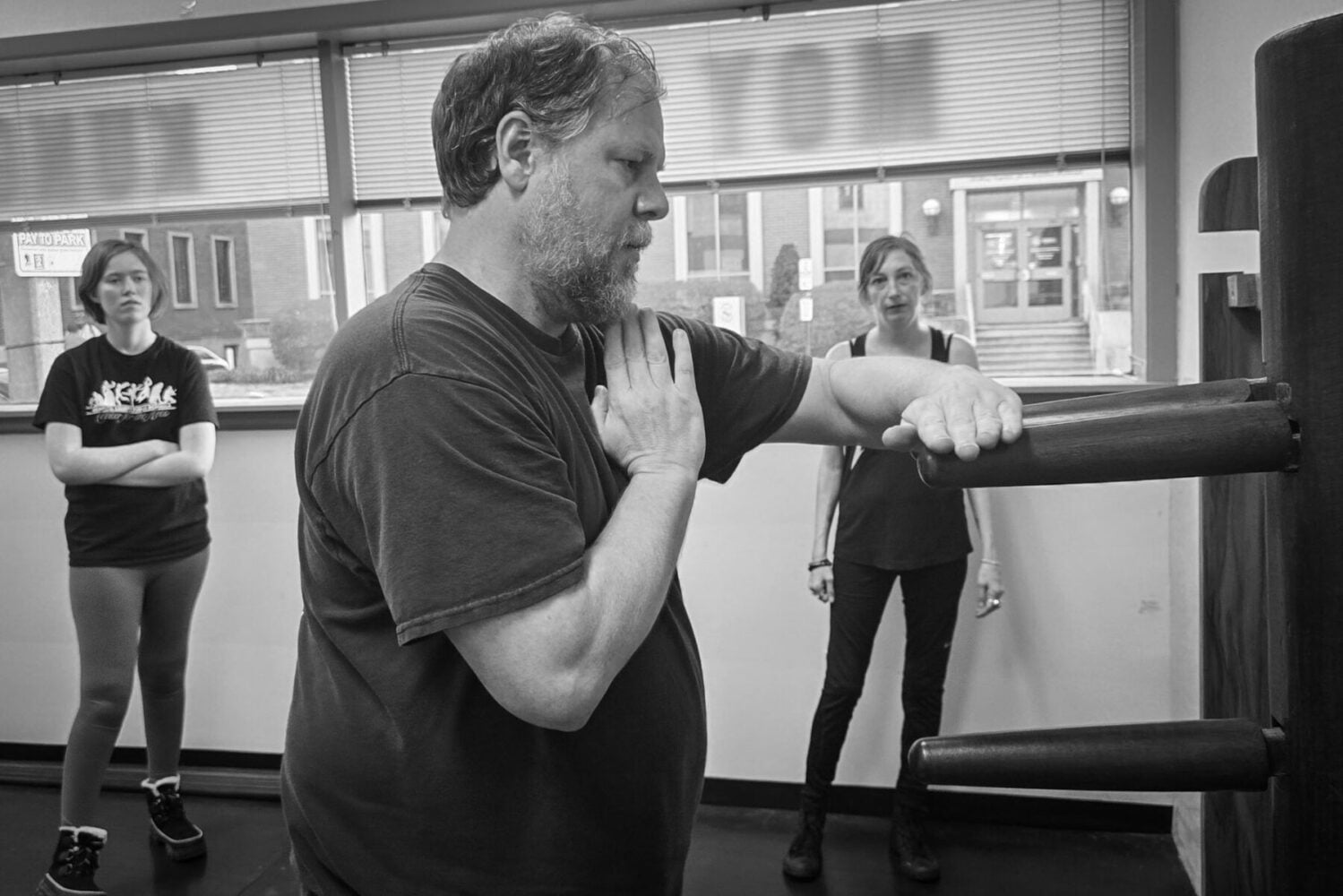
Now it was time to learn some actual moves.
The class was small, just two other people.
First, he went over the horse stance, learning how to position yourself to center your gravity. Then we went over punching, palm strikes, and blocking, each focusing on how you hold your hands, angle your shoulders, and what part of the hand to use for the most impact.
Marsh taught me the first of the four forms of Wing Chun, Siu Nim Tao, which is a cycle of slow, almost beautifully meditative hand motions designed to help protect your neck while deflecting an attacker’s movements.
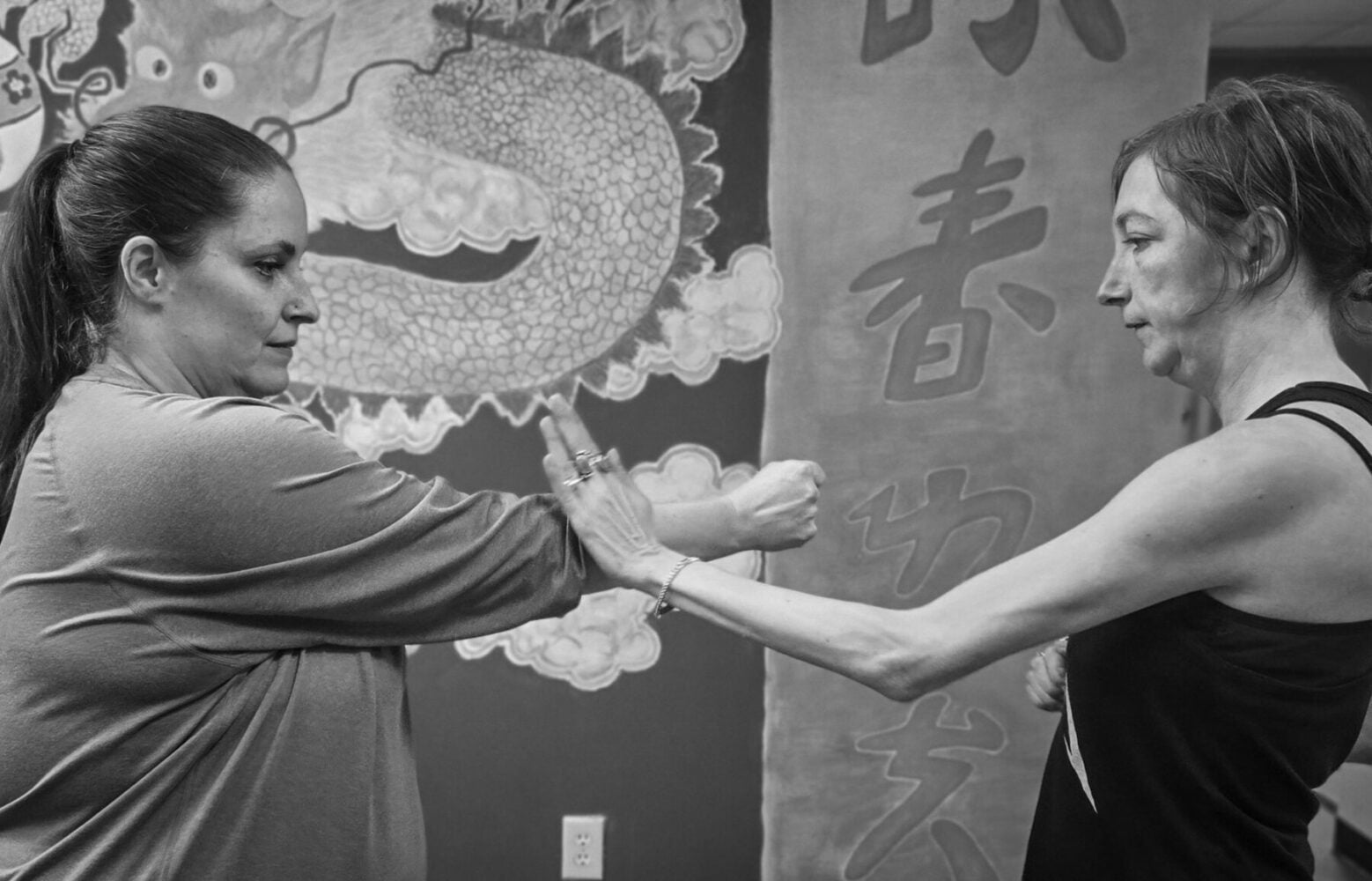
Then we did some partner work.
Working in pairs to block and attack, how to step and move when the other person moves, sort of like learning to tango.
In comes the striking pad (a padded, flat punching bag you hold in your hand so your partner can hit their opponent with force without harming them).
The pad is not just for you to be able to hit without harm. The way they use it is to advance the technique because, as the pad moves, you move. It lets you practice distance, how to center, and how to predict.
Then we move to the wooden horse, which is a wooden structure with poles sticking out of it that you can move around as you are working on your striking points. This lets you go all the fuck out, striking as hard as you want without worrying about your partner, and lets you practice your rhythm solo dolo.
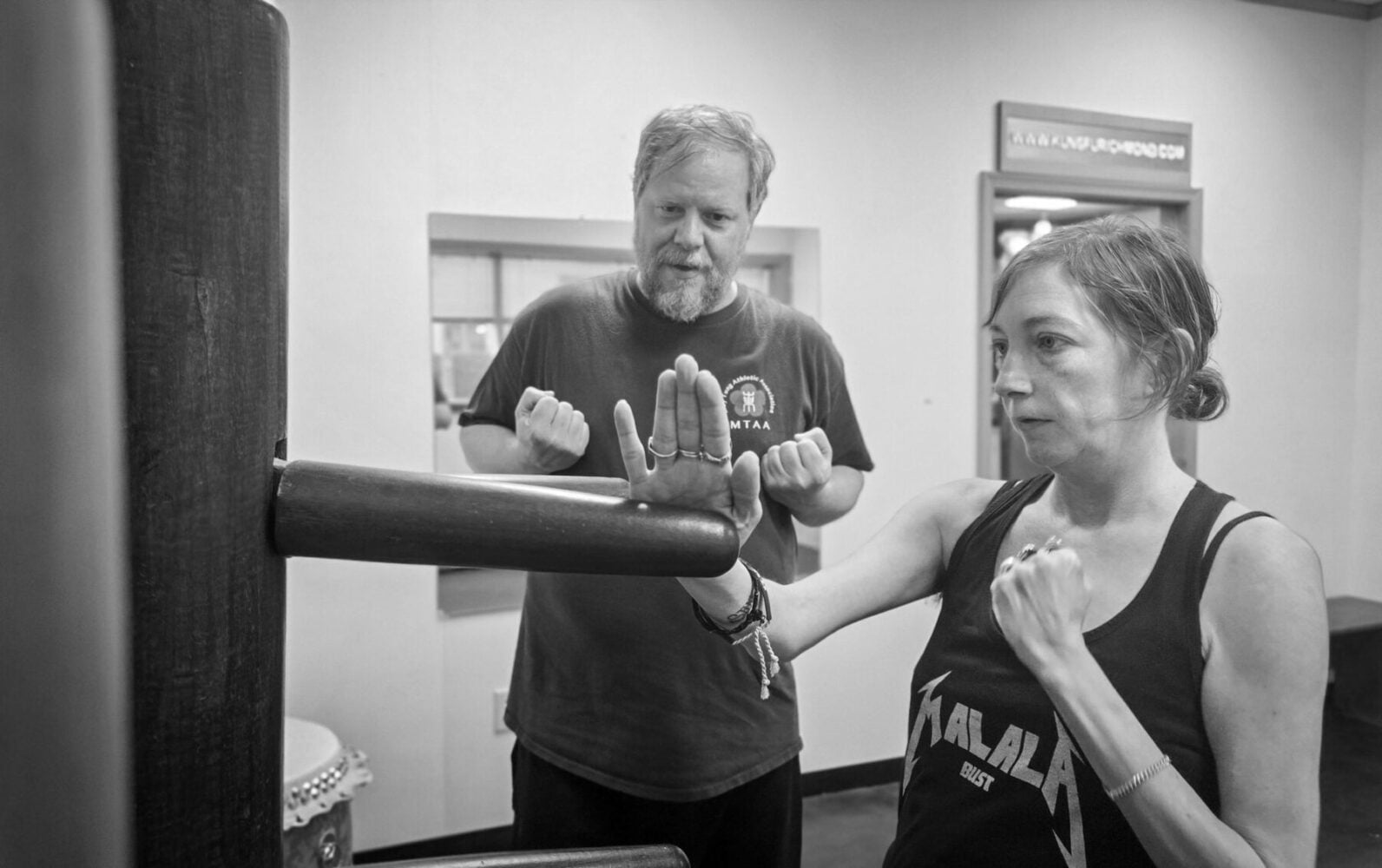
Photo by Christian Detres
Aside from learning the stance, and how to block and how to strike, you also need to know where to strike.
“Generally speaking, your head is like a power button. If you mess with people’s eyes and throats, then you’re gonna stop them. And so women can’t necessarily go blow for blow. They have to go in and strike the person to turn that computer off.”
Knowing exactly where to aim a strike and how to position your body is the real lesson here.
Is Wing Chun Kung Fu right for you?
Marsh notes that there are a ton of reasons people take the class.
“Not everybody needs a lot of kung fu, but they might need something physically to get moving, or they need something to mentally relax them. Most people are studying for health and fitness or mental health and wellness. Everybody doesn’t want to be beat up. But very few people come in to actually fight someone else.”
Felix and Stephanie were the other two in the class with me. Both have been taking the class for about eight months. I was curious about what brought them there.
“I wanted a whole body way to practice discipline and balance,” Stephanie explains, “and also, as [Marsh] said, confidence about how to be out in public, how to appropriately position myself and de-escalate. And just to feel more sure in my skin and do it in a way that, as he says, ‘I don’t need to become somebody else, but learn the mechanics of my body.’ The slow build of discipline, getting in my body, and seeing how it can move with me, is really why I keep coming back.”
People get involved for different reasons, and for Felix it was a different catalyst with surprising results.
“I started for several reasons, to learn self-defense and also because my mom wanted me to do something active. I sit in my room all day drawing and reading. But definitely the reason I continue is because it’s helped me have a lot more coordination. I have much better reflexes. I don’t walk into walls anymore. I’m more stable, emotionally and physically.”
The intro class is not just designed to give you an idea of what Wing Chun is, but Marsh attests that it is also able to give you some immediately useful skills.
“Now I’m giving you the highlight reel to get you moving. We want to give you something you can use right now, but we also have to be very realistic about it being a process. There are no prodigal sons, no prodigy students. There are people who work very hard.”
After the intro, the classes focus on each part individually.
“We will spend a whole class thinking about our stance or a whole class on why this block holds or a whole class on how do I get more snap out of a punch?”
You can take one class to get a taste and basic skills or stay on and get that “one inch Bruce Lee punch” that you will never have to use simply because you know you can do it.
I wanna learn to fight like a girl, so I will definitely be going back to the Moy Yat Kung Fu Academy for the training, the understanding of how your body, no matter the size, can work to your advantage, and for more of the lore.
Holla at your bestie and book an intro class. It’s time for some girl time.
Main photo: The writer in the middle of doing Siu Nim Tao which means “Plant the Seed”. This is the first of the four forms of Wing Chun. Photo by Christian Detres
Support RVA Magazine. Support Independent Media in Richmond.
At a time when media ownership is increasingly concentrated among corporations and the wealthy, RVA Magazine has remained one of Richmond’s few independent voices. Since 2005, the magazine has provided grassroots coverage of the city’s artists, musicians, and communities, documenting the culture that defines Richmond beyond the headlines.
But we can’t do this without you. A small donation, even as little as $2, one-time or recurring, helps us continue to produce honest, local coverage free from outside interference. Every dollar makes a difference. Your support keeps us going and keeps RVA’s creative spirit alive. Thank you for standing with independent media. DONATE HERE.
We’ve got merch HERE
Subscribe to the Substack HERE
And Reddit HERE
And YouTube HERE