
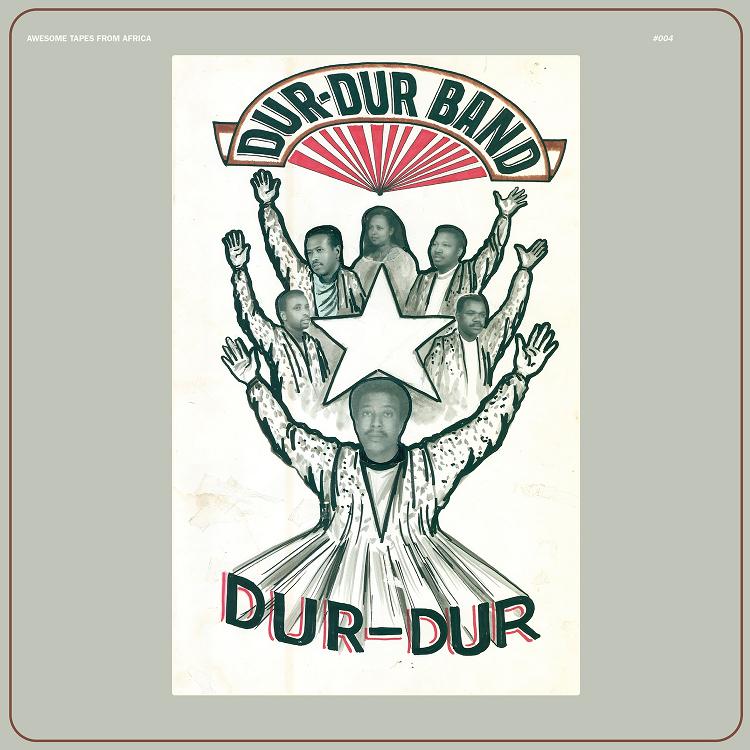
Dur-Dur Band – Volume 5 (Awesome Tapes From Africa)
In a recent article, photographer Peter Dicampo – whose blog Everyday Africa offers photographic documentation of, as the title suggests, the everyday lives of Africans continent-wide – lamented the difficulty and confusion encountered when the affluent West is confronted with Africa as a whole. Dicampo expresses concern that, through various forms of cultural conditioning, the West views Africa with a mix of both pity and unease that is both condescending and detrimental to any worthwhile conversation about the continent’s problems and potential.
Dur-Dur Band – Volume 5 (Awesome Tapes From Africa)
In a recent article, photographer Peter Dicampo – whose blog Everyday Africa offers photographic documentation of, as the title suggests, the everyday lives of Africans continent-wide – lamented the difficulty and confusion encountered when the affluent West is confronted with Africa as a whole. Dicampo expresses concern that, through various forms of cultural conditioning, the West views Africa with a mix of both pity and unease that is both condescending and detrimental to any worthwhile conversation about the continent’s problems and potential. He specifically mentions news stories featuring “starving Somalis and Kalashnikov-wielding Libyans,” though I doubt there would be much argument that this sort of cultural myopia has roots that extend considerably further than the origins of network news. The extent to which an Instagram feed, well-executed or not, will change preconceptions is debatable, but the point is valid. If, for example, Somalia is mentioned to most Westerners, the immediate associations – military dictatorship in the post-colonial era, the civil war that’s lasted the past two decades, maybe Black Hawk Down for the Ridley Scott fans – are exclusively negative. And while none of these are wholly innaccurate, they also fail to capture the extent to which, despite its troubles, Somalia has boasted a rich and varied history. Mogadishu, at one point known as the “pearl of the Indian Ocean,” has stood for millenia as not only as a port through which trade flowed, but as a cultural crossroads in which ideas and influences from abroad could intermingle with those that had arisen domestically.
The Dur-Dur Band were but one example of this sort of melange. Throughout the 1980s, the group was among the most popular of the country’s bands, with its extended lineup (which included four lead vocalists, two backing singers, two percussionists, two guitarists, a horn section, and a keyboard player – though the specifics of the ensemble varied depending on the recording) deftly interweaving disparate elements into a taut, seamless whole that, though decidedly a product of the 1980s African pop market, was rawer and funkier than many of their contemporaries. Volume 5 consists of recordings released in 1987, rescued from obscurity by the label/blog Awesome Tapes From Africa, which (as the nomenclature suggests) has made something of a mission out of uncovering material from the cassette-dominated African music industry and exposing it to the world at large.

Considering the re-issue’s source material was a quarter-century old cassette tape, the sound quality is exceptional, though in the grand scheme of things doesn’t possess the highest fidelity. This lack of pristine clarity ultimately adds extra layers to the music, however. On one hand, the slightly out-of-phase treble that pops up throughout the album acts in conjunction with the heavy echo that is often applied to the vocals to lend the songs a subtle, if not always intentional, psychedelic quality. On the other hand, the recordings’ roughness helps reinforce the documentary nature of the release, highlighting that this was not something cleaned up for mass consumption but rather presented as work possessing merits that speak for themselves. The songs’ conjunction of influences may seem strange at first, with sinuous vocal melodies darting in and out of bouyant guitar and keyboard interplay, all of it in turn anchored by a heavy funk base, but their compelling, infectious nature quickly renders the material more familiar than it might at first seem. Despite the occasional presence of some dated synthesizer and drum machine elements (mercifully scant though they may be), the band’s sound is almost anachronistic, favoring an organic feel that unfortunately was not the rule of the day in popular music of the era.
Unlike many of the Somali bands of the era, The Dur-Dur Band wasn’t specifically state-affiliated (though these recordings were made with the aid of the government-run Radio Mogadishu). This level of autonomy allowed the band to utilize thematic material that’s simultaneously more universal and specific to their own circumstances. Though the lyrics primarily concern themselves with the difficulties of both romantic relationships and social entanglements, there are enough references to Somali history and tradition that the album’s role as a nexus of traditionalism and modernity remains intact.
Whether or not a listener possesses much knowledge of Somali history, this reissue speaks for itself. The music possesses an undeniable energy, a vivacious songcraft that makes the band’s initial success unsurprising and their dispersal to the far corners of the globe (band leader Abdinur Daljir and his wife own a music store in Columbus, Ohio while other members remained close by in Ethiopia and others relocated as far away as Australia) that much more tragic. An album like this may not prove a panacea for cultural misunderstanding, but like an individual piece of a mosaic, it can do its part to help reveal a larger picture, one in which creation and destruction perpetually entwine themselves, one that cannot be summed up by another culture’s reductionist preconceptions.