
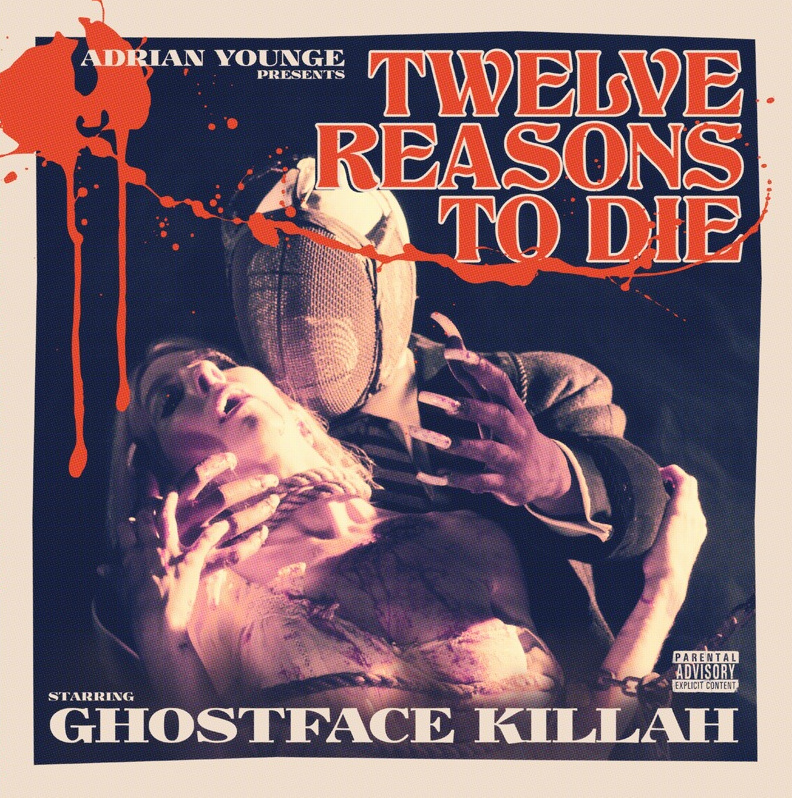
Ghostface Killah & Adrian Younge – Twelve Ways To Die (Soul Temple Music)
There was a time when a listener could purchase anything affiliated with the Wu-Tang Clan without worrying whether the level of quality would hold up to that of their larger body of work. For several years after their inception, the group’s output, alongside that of its component members and collaborators, defined itself by experimental tendencies and raw darkness unparalleled in anything that was going on in hip hop, especially the genre’s more popular strata.
Ghostface Killah & Adrian Younge – Twelve Ways To Die (Soul Temple Music)
There was a time when a listener could purchase anything affiliated with the Wu-Tang Clan without worrying whether the level of quality would hold up to that of their larger body of work. For several years after their inception, the group’s output, alongside that of its component members and collaborators, defined itself by experimental tendencies and raw darkness unparalleled in anything that was going on in hip hop, especially the genre’s more popular strata. It’s debatable when this quality began to decline, but it’s difficult to debate that it did. While the group and its members have crafted some spectacular music since their heyday (witness The W‘s Isaac Hayes collaboration “I Can’t Go To Sleep,” or RZA’s better film scores) but this has often proved the exception rather than the rule that it once was.
Despite this, Ghostface Killah has been of the few members that could be counted on for a relatively stable degree of consistency, offering a decade worth of solo albums (those released between 1996 and 2006) that rarely faltered. And while even he has subsequently released a few albums that don’t hold up to the legacy of his best work, it comes as little surprise that he would be partly responsible for Twelve Ways To Die. This album may not be on the same level as some of the earliest Wu-Tang related material (to which it bears few sonic similarities), but it is more in line with the group’s initial willingness to take chances and embrace elements that many artists would consider too weird or cerebral.
Though Ghostface’s is the most familiar name on the album, however, Adrian Younge’s production work is the most immediately recognizable indication of the extent to which Twelve Ways To Die is a sharp deviation for those involved. Fresh from his collaboration with Delfonics member William Bell, Younge scales back the orchestration of that work, instead weaving a tapestry of live instrumentation that blends low-key psychedelic soul and the sort of sinister atmospherics that wouldn’t be out of place on the soundtrack to any number of vintage giallo films. Though it’s a hyper-stylized mixture (occasionally bordering on camp – especially when the backing singers iterate plot points), it’s integrated cohesively enough that it works, providing a cinematic-sounding backdrop to Ghostface’s narratives.

It’s this selfsame dedication to plot cohesion that both demonstrates Ghostface’s lyrical versatility and confines him. Though he’s always been one of the Wu-Tang’s better storytellers, Twelve Ways To Die possesses a linear focus that had not heretofore manifested itself in any of his work. What at first seems like it’s going to play out as a fairly standard narrative of crime families, betrayal, and murder takes on a weird, hyper-violent mystical slant towards its conclusion, one that acts as a sort of explanatory prequel for the character of Ghostface Killah (as opposed to the rapper). This sharp conceptual deviation prevents the plotline from treading too close to the standard mob movie tropes from which it initially borrows, but often constricts some of Ghostface’s strengths as a lyricist. While he has been able to inject narrative elements into his work for some time, it’s usually done in brief snippets, evocative scenery that gives way to imaginitive flights of verbal fancy. On one hand, the lack of these brief yet vivid scene-setters is a shame, as they’ve provided so distinct a stylistic touchstone in his larger body of work. On the other, had Ghostface indulged in some of his denser wordplay, the overarching thematic elements likely would have suffered. So while long-term fans may miss the verbosity that’s been one of the elements that made his work genuinely great in the first place, it’s admirable that he’s able to rein in some of his wilder lyrical tendencies in order to experiment with form.
Twelve Ways To Die is a genuinely collaborative endeavor, one with equal cessation of control by both contributing parties, each half of the creative team subduing some of the more easily recognizable components of their respective approaches in service to the album as a whole. But none of this is to suggest that the work is compromised. On the contrary, it’s easily one of the best Wu-Tang related albums in years, one that, though it’s not perfect and is something of an outlier both sonically and lyrically, is very much in keeping with the sort of experimental individualism that made the reputations of the group and its members in the first place. Neither a step forward nor a regression, it’s instead a brief detour, another facet on a body of work already possessing many.