
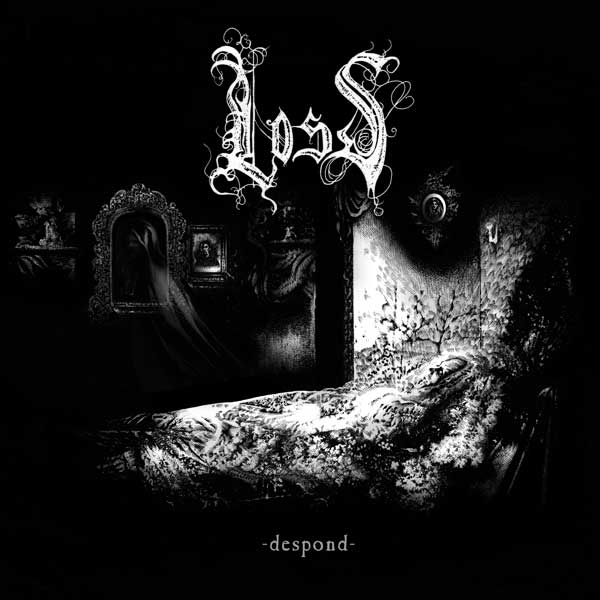
Loss – Despond (Profound Lore Records)
“When I was a little boy, my mother used to sing me a song. It went like this: ‘Life is short, life is shit, and soon it will be over’”
Versatility is a much-trumpeted creative virtue – often-praised are the artists who can explore the manifold aspects of the human experience through whatever variety of hue and timbre may lie at hand. But rarer are those who can lay claim to a single concept, prying deep into the idea’s core and harvesting all that may lie within. It’s tricky territory – the line between single-mindedness and monomania (or worse yet, monotony) so easily dissolves into a gray haze of semantics, a redundancy where all the good ideas in the world come up short because the proverbial forest could not be distinguished from its component trees. But it can be done, and done well, as Tennessee funeral doom band Loss demonstrates on their most recent effort, Despond.
Loss – Despond (Profound Lore Records)
“When I was a little boy, my mother used to sing me a song. It went like this: ‘Life is short, life is shit, and soon it will be over’”
Versatility is a much-trumpeted creative virtue – often-praised are the artists who can explore the manifold aspects of the human experience through whatever variety of hue and timbre may lie at hand. But rarer are those who can lay claim to a single concept, prying deep into the idea’s core and harvesting all that may lie within. It’s tricky territory – the line between single-mindedness and monomania (or worse yet, monotony) so easily dissolves into a gray haze of semantics, a redundancy where all the good ideas in the world come up short because the proverbial forest could not be distinguished from its component trees. But it can be done, and done well, as Tennessee funeral doom band Loss demonstrates on their most recent effort, Despond.
It doesn’t take a terribly astute observer to come to some conception of what Despond has in store. Between the band’s name, the album’s title, and songs like “Conceptual Funeralism Unto The Final Act (Of Being)” or “Cut Up, Depressed, and Alone,” a listener is confronted with an extended evocation of all of the moments that most of us would prefer to forget. It may not be possible to condense the totality of life’s woes into an hour’s worth of songs, but Loss has come about as close as any band in recent memory. And while a dour mentality is certainly nothing new to the genre, Loss is able to come up with results that are far more textured than many of their contemporaries, despite working with what might at first seem a limited palette.

On first listen, Despond plays out like a laundry list of funeral doom’s standard aesthetic components – most notably the glacial pacing, elegiac melodic components, and guttural vocals upon which the style generally relies. But with the exception of the tempo (which only exceeds thirty beats per minute or so for a brief section towards the album’s end), Loss offers slight variations on the other elements, keeping their approach distinctive and far more compelling than many of their peers. Whereas a great many doom metal bands are content (if “content” would be an appropriate term to apply to something so glum) to simply plod away with a succession of riffs, Loss approaches song structures in a far more dynamic fashion. The bulk of the material is undoubtedly heavy, but even the album’s most detuned dirges often give way to moments of placidity that are no less unsettling for their lack of volume – and even these elements are sometimes pushed aside for decidedly non-metal moments like the dark ambient soundscapes of “Deprived of the Void,” or the lugubrious organ coda of closer “The Irreparable Act.” The vocals also occasionally veer from their standard course, pushing upwards from a low-register death metal growl to a harsher rasp in “Open Veins To A Closed Curtain,” or even a foray into more melodic singing towards the beginning of “Silent And Completely Overcome.”
Describing the breadth of Loss’s aesthetic variations might seem at odds with a depiction of the band as one embarking on a singular endeavor. But the deviations within Despond intermingle effortlessly, and the album flows with the resigned effortlessness of the bleakest mood, a deep sigh that stands in contrast to the assertive roar that characterizes most metal. The musical detours taken by the band only reinforce the monolithic certainty of their purpose and allow them to opt for an approach that seems almost Cubist, with all facets of a single mood held in full, simultaneous display. It’s music that requires immersion, a willingness to offer more than a casual ear – and this may be too much for most people. Loss succeeds where many metal bands do not. Their vision of gloom and desolation seems to emanate from a very central, personal place, rather than as a reflection of some cartoonish version of the macabre. It’s not pleasant, it certainly isn’t fun, but it’s memorable in a way that few similar bands are.