
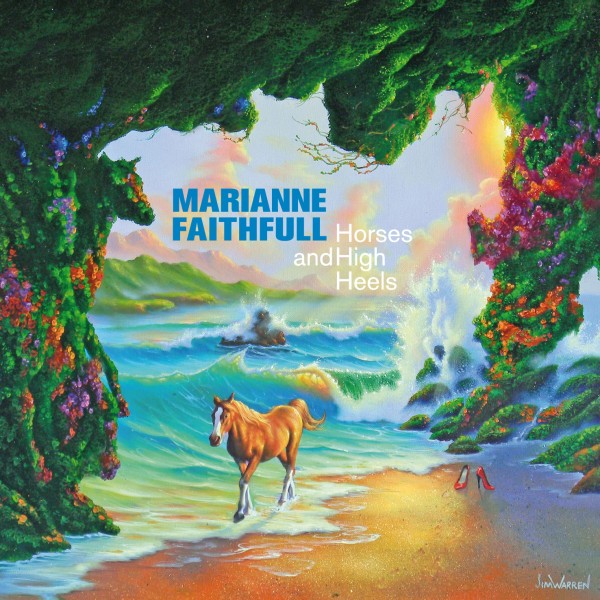
Marianne Faithfull – Horses and High Heels (Dramatico)
There’s a quote, often mis-attributed to George Burns, that describes the entertainment industry as a “hideous bitch goddess,” an entity that gnaws and digests innocent aspirations like peanuts at a cocktail party. Most never get a chance, those who get one often blow it, and those who attain some success often fail to retain it for very long. The public loves little more than turning on those whom they had so recently venerated. It’s a long way from the top, and once that tumble has happened, it can be difficult to climb back to any level of respectability.
Which is why Marianne Faithfull’s career is such an anomaly. By all reasonable expectations, she really probably shouldn’t even be alive right now, much less continuing to put out albums that garner the sort of acclaim that they do. She went from being a successful folk singer in the ’60s (and inspiration for “Wild Horses,” “And Your Bird Can Sing,” and “Carrie Anne” amongst other songs) to being a junkie living in various squats or on the streets through the 70s and 80s. She recast her narcotic-ravaged voice as the primary focus for the icy, caustic post-punk of Broken English, then again for her forays into lounge jazz, stylized Brechtian evocations of Weimar Germany, and ultimately her recent offerings – the spare, melancholic ruminations on aging, love, and mortality present on albums like 2006’s astounding Before The Poison. Not to mention battles with mental illness, cancer, and hepatitis C, her collaborations with artists ranging from David Bowie to Metallica, and an acting career that’s seen her play everyone from God to the devil.
Marianne Faithfull – Horses and High Heels (Dramatico)
There’s a quote, often mis-attributed to George Burns, that describes the entertainment industry as a “hideous bitch goddess,” an entity that gnaws and digests innocent aspirations like peanuts at a cocktail party. Most never get a chance, those who get one often blow it, and those who attain some success often fail to retain it for very long. The public loves little more than turning on those whom they had so recently venerated. It’s a long way from the top, and once that tumble has happened, it can be difficult to climb back to any level of respectability.
Which is why Marianne Faithfull’s career is such an anomaly. By all reasonable expectations, she really probably shouldn’t even be alive right now, much less continuing to put out albums that garner the sort of acclaim that they do. She went from being a successful folk singer in the ’60s (and inspiration for “Wild Horses,” “And Your Bird Can Sing,” and “Carrie Anne” amongst other songs) to being a junkie living in various squats or on the streets through the 70s and 80s. She recast her narcotic-ravaged voice as the primary focus for the icy, caustic post-punk of Broken English, then again for her forays into lounge jazz, stylized Brechtian evocations of Weimar Germany, and ultimately her recent offerings – the spare, melancholic ruminations on aging, love, and mortality present on albums like 2006’s astounding Before The Poison. Not to mention battles with mental illness, cancer, and hepatitis C, her collaborations with artists ranging from David Bowie to Metallica, and an acting career that’s seen her play everyone from God to the devil.
And it may be a surprise that somebody who has lived a life as chaotic and varied as Faithfull’s would create music as serene and assured as she does, but if her most recent efforts display anything, it’s a world-weary balance learned from life’s highest peaks and lowest valleys. Horses And High Heels, her newest effort, is little exception. Where an album like Before The Poison was almost monolithic in its stark austerity, a successful artistic statement achieved by rarely varying from some shade of gray, her newest displays a wider aesthetic range than her music has for many years.

On paper, Horses And High Heels can be divided between Faithfull’s original material and her cover songs, but on the album itself the distinction is less blatant. It begins on a note that’s both familiar and off-putting – a cover of The Gutter Twins’ “The Stations” that Faithfull molds in her inimitable style, hammering out the original’s cresting and waning dynamics into a minimal meditation on loss. It’s familiar in the sense that she has displayed no hesitation to re-interpret music by some of contemporary music’s more maudlin figures (her previous albums have featured collaborations with PJ Harvey, Nick Cave, and Antony Hegarty amongst others), and in her damaged delivery, but jarring in the fact that she is able to wrench the song into something so radically separate from the original with so little actual alteration. It’s a song that wouldn’t have been far out of place on her previous albums, but it gives little indication of what’s to come. Faithfull performs a difficult task, taking disparate source material and really making it her own. It’s not just gloomy indie rockers that fall to her grasp either. Interpretations of Carole King’s “Goin’ Back” and Elton John’s “Love Song” are piano ballads that throw in just enough uptempo rhythmic flourishes to prevent them from becoming weighted down with syrupy melancholy, but a run-down of soul singer Jackie Lomax’s “No Reason” is one of the most upbeat songs Faithfull has ever committed to tape. Even so, lyrics like “Ain’t got no reason to be happy / Ain’t got no reason to be sad / But I just got reason to be bad” retain a determined ambivalence that is nothing if not familiar territory for the singer.
But it’s a testament to her handling of the material that a listener unfamiliar with the original songs (and without the liner notes) would be hard-pressed to discern the covers from Faithfull’s own material. Songs like “Why Did We Have To Part” or the album’s title track tread the same line as the aforementioned covers – ever so slightly more upbeat than Faithfull had attempted to sound in decades, but retaining a dour sensibility all the same. There are aesthetic outliers – “Eternity” comes to mind, with its North African tinges supplied by a sample of the Master Musicians Of Jajouka (from a recording made by the late Brian Jones, who was still in the Rolling Stones when Faithfull was most involved with that band – it’s hard to believe this isn’t a conscious self-referential decision) – but for the most part, Faithfull sounds like a worn-down cocktail waitress joining the house band for a few songs at the end of a long night.
It’s a spectacular release all the same, one that bleeds hard experience. It’s bluesy without the connotations usually present when old, white, British people attempt the blues; folksy without the affected simplicity such a term would normally imply. It’s weary and resigned without being gloomy or defeatist; gritty without seeming like it’s putting on a tough veneer. There’s a darkness present that only the decades can beat into somebody, but there’s a resignation that can only be learned by walking through life’s darkest valleys without the slightest thought of ever resting for a moment.