
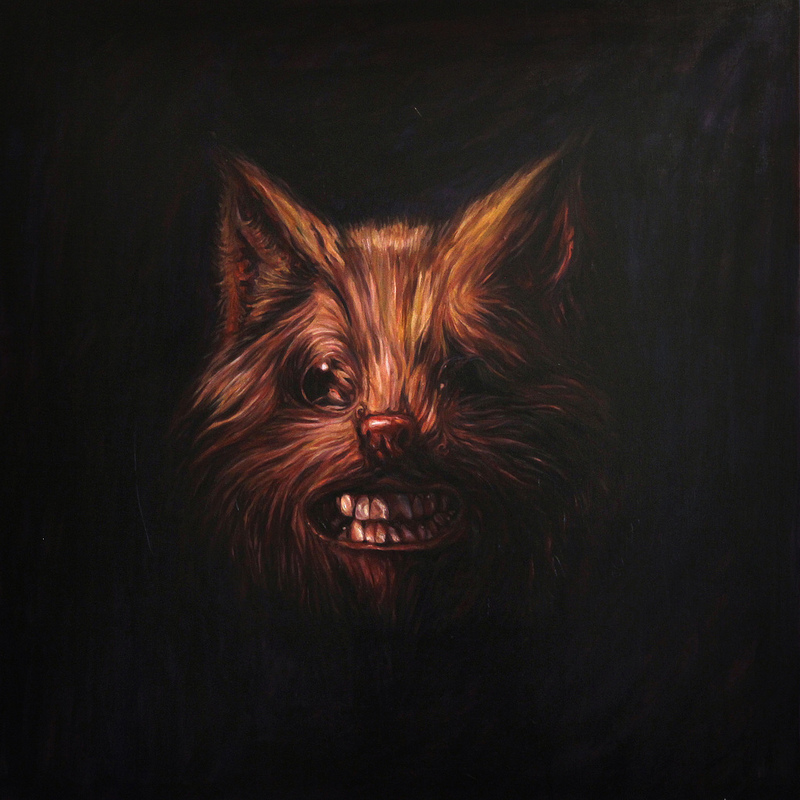
Swans – The Seer (Young God Records)
In recent statements regarding the new Swans album, frontman Michael Gira has expressed his desire that the music, no matter how tortured or torturous it may at first seem, be taken as an expression of a search for the ecstatic. And while he may insist that the intent is to spread joy through the music, another connotation of ecstasy, namely the losing of one’s self in pursuit of something larger and more transcendent, seems more apt.
Swans – The Seer (Young God Records)
In recent statements regarding the new Swans album, frontman Michael Gira has expressed his desire that the music, no matter how tortured or torturous it may at first seem, be taken as an expression of a search for the ecstatic. And while he may insist that the intent is to spread joy through the music, another connotation of ecstasy, namely the losing of one’s self in pursuit of something larger and more transcendent, seems more apt. Swans have never been a band creating easily digestible output – from the sturm und drang quasi-industrial dirges of their earlier work, to the eerie, ethereal later albums – but The Seer magnifies everything the band had previously done into something in which every note lives up to Gira’s purpose – not so much evoking moods as wiping clean the emotional slate in favor of something belonging less to a particular moment or individual.
The album’s first two songs act as the most direct catalyst for this approach. The first, “Lunacy,” features Alan Sparhawk and Mimi Parker of Low accompanying Gira in a minimalist melody, the mantra-like elements of which are only underscored by the minute-plus section where the only word repeated is the song’s title. Similarly, the following song, “Mother Of The World,” begins with a fiercely insistent jackhammer beat, a stuttering motorik pulse that’s repetitive to the point of exasperation until being saved by the drone textures, additional percussion, and eventually vocals that slowly force themselves out from underneath the domineering rhythm. Each song is at first frustrating, some of the more difficult moments the band has concocted (though not in the hostile manner of Cop or Filth – each of which was noisy and repetitive in its own right, but with a sense of aggressive catharsis and release that mitigated the maddening minimalism), and each demands a sacrifice from the listener – to take it in not specifically for enjoyment, but for abandonment. Attempting to listen to either song casually could easily prove vexing, but taking both in tandem as a sort of extended, dual invocation is the only way to really grasp the album as a totality.
From this base, the album builds in extreme directions, alternately incorporating some of the most aleatoric and inviting music Swans have made to date. Three of the pieces (“songs” seems like the wrong word in this case) are fairly extended workouts – “The Seer,” “A Piece Of The Sky,” and “The Apostate” – and these each represent the band at their most abstruse. Dense, Ligeti-like tonal clusters are the most immediately recognizable feature, but these mass and dissipate around a variety of other elements – martial percussion, metallic dirge, even squalls of bluesy harmonica. But despite the eclecticism, each manages to let the diverse facets build and recede in a natural-sounding manner rather than as forced syncretism. And while this gradual waxing and waning certainly encourages the work’s development, it seems to have little to do with linear forward momentum, almost as if the band were applying some simulacrum of entropy and order’s eternal struggle, with the implicit suggestion of music as an elemental and unalterable force.

Though the other half of the album tends to opt for concision and a notably more restrained aesthetic, it’s difficult to see the songs as being the opposite of their harsher counterparts that they may at first seem. Despite its name, a song like “Seer Returns” doesn’t attempt to condense the long-form exploration of the album’s title track into something more palatable, but rather acts as a subtler counterbalance, with an unexpectedly bouncy rhythm underpinning hushed yet sinister vocals and string drones. Similarly, “Song For A Warrior” acts almost as the inverse of “Mother Of The World,” supplanting the former’s buildup from harsh introduction to accessible coda with Karen O of the Yeah Yeah Yeahs gently crooning over a soft, almost country-ish backdrop – possibly the most conventionally pretty sounding song Swans have ever attempted – that gradually smothers itself in swaths of sound until it’s not far removed from the tightly-wound dissonance of the album’s harsher moments. Possibly the strongest moment comes with “Avatar,” a tense yet restrained polyrhythmic mass of chimes, pulsing drums, and drone guitar that retains the atmospheric qualities of the album’s quieter moments while also indulging the darker, more expansive qualities of its long-form dissonance, letting the two play off each other as it steadily builds in intensity before erupting in its last sixty seconds into the most satisfying, cathartic moment of release to be found on The Seer.
This intermingling of disparate approaches, rather than the simple juxtaposition that it might initially seem, helps to reinforce the almost Hesse-like conceptual cross-currents in which the studied and subtle inform and play upon the feral and the visceral. The album’s first half emphasizes this animalistic/visionary impulse, pairing songs like “Lunacy” and “Mother Of The World,” or “The Seer” and “The Wolf,” that implicitly suggest that the line between the otherworldly and the tangible might not be as clearly defined as many would imagine. That the album’s course is sharply steered towards a more urban recontextualization with “93 Ave. B Blues” demonstrates how nuanced and expansive the vision is, though it’s difficult to tell if this change of course is included for the contrast provided by such concrete imagery or whether it’s a conceptual reframing of the more abstract content. But for all the expansive nuance in the none-more-gray area that hovers over The Seer like a fog of ideas and energy, Gira maintains his prophet in the wilderness approach, bellowing and whispering at the heavens and into the cracked earth with equal force of will, a beacon amidst it all, radiating that terrifying ecstasy that he wishes to impart to anyone who would listen with full attention.
It’s this gravitas that holds together the seemingly disparate extremes present on The Seer. While the band’s versatility is certainly a notable quality (especially for a group whose best-known albums can seem almost monomaniacal in their intent), the band’s pendulum-like approach is less fascinating for the apex of its swing than for the pivot on which it cycles. Plenty of artists play with juxtapositions of quiet and loud, brief and long-form, or sacred and profane; just as a great many veterans work with and against preconceptions based on their previous work. But The Seer represents a middle course, one that unites extremes of dissonance and consonance, of the old way and the new, into something that’s either singular in spite of its versatility or heterogeneous in spite of its nigh-monolithic intensity, but none the weaker or less ecstatic for its embrace of a wide range of ideas.