
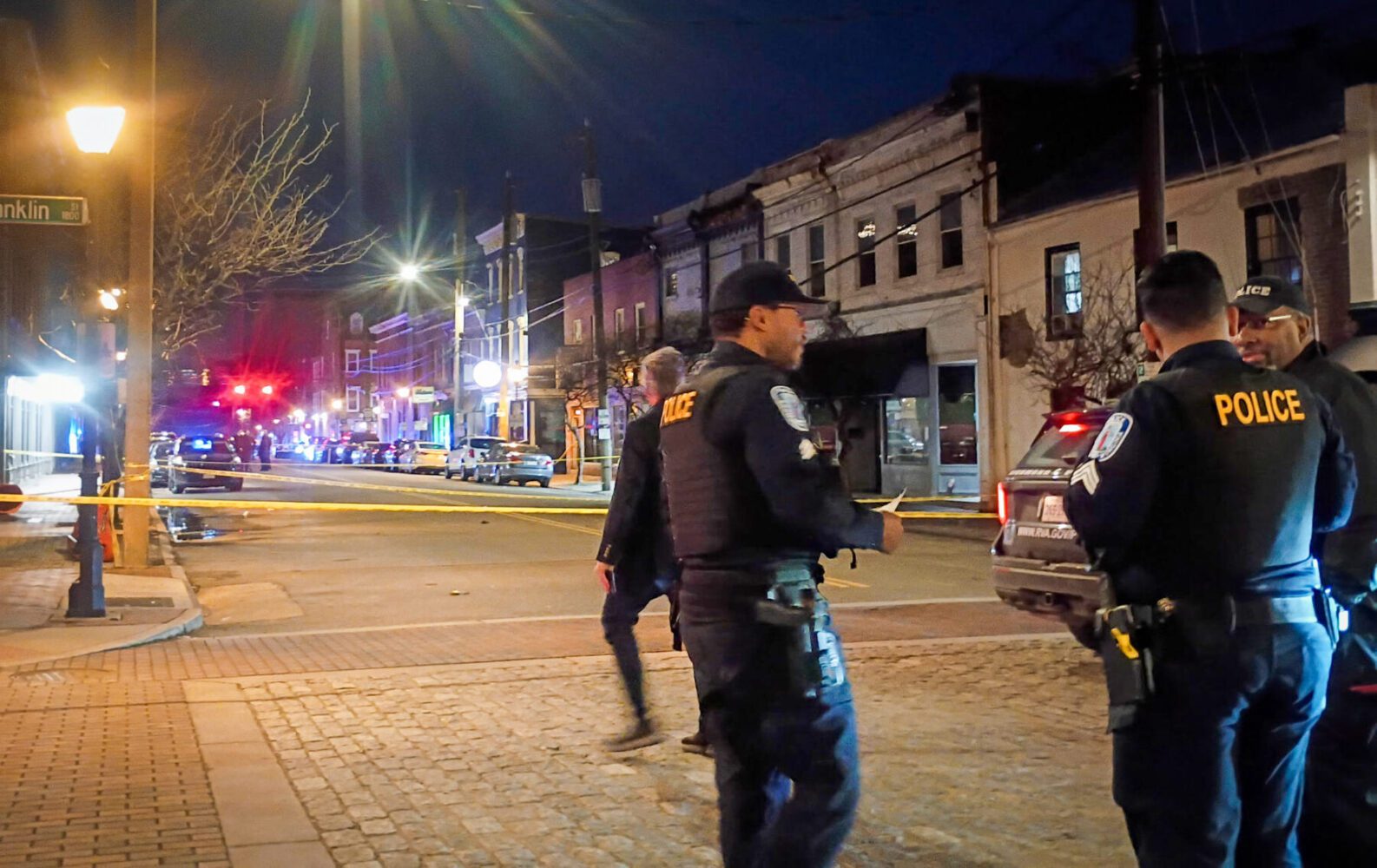
On the first warm weekend of 2026, in the early hours of Saturday, Feb. 21, at least nine people were shot on North 18th Street in Shockoe Bottom. Two people, 23-year-old Genesis Tamar Jones and 42-year-old Dominic Antoine Jackson, were killed, and seven others were wounded. Police say the shooting began as an argument between two groups after most bars had closed and escalated when guns were drawn.
The scene was chaotic. For many residents and business owners, the violence itself was devastating, but not entirely surprising. Several said they are worn down by what feels like a cycle that has yet to be meaningfully broken.
On Sunday morning, a Shockoe Bottom business owner said he was shaken after reviewing security footage from cameras mounted outside his building. The footage captured the shooting and the killing of a man directly in front of his property.
We were also told that employees at McCormick’s Irish Pub witnessed first responders performing CPR on the woman who later died.
Another business owner said the city’s response came quickly the following day. According to that owner, every establishment in the area was subjected to an ABC sweep. Some operators expressed frustration, saying that when violence breaks out in the street, businesses that are operating legally often feel the immediate impact of enforcement efforts.
The reaction ties back to concerns raised last year after another round of violence in the district. At that time, we reported on how large crowds often gather in the streets after bars close, how visible firearms and open carry add to tensions, and how enforcement efforts tend to intensify after an incident rather than through sustained coordination. Business owners described what they saw as a reactive approach to managing a dense nightlife district and questioned what structural changes would be needed to improve safety without undermining economic activity.
Mayor Danny Avula reiterated the need for change following the shooting and outlined planned violence prevention efforts. At a press event, Avula said the city is working on initiatives aimed at making the area safer after bars and clubs close, including deploying unarmed community ambassadors to patrol the streets and guide people home as crowds disperse. The mayor described the strategy as one used in other cities to provide a visible, non-police presence during peak hours. Officials said funding, hiring, and training are still being finalized, with a rollout expected this summer.
Anti-violence activist Charles Willis, who was at the scene near North 18th and Main streets hours after the shooting, called for what he described as a broader cultural shift around guns and nightlife in the district. Willis said too many people are carrying firearms into social settings and urged a change in mindset. He is working with city leaders on plans for a peace walk in Shockoe Bottom later this week.
Business owners remain divided on whether the proposed measures will be sufficient. Some question whether unarmed ambassadors can deter violence when large crowds and alcohol are involved. Others say increased police presence may calm a weekend but does little to address underlying patterns.
Some owners have also taken issue with the term “mass shooting.” Their objection is not to the scale of the incident. Nine people were shot and two were killed. Rather, they argue that the phrase evokes a random, ideologically driven attack by a lone gunman. Police have said this incident stemmed from a dispute between groups that escalated into gunfire, and for people who live and work in the Bottom, that distinction matters.
Still, the larger concern for many in the district is the repetition. The same blocks, shifting strategies, and a familiar sequence: heightened patrols, enforcement sweeps, public assurances, a quieter stretch, and then another weekend that restarts the debate.
Whether this moment leads to lasting changes in how the district is managed remains to be seen. For now, the investigation continues, and the Bottom enters another season under heightened scrutiny.
Photo by Joe Domino
Support RVA Magazine. Support Independent Media in Richmond.
At a time when media ownership is increasingly concentrated among corporations and the uber wealthy, RVA Magazine has remained one of Richmond’s few independent voices.
Since 2005, the magazine has provided grassroots coverage of the city’s artists, musicians, and communities, documenting the culture that defines Richmond beyond the headlines.
But we can’t do this without you. A small donation, even as little as $2, one-time or recurring, helps us continue to produce honest, local coverage free from outside interference. Every dollar makes a difference. Your support keeps us going and keeps RVA’s creative spirit alive.
Thank you for standing with independent media. DONATE HERE.
We’ve got merch HERE
Subscribe to the Substack HERE
And Reddit HERE
And YouTube HERE