
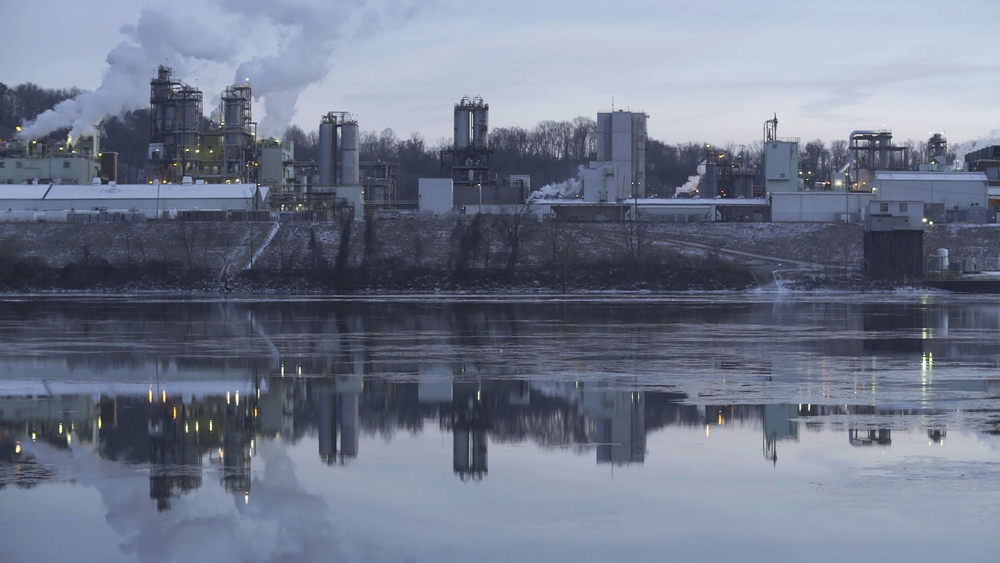
Documentary film The Devil We Know reveals the dangers of many ordinary household chemicals we’ve overlooked — and explains how we got to this point.
Released in January, the 2018 documentary The Devil We Know is a damning expose of the DuPont corporation.
The film, citing documents by the chemical manufacturing corporation’s own filings, breaks down how deadly chemicals — known as per- and polyfluoroalkyl substances (PFAS) — entered the bloodstreams of 99.7% of Americans nationwide, in “one of the biggest environmental scandals of our time.”
The most prominent source for the chemical is in Teflon, or polytetrafluoroethylene (PTFE). This chemical is found in everyday objects like nonstick pans, wiper blades, and any homemade, industrial-coated iron man suit. But Teflon isn’t the only PFAS on the market; it’s just one chemical in a family of thousands, each used for a myriad of consumer products.
The film claims that Perfluorooctanoic acid (PFOA), also known as C8 –– the active synthetic chemical used in the making of Teflon — is only one of over 80,000 untested chemicals currently in production. At one point at least 6.5 million Americans in 27 states were drinking water tainted by the Teflon toxin. Meanwhile, DuPont and others remained free to slightly change C8’s chemical formula and continue producing it, even after the story hit national headlines.

I spoke with Kristin Lazure, producer of the film, to shed some light on what inspired its production, and whether I should ditch my Teflon pans for new stainless steel and cast-iron cookware sets. The answer was yes.
“Ken Cook of the Environmental Working Group says it perfectly in the film — as consumers, we assume that because something is on the store shelf, that it is relatively safe,” Lazure said. “That just isn’t the case.”
Residents of Parkersburg, West Virginia — ground zero for the film’s story — first began to discover signs of the chemicals’ devastating effects on their livestock. From there, concerned citizens began an in-house investigation on the DuPont chemical plant, only to discover that chemicals had been intentionally dumped in the Ohio River –the water source for not only the West Virginia town and its 70,000 inhabitants, but for much of the midwest — dating as far back as 1982.
Reports of this contamination made national headlines. Many were shocked and concerned. The settlement of a 2004 class action lawsuit mandated that studies be conducted on the chemical. The results revealed that the chemicals were causing some major health concerns: testicular, kidney, liver, and pancreatic cancer; ulcerative colitis; weakened immune systems; low birth weights; endocrine disruption; increased cholesterol; pre-eclampsia; and even abnormal weight gain in children and dieting adults. Additional studies have found an association between the chemical and ovarian cancer, lymphoma, birth defects, and attention deficit disorder in children.

2017 DuPont warehouse fire in Parkersburg WV/via Imgur
However, many did not want to believe the facts the studies uncovered. Their motivation for disbelief was primarily financial — according to Lazure, the plant brought opportunity to the town, and created a reciprocal investment between it and the town residents.
“It’s a tale as old as time — a company putting the bottom line over the welfare of people and the environment is unfortunately not rare or surprising,” Lazure said. “But I think what has been shocking to audiences is seeing the company’s internal documents, and hearing the callousness of DuPont executives in the video depositions that we obtained.”
DuPont ran an internal investigation on the PFAS chemicals, and the Environmental Protection Agency ran some of their own. The eventual revelations, and pressure from the EPA, led DuPont to phase the specific chemicals they were using at the time out of production. Their manufacture, use, and import is now banned in the U.S. However, evidence suggests that the next-generation PFAS chemicals that DuPont replaced the banned chemicals with may have similar toxicity.
“Under pressure, DuPont and other companies phased out PFOA,” Lazure said. “But they have replaced it with other PFAS chemicals like GenX. Early testing of this chemical shows similar health effects to PFOA.”
According to Lazure, DuPont refused to take part in the film. When we reached out to DuPont Corporation for a statement, their reply was about what you’d expect.
“Thank you for writing. This product line has been divested and is now part the Chemours Company. Please call 844-773-2436 or 302-773-1000 for assistance. If you prefer to access their website, the address is www.chemours.com. Regards, DuPont Corporate Contact, Wilmington, Delaware USA. 800-441-7515 302-774-1000″
With this response in mind, we decided to see what the government would have to say. We spoke to Virginia State Public Health Toxicologist Dwight Flammia, who showed roughly the same amount of enthusiasm for the subject. “More research on these chemicals is being done, to understand the health risk,” he said.
And this is true. Government oversight offices have since tightened their grip on the issue and research is indeed being done. But the problem doesn’t stop there. Even today, as many as 110 million Americans may be drinking water tainted with PFAS chemicals, from sources like sea salt microwave popcorn wrappers and waterproof jackets. New research by the CDC reports that this issue extends to other nations, including Italy, the Netherlands, and China. This issue has not been resolved — if anything, it’s getting worse.
“Researchers call it a ‘regrettable substitution,’ when one harmful chemical is replaced by other chemicals that are similarly harmful, or whose impact on human health are unknown,” Lazure said. “That’s what’s happening here.”

The Environmental Working Group recently released its national Tap Water Database, which found that at least 16 million Americans in 33 states were being served tap water contaminated with chemicals from non-stick coatings. Many had not been previously informed that their drinking water contains PFAS chemicals at levels deemed harmful by independent scientists and EWG, because the test information was not initially made public.
“Referring to PFOA and PFAS, there is a lifetime health advisory for these chemicals in drinking water,” said Flammia. “If the concentration of chemicals are above health advisories, the consumer should consider an alternate source of water. The Office of Drinking Water can help with determining if your water is safe.”
If PFAS chemicals have been detected in your water, a water filter with reverse osmosis may be effective for reducing or removing the contaminants. The Devil We Know‘s website also offers a Chemical Detox Challenge for anyone to follow.
But for Lazure, real change begins with how we mobilize as a community, much like the residents of Parkersburg did years ago. “People usually walk away from our films pissed off and wanting to do something to affect change,” she said. “We work hard to provide them with some information and some tools to do that.”
Changes that we make in our own homes are important for well-being, but they also have tremendous power to shift policy, Lazure said. “For example, if there’s a sea change and people en masse turn away from Teflon, DuPont will be forced to turn to green chemistry to make this product. If we demand safer products, they’ll become more readily available.”
However, until we follow the example set by Parkersburg years ago, Lazure fears nothing will change. “If you look at it from the perspective of chemical corporations, why would they spend money to develop safer alternatives when there’s still a huge market for poison?”
To find out where you can see The Devil We Know, click here.