
What is it?
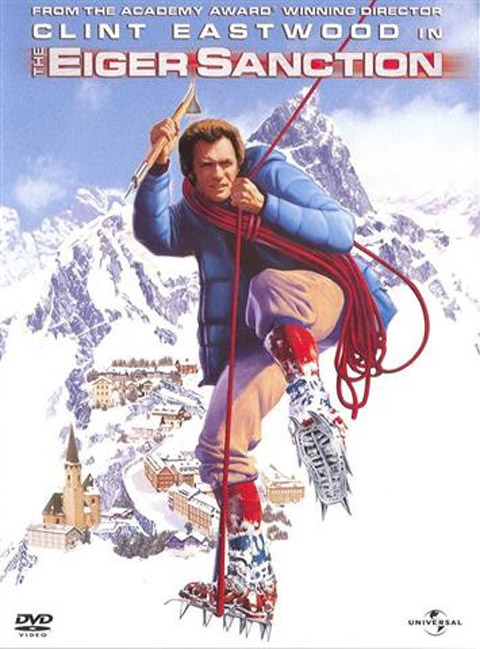
The Eiger Sanction is a 1975 film (based on the novel by Trevanian) starring Clint Eastwood. It was critically panned upon release, and despite a warm reception from the rock climbing community, it never really found an audience.
Why don’t I know about it?
Neither critics nor audiences were very enthusiastic about the piece, and it certainly represents an atypical performance from Eastwood in an atypical role. It also has a nasty history punctuated by death and typical Hollywood politics.
What makes it unique?
Eastwood directed the film, his fifth in that capacity. Clint elected to shoot on location though many felt this was unwise and unnecessary. Some even claim that sheer machismo was the famed performer’s primary motivation for making the film in such fashion, and Eastwood did insist on doing his own stunts throughout. This includes a scene in which he cuts his safety line. The rugged star would emerge unscathed, but others were decidedly less fortunate.
MORE (including the ORIGINAL 1970’s trailer) BENEATH THE BREAK
What is it?
The Eiger Sanction is a 1975 film (based on the novel by Trevanian) starring Clint Eastwood. It was critically panned upon release, and despite a warm reception from the rock climbing community, it never really found an audience.
Why don’t I know about it?
Neither critics nor audiences were very enthusiastic about the piece, and it certainly represents an atypical performance from Eastwood in an atypical role. It also has a nasty history punctuated by death and typical Hollywood politics.
What makes it unique?
Eastwood directed the film, his fifth in that capacity. Clint elected to shoot on location though many felt this was unwise and unnecessary. Some even claim that sheer machismo was the famed performer’s primary motivation for making the film in such fashion, and Eastwood did insist on doing his own stunts throughout. This includes a scene in which he cuts his safety line. The rugged star would emerge unscathed, but others were decidedly less fortunate.
MORE (including the ORIGINAL 1970’s trailer) BENEATH THE BREAK
The Eiger is a mountain in the Bernese Alps in Switzerland. Though at only a little over 13,000 feet the Eiger isn’t among the highest mountains, it is commonly regarded as one of the most treacherous. The name means “ogre” in German, though they call it by another name that literally translates to “Killer Wall.”
On the second day of shooting, a man named David Knowles was killed by a falling boulder, which also seriously injured another man. Knowles, 27, had climbed the Eiger before, and he was acting as a body double and a photographer for the production. Eastwood considered shutting the project down at that point, but was urged by the rest of the climbers to continue. Thinking that Knowles would have died for no reason if the film was halted, Clint reluctantly pressed on. The shoot remained difficult.
There were numerous injuries throughout the production, some serious and some very minor. At least one of the wounded would later claim that Eastwood’s lack of preparation and patience were the primary reasons for his injury.
The picture faired poorly upon release, and Clint blamed the studio for a lack of promotion. Indeed, the star was so incensed that he left Universal Studios and embarked on a long and extremely successful partnership with Warner Brothers, a relationship that is still producing quality films.
Is it any good?
It is a very odd picture, and it is strange to see Clint play a suave assassin in the James Bond mold, but I enjoyed The Eiger Sanction. It was dated, to be sure, and there was some material along the way that had me wondering how many marches would be staged upon the film’s release in this politically correct day and age. Yet it was also very clever, very tense at times, and frightening realistic during much of the climbing that takes place during the final act.
Clint plays Dr. Jonathan Hemlock, a dashing killer and art lover who is coaxed out of retirement for a final assignment consisting of two “sanctions,” or assassinations. The first is a simple affair, but the second requires Hemlock to align himself with a team set to climb the Eiger. Since Hemlock is an expert climber as well as a skilled assassin and a professor, and a lover of fine art, this is a cinch, and before long they’re on a most dangerous climb while Hemlock tries to identify his prey.
Did I mention that Clint talks a lot here, a departure from his “squint and stare” routine that proved so profitable? Or that he’s an absolute chick magnet in this one, drawing fine women like moths to a flame? There’s also a homosexual enemy with a dog named “Faggot” and an albino who Hemlock refers to as “the bloodless freak.” This is all a bit much for typical Eastwood fans, and I was certainly taken aback by a lot of what transpired.
Yet it actually works. It all manages to tie together in the end, and while The Eiger Sanction never soars to great heights, it does provide a lot of suspense and some truly memorable setpieces. This is a piece destined to stand out in the star’s considerable legacy even if his direction is a bit uneven here and even if it is significant for its bitter history more than anything else.
The verdict:
I wouldn’t rush out to see this film, yet it is a curious piece with a remarkable history, and any fan of Eastwood should be sure to watch it. It isn’t even close to ranking among his best films, but it’s nowhere near the bottom of that list either. If you don’t mind some offensive content and a thoroughly unique outing as a dapper hitman/art lover/college professor guy/absolute chick magnet for the beloved star, you should enjoy it as well.