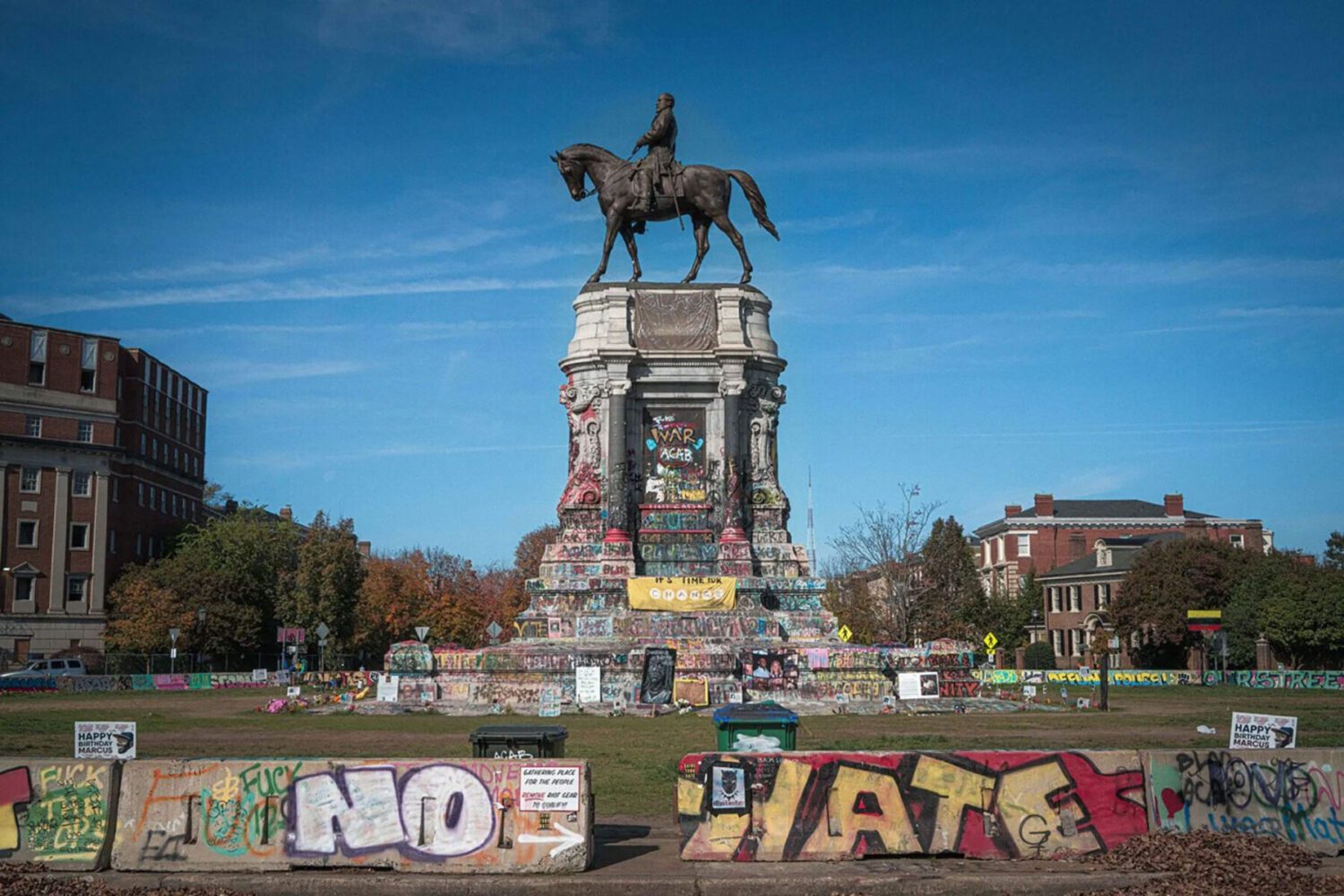
“The rebel yell, reinforced by a glorification of the lost cause was everywhere manifest,” reported John Mitchell Jr., editor of the Richmond Planet, an African American weekly newspaper, at the time of the Robert E. Lee monument’s unveiling.
It was the spring of 1890. Boxes adorned with Confederate flags held the 12-ton bust, as a faithful army of men, women, and children wheeled it into the city.
“Nowhere in all this procession was there a United States flag,” Mitchell observed.
Celebrated as the statue was when it first rolled into town, many of us rejoiced to see it go more than a century later, an act of racial reckoning that previously felt unthinkable for Richmond.
On September 8, 2021, the general became the last to fall, unceremoniously pulled from his post where he, like other Confederate leaders, loomed large over Monument Avenue. And with it, the hope of a new era, in which this former capital of the Confederacy would no longer lag in the shadows of these stone-faced symbols of the Lost Cause, rose to take their place.
Not every Lost Cause shrine has been toppled, though. Lee and his chiseled comrades may have been silenced. But in other parts of Richmond, their unholy war cry, reduced to more of a whisper, can still be heard, enshrined in what is arguably as foundational to the city’s postbellum identity as the monuments themselves.
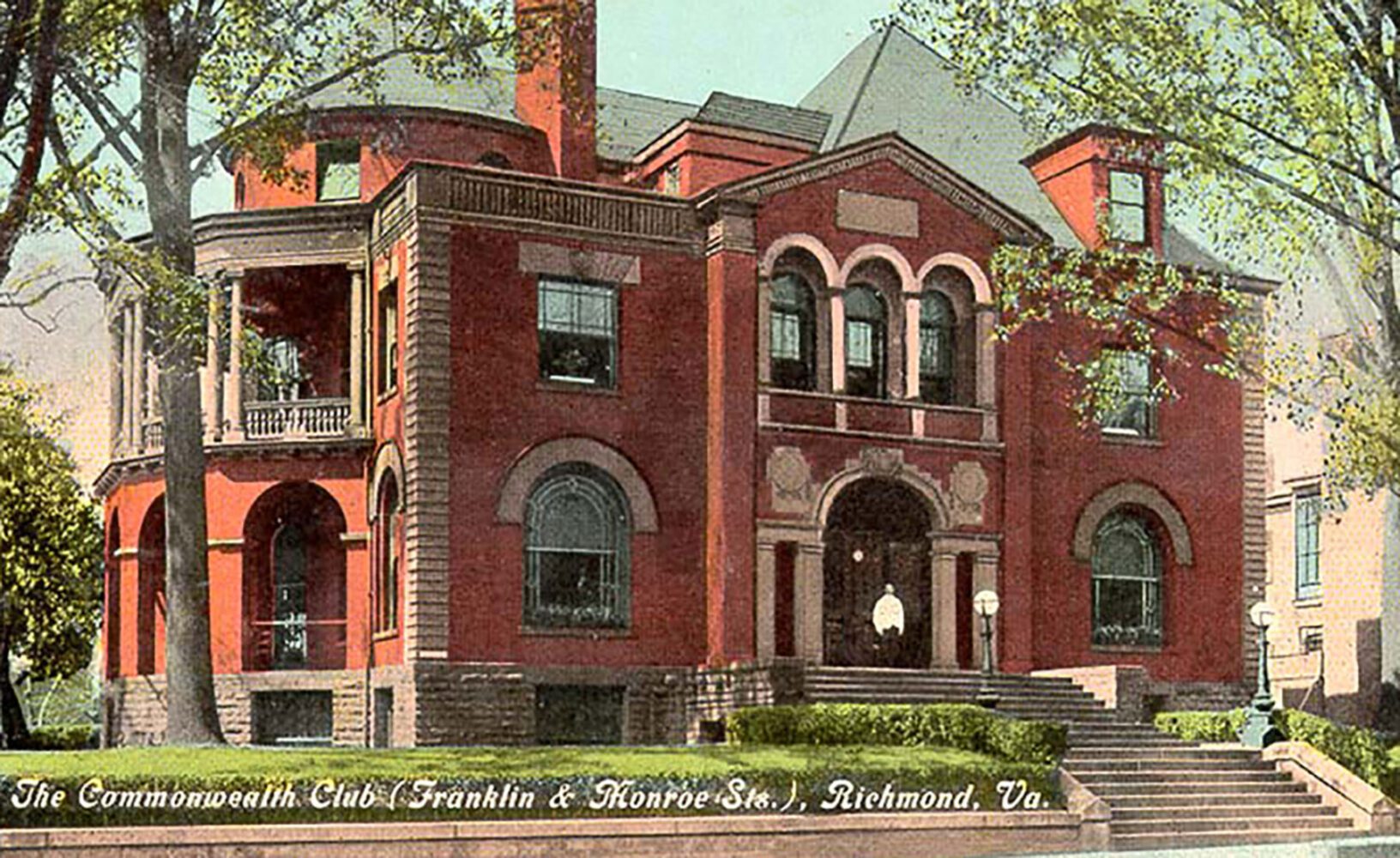
A mere mile away stands another relic of that era: the Commonwealth Club, a private social club of considerable public and political influence, which, decades ago, was branded by critics as “the last stronghold of white supremacy,” as the Richmond Times-Dispatch once reported.
Also founded in 1890, the club is located at the intersection of Franklin and Monroe Street, a four-story fortress furnished with dining rooms and bars, a wine cellar stocked with rare vintages, and a basement for all sorts of gentlemanly exploits. Cigar smoking and whiskey drinking, bridge games and boxing matches, and on occasion, even some naked swimming.
Despite its clout, it originated, in a sense, as the losers club. Most of its founders, who initially wanted to name it the “Lee Club,” were former Confederate soldiers. Still reeling from the sting of defeat to the North, they longed “to relive the glory years, to remember the South’s hope and the exploits of her heroes,” recounts Langhorne Gibson Jr. in This Splendid House: One Hundred Ten Years at the Commonwealth Club, an authorized history of the Commonwealth Club published in 2001.
But all this nostalgia for the old South was different from the Lost Cause mindset that later took hold. Or so they maintain.
Gibson, in his book, copies of which are placed around the clubhouse, offers the same justification for the Lee statue, describing it as little more than “a celebration of former greatness, a tribute of love and respect to the Southern hero.”
What the club doesn’t mention is that its original members comprised some of the movement’s fiercest defenders – like Joseph Bryan, the Times-Dispatch owner who declared himself “aligned … with the white supremacy cause”; Tredegar Iron Works’ Joseph R. Anderson, who campaigned for the local statue of Jefferson Davis and whose son Archer oversaw the dedication of the Lee statue; and prominent Lost Cause author (and lynch-mob apologist), Thomas Nelson Page.
For years, within the Commonwealth Club’s red-brick walls, men would raise a glass to Davis, their venerated leader, toasting to “Mr. President.” Annual balls were held to celebrate the birthdays of Generals Lee and Jackson. Regal portraits of Confederate figures and the battles they led were proudly displayed. And members were regaled by Black headwaiter William Rush’s rousing rendition of Lee’s Farewell Address to the Army of Northern Virginia.
***
The “Lost Cause,” a term coined by Richmond’s Edward A. Pollard, refers to a subversive way of thinking about the Confederacy’s war effort that caught on after its defeat in 1865. Champions of this myth, while romanticizing the old South and falsely denying the horrors of slavery, insisted that the Civil War was about protecting states’ rights. Slavery, they claimed, had nothing to do with it.
That revisionist message fueled a wave of propaganda, particularly in the decades after Jefferson Davis’ death, just as the Commonwealth Club was coming into being.
Statues were erected. Heritage groups formed. History books written and rewritten. Novels and films produced. All of which were meant to soothe the shattered egos and uneasy consciences of white Southerners, distort the truth about a war they had lost, and help them regain power, while rolling back progress made by African Americans during the Reconstruction era.
“The period from 1889 to 1913 remains the most crucial period in Southern history exclusive of the Civil War,” writes one historian. “Within this span of only twenty-four years Southerners satisfied themselves and the North that the cult of the ‘Lost Cause’ merited universal respectability.”
These ideas were inscribed in the fabric of institutions throughout the South, both political and cultural. Some have since striven to shed their Lost Cause legacies. Last July, I did a story for the Southern Foodways Alliance about the evolution of a Lost Cause writer’s retreat and whites-only clubhouse into a Black-owned Southern restaurant in Social Circle, Ga., helmed by a Liberian immigrant chef.
A remarkable story, to be sure. But as I observed then, “change doesn’t come easily or often to a Lost Cause-era dining room weighed down by distorted ideas of the former Confederacy and the antebellum way of life it sought to defend.”
This has shown to be the case at the Commonwealth Club.
***
In the decades after its founding, the club came to represent what former Times-Dispatch reporter Karin Kapsidelis and Pulitzer Prize winner Michael Paul Williams called “a symbol of white male political hegemony,” exactly as architects of the Lost Cause envisioned.
Membership was granted only to white men for most of the twentieth century. (White protestant men to be precise, as the club did not accept any Jewish members until the late 1960s.)
Handpicked and vetted, its roster, historically, reflected a who’s who of prominent businessmen, lawyers, politicians, and lobbyists. Among them were the likes of U.S. Senator Harry F. Byrd, leader of Virginia’s “massive resistance” to school desegregation.
“Sharing their conservative preserve with rich antiques and striking portraits of Colonial and Confederate heroes, they continue a long tradition of behind-the-scenes power-brokering,” wrote the Washington Post, in 1979, of the Commonwealth Club’s members.
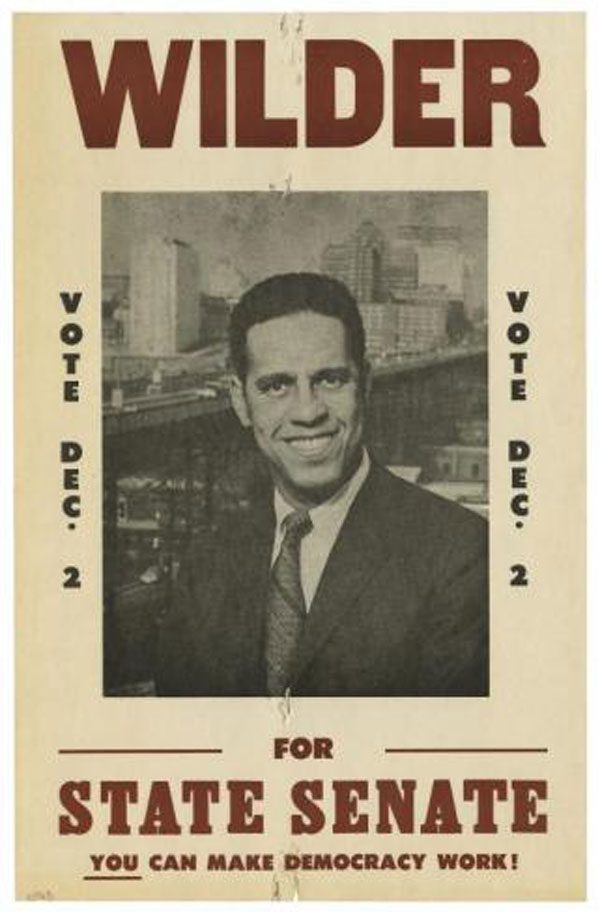
Douglas Wilder, an African American who waited tables at the Commonwealth Club in his youth before eventually serving as Virginia’s 66th Governor (and the 78th Mayor of Richmond), confirms that this was, indeed, the place where white male elites, including public officials, would convene and amass power.
It was a private establishment, yes. But its broader impact on public life was undeniable.
“All the major decisions were made at the Commonwealth Club,” Wilder tells me. It was “the center of political activity in Virginia.”
Legislative committee heads would regularly convene closed-door sessions there after the General Assembly had adjourned for the day. That was the point of having “a cloistered group of individuals of like mind,” he adds.
While acknowledging a lack of diversity in its ranks early on, the club insists this was more a product of society at that time than any founding ethos.
“Discrimination is not written into our charter,” Commonwealth Club president E. Massie Valentine, whose family founded The Valentine Museum, emphasized back in the early 1980s. (Having read through the club’s original charter, along with its constitution and bylaws, I can attest that this is technically accurate.)
Regardless, as more people of color and women rose to power and the face of Virginia’s ruling class went from lilywhite to melanated shades of black and brown, the club’s exclusivity and elitism increasingly came under attack.
The first shot was fired in 1968. Dr. William Ferguson Reid had just made history as the first African American legislator in Virginia since Reconstruction. After he was left off the list for a cocktail party at the club, 50 fellow lawmakers boycotted the soiree in solidarity.
But it was Wilder who dealt it the deadliest of blows.
As the only Black state senator in 1979, he famously railed against it as “a racist club, a retreat from the world where social gains are being made.” It was high time the members of that club “left the cocoon and stopped talking about Civil War victories,” he told the Washington Post.
As candidate for U.S. Senate in 1982, he put them on blast after a pair of white politicians refused to bring him to lunch there. And as newly-elected Lieutenant Governor in 1986, he made waves when he and Attorney General Mary Sue Terry, the first woman to hold statewide office, were denied invites to an annual chitterling breakfast at the club. Governor Gerald Baliles took the unprecedented step of snubbing the high-profile political event the following year.
With pressure from advocacy groups and even the state legislature, the Commonwealth Club finally capitulated, making Frank Royal, a local physician, its first Black member in late 1988.
“Dr. Royal’s acceptance for membership follows years of adverse publicity about the club’s racial exclusivity,” reported the Times-Dispatch, noting “some muted grumbling about his proposed membership.”
Wilder, in the end, exacted his revenge. While secretly pushing for Dr. Royal’s induction into the club, he openly declined an honorary membership the next year, after being elected the first Black Governor in the country.
***
Richmond has arguably evolved more on race issues since. Following George Floyd’s murder in 2020 and protests that erupted nationwide, a growing discomfort over Lost Cause symbols, and a greater willingness to grapple with their history than in generations past, swept the city. Citizens demanded change. (Though, some still believe this was purely symbolic and did not translate into tangible improvements in the lives of the Black community.)
Monument Avenue wasn’t the only thing that underwent a racial reckoning. Public and private institutions, all across Richmond, did their own soul searching as well.
The Valentine Museum, whose namesake includes the late Edward Valentine, a Richmond artist credited with a number of Confederate statues, spent several years overhauling the space and putting its racist roots more candidly into context. His old studio now houses an exhibit on the Lost Cause. Schools, like the University of Richmond, stripped the names and images of enslavers and white supremacists from their campuses.
In early 2024, a $225 million project, slated for construction in Shockoe Bottom, was unveiled, recognizing it as the site of one of the biggest slave-trading hubs in our country’s history. Part of that project includes an educational center in Main Street Station, which broke ground this April.
There are certainly forces fighting against such progress. In Virginia, over the last few years, we have already seen some pushback, including efforts to unwind the rebranding of Confederate-named schools, scrap Diversity, Equity & Inclusion (DEI) programs, and ban books for so-called “divisive teachings” on race.
Much of this has, thus far, transpired outside of Richmond. But that could change, given the stance of the new presidential administration – which, among other things, vowed to combat what it calls “equity ideology” and to restore monuments under its purview to their former glory.
It has already been reported that a Trump-led DEI purge at the federal level resulted in the removal from the Virginia National Guard’s website of all references to Richmond’s historic Leigh Street Armory, the oldest U.S. armory for a Black militia and home of the Black History Museum & Cultural Center of Virginia.
This February, the U.S. Department of Education wrote to colleges targeting DEI programs and other race-based initiatives and threatening to pull federal funding. Here in the city, Virginia Commonwealth University president Michael Rao and other administrators penned a conciliatory response, affirming “that VCU policies, practices and documents are generally aligned with the Department of Education letter.” Its Board of Visitors, despite members of color who opposed the decision, later voted to eliminate the university’s office of DEI.
“DEI is dead,” Governor Glenn Youngkin’s chief diversity officer recently proclaimed.
In time, if the political climate in Richmond shifts significantly enough, places still resisting change may no longer find themselves on the wrong side of history. Perhaps that has even been a strategy for some of them all along, biding their time like a dormant seed waiting to bring the Lost Cause back to life.
If Wilder’s career in politics has taught him anything, it’s that changes don’t happen on their own. “They can only take place and will take place with demand,” he says, “and if people are happy with things as they are, that’s going to be the way it’s going to be.”
Ever since the Commonwealth Club was forced to welcome racial minorities into the fold, after the controversies of the 1970s and ‘80s that it fails to acknowledge anywhere in its own account of history, seemingly little has been done, or asked to be done, about tackling its Lost Cause legacy. Not even when the Confederate statues around it fell.
There have been opportunities to do so. A group of civic-minded citizens, including some club members, convened there in 2010 as part of a series called The Future of Richmond’s Past. Organized by then–University of Richmond president Edward Ayers, the meeting sought to provoke honest conversations about race and slavery in the lead-up to the 150th anniversary of the Civil War.
Other than providing a venue, the club didn’t participate in any real way, Ayers tells me. The American historian, in fact, recalls the irony of urging his audience “to confront the city’s past,” when “the lobby right outside the place where we dined, and where I gave that talk, displayed portraits of Confederate generals.”
In September 2023, right-wing rabblerouser Andy Ngo, who has been critical of the Confederate monument removals, was invited by two conservative groups, the Virginia Council and the Common Sense Society, to speak at the Commonwealth Club. Only at the eleventh hour did it back out of hosting the event, vaguely citing “the club’s values.”
As reported by Fox News, the club privately emailed the Ngo event organizers to express its regret, stating, “After careful consideration and in light of the current political climate, the leadership of the Commonwealth Club have made the difficult decision to decline hosting the event.”
The Virginia Council, founded and chaired by Republican candidate for Lieutenant Governor, John Reid, issued their own statement critiquing the last-minute decision: “The Commonwealth Club had an opportunity to stand up with us, but they backed out in fear.”
Two individuals I spoke with, both of whom are Black, recounted their experiences as employees of the Commonwealth Club within the past five years. (Citing fear of personal and professional repercussions for criticizing such a wealthy and well-connected institution, both requested anonymity. They still live in the area and conduct business in the city.)
In their view, the club remained a predominantly white space, not just in terms of membership, but among staff as well. Nearly all employees of color worked in service roles, while those in leadership positions were overwhelmingly white.
One of the former employees, who worked in the dining rooms, feels the club only ever paid “lip service” to workplace diversity efforts, particularly in the aftermath of the 2020 anti-racism protests. While this claim has not been independently verified, she also alleges that the club briefly removed its Confederate portraits, only to rehang them two years later.
“They didn’t [have the Confederate paintings up] at the moment, but they do again now,” she says. “Their board approved putting them back up around the middle of 2022.”
The second employee, who was hired by the club at the end of 2022, says he couldn’t corroborate the allegation, noting that he spent most of his time in the kitchen and paid little attention to the artwork on the walls.
Blue, clothbound copies of the Commonwealth Club’s authorized history, “read it and appreciate the rich heritage,” Gibson’s book tells its readers, were also handed out to them like a sort of employee bible. Though, the second employee personally confesses that, after being told to read it, he threw it straight into the trash.
***
My own introduction to the Commonwealth Club came from an Uber driver, a history buff who had taken it upon himself to play tour guide during one of my first visits to Richmond back in 2018.
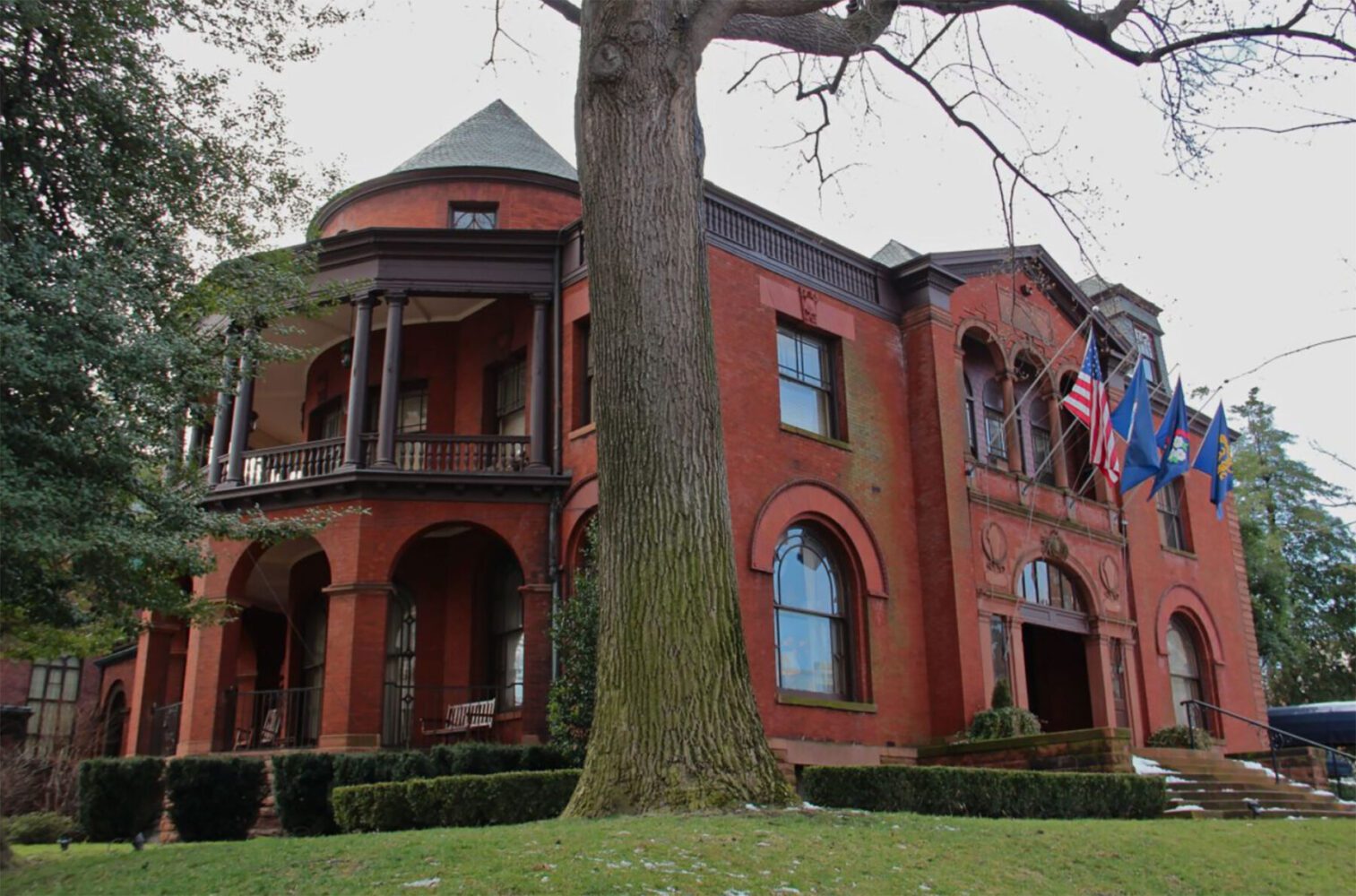
The driver, who was white, made a point of mentioning that Black folks previously weren’t admitted there, as we passed by the building with its signature blue awning. He also took me to see the Confederate statues, and when asked why the city didn’t just take them down, laughed off the seeming absurdity of my suggestion. Welcome to Richmond, I thought to myself.
Not until this year did I finally get a chance to set foot inside the Commonwealth Club. The price of admission: a ticket to a black-tie masquerade ball, open to the public.
Held in the main ballroom, the event itself, ironically, a party for party planners, was like some big, beautiful wedding, complete with a DJ, buffet stations and passed hors d’oeuvres, and an open bar.
Those in attendance varied in age, gender, race, even sexual orientation (they were party planners, after all). So did the catered cuisine, which ranged from duck empanadas to cheeseburger sliders to braised short ribs in martini glasses.
A bunch of other events were scheduled that same evening, including a Commonwealth Club board meeting down the hall, from which the sound of men laughing could be heard outside. A former colleague of mine, who I bumped into on my way to the restroom, volunteered that he had come for a company-sponsored reception attended by VCU President Rao.
In the lobby bar and dining rooms on the second floor, small groups of individuals, including a Democratic state senator, gathered. And wafting up from the green-carpeted basement stairwell was the thick scent of gentlemen smoking cigars.
To the casual observer, all of it looked very much like any other traditional social club.
As the night went on, I played a little game of “spot the Lost Cause symbol.” The basement was off limits. To my surprise, far more landscapes and fox hunting scenes than Confederate iconography could be found on the clubhouse walls.
But every now and then, something would catch my eye: an oil painting of a soldier hoisting the rebel flag in the Battle of the Crater, mounted right above a credenza used to showcase an old coffee table book on Monument Avenue; a painting of the Battle of New Market, another win for the Confederacy, capturing the charge of young, gray-jacketed VMI cadets; and a gold-framed painting of “Light Horse Harry” Lee, Robert E.’s father.
Lee himself, whose portrait once hung in the corridor between the main ballroom and the Washington Room, was nowhere to be seen. In his place, at least for the time being, stood an interactive photo booth.
However, displayed atop the mantel in the first-floor reading room was a row of Lee biographies, alongside other Civil War histories, with titles such as Reflections on Lee, Lee Takes Command, Robert E. Lee: The Soldier, They Called Him Stonewall, The Confederate Constitution of 1861, Fighting for the Confederacy, Virginia, the Gray and the Green, Wearing of the Gray, and Life in the Confederate Army.
I’ll admit, none of these were anywhere near as glaring as a 60-foot monument in the middle of a major traffic circle. And yet, that also made them harder to call out – the hidden symbols, the well-established traditions, the ideas masking as history, all of which somehow blended seamlessly into the basic structure and design of the Commonwealth Club.
***
“A place that will never be caught changing with the times.” This was The Washington Post’s frank assessment of the club back in 1979.
To this day, the Confederate veteran–founded gentlemen’s club is, by and large, a quiet, unbending institution — one that still confidently declares itself “proud of its history” on its website, a history left unscathed even as other signs of the Lost Cause era fade.
What happens in the Commonwealth Club stays in the Commonwealth Club. And whatever misgivings it may or may not have about that history aren’t meant to be visible to anyone beyond those four walls.
Insiders are notoriously guarded. While their bylaws don’t forbid them from talking to the press, they do frown upon any conduct that could “endanger the good order, welfare, or character of the Club.”
Not surprisingly, then, neither the management nor the various members I contacted about changes were willing to be interviewed. (On July 7, I got ahold of the club’s general manager, Eric Abuneel, who agreed to speak with me the next day. After a series of unanswered calls and emails, however, he rescinded the offer and told me to “try us back in the fall.”)
But can this imperviousness sustain them? Or by being so protective of the past, are they bound to repeat the mistakes their Lost Cause predecessors made?
At one point, the club held the most prestige as a place where white men would gather to strike backroom deals and covertly shape public policy. But the world has changed. Politics has changed. A club – with a controversial backstory that privileges wealth and, according to my sources, still excludes female members – doesn’t square with the openness of government today, in terms of how it’s run and who’s running it.
“If you are going to have open government, you can’t have it in these clusters,” says Wilder. “It has to be open.”
“There should be no discrimination period if you are dealing with matters relative to the people’s interest and the public,” he adds, pointing out that “they still do not accept women” and pondering the ramifications of this for our first female Governor (whoever she may be). “To the extent that it has retreated and gotten away from racial discrimination as it relates to membership, that’s a good thing, but can it justify its existence?”
Dr. Bob Holsworth, former dean of VCU’s College of Humanities and Sciences and founding director of the Wilder School of Government and Public Affairs and its Center for Public Policy, agrees with the former Governor.
“The political elites in Richmond right now are predominantly African American,” he notes, and “not many of them are members of the Commonwealth Club at the moment.”
Nowadays, in his opinion, one’s membership in an exclusive club may be more of a liability than an asset for public figures, especially elected officeholders and folks funded by taxpayer dollars.
“I am perfectly comfortable with private clubs,” says the former college dean, but “public institutions ought not to be spending taxpayer dollars at places in which more than half of the taxpayers can’t join.”
Holsworth claims that, having served two terms on VCU’s Board of Visitors, he pushed Rao – the fourth highest-paid public university president in the state – to resign as a Commonwealth Club member a couple of years back for that very reason. A VCU spokesperson, meanwhile, maintains it has been “at least a decade” since their president was a member.
It was also reported that VCU threw a fundraising gala at the club for president Rao’s inauguration in 2011. And in 2020, the university had planned an “Evening with the President” there, before cancelling it due to COVID.
“It’s wrong to think of this place as a locus of control any longer, whether it be economic or political,” Holsworth concludes. “Being a member of the Commonwealth Club is not what gives [people] their authority and power.”
As for Wilder, his estimation of it hasn’t changed at all. “If what is taking place now is considered an improvement – as the blind man said, we will see,” he says.
But from where the elder statesman sits today, the view is the same: he has no desire to join the Commonwealth Club and fails to grasp the purpose of it.
Support RVA Magazine. Support independent media in Richmond.
In a world where corporations and wealthy individuals now shape much of our media landscape, RVA Magazine remains fiercely independent, amplifying the voices of Richmond’s artists, musicians, and community. Since 2005, we’ve been dedicated to authentic, grassroots storytelling that highlights the people and culture shaping our city.
But we can’t do this without you. A small donation, even as little as $2 – one-time or recurring – helps us continue to produce honest, local coverage free from outside interference. Every dollar makes a difference. Your support keeps us going and keeps RVA’s creative spirit alive. Thank you for standing with independent media. DONATE HERE.
Also, you can show your support by purchasing our merch HERE.