
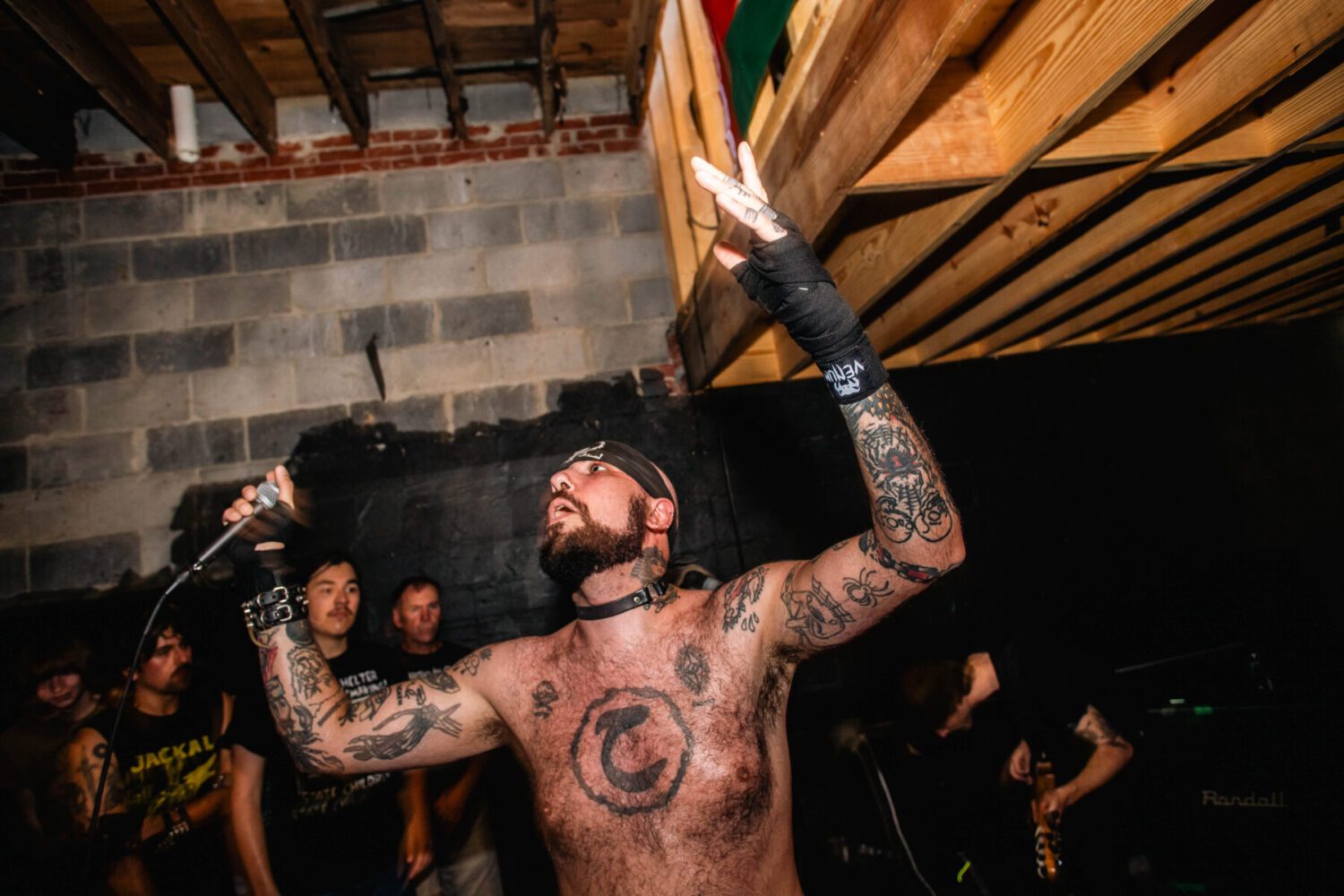
“When you say something is Haram it is 100 percent forbidden. You will burn in hellfire.” – Nader Haram
NYC’s Haram might be the most exciting thing in punk rock right now. Or art in general. Blistering, fast, and dangerous, they’re an antidote for the pervasive mediocrity that can pass for music these days. Started in 2015, their music isn’t just dissidence for the sake of dissidence; that too, is equally mediocre. Instead, their music is a ritualized challenge. Inaccessible and esoteric, unless properly sourced. Their lyrics are in Arabic. Their references cascade with symbolism. Even their name, Haram, is a signal, but only for those following where it leads.
I saw Haram not too long ago at a secret(ish) show in Richmond after buying their record When You Have Won, You Have Lost at Vinyl Conflict, the cover art, a beautiful melange of Arabic calligraphy in the shape of a lion, is also a potent symbol of moral and spiritual struggle. On the back of the record there are images of Salah ad-Din and Fatimih, renowned in Islamic history.
When asked if I wanted to meet their frontman, Nader Haram, who grew up in Lebanon, I seized on the opportunity. Not just to talk about punk, but because I also spent a significant part of my life in the Middle East and wanted to understand how the Arabic language, culture, and Muslim identity could carve out a unique place in music in 2025.
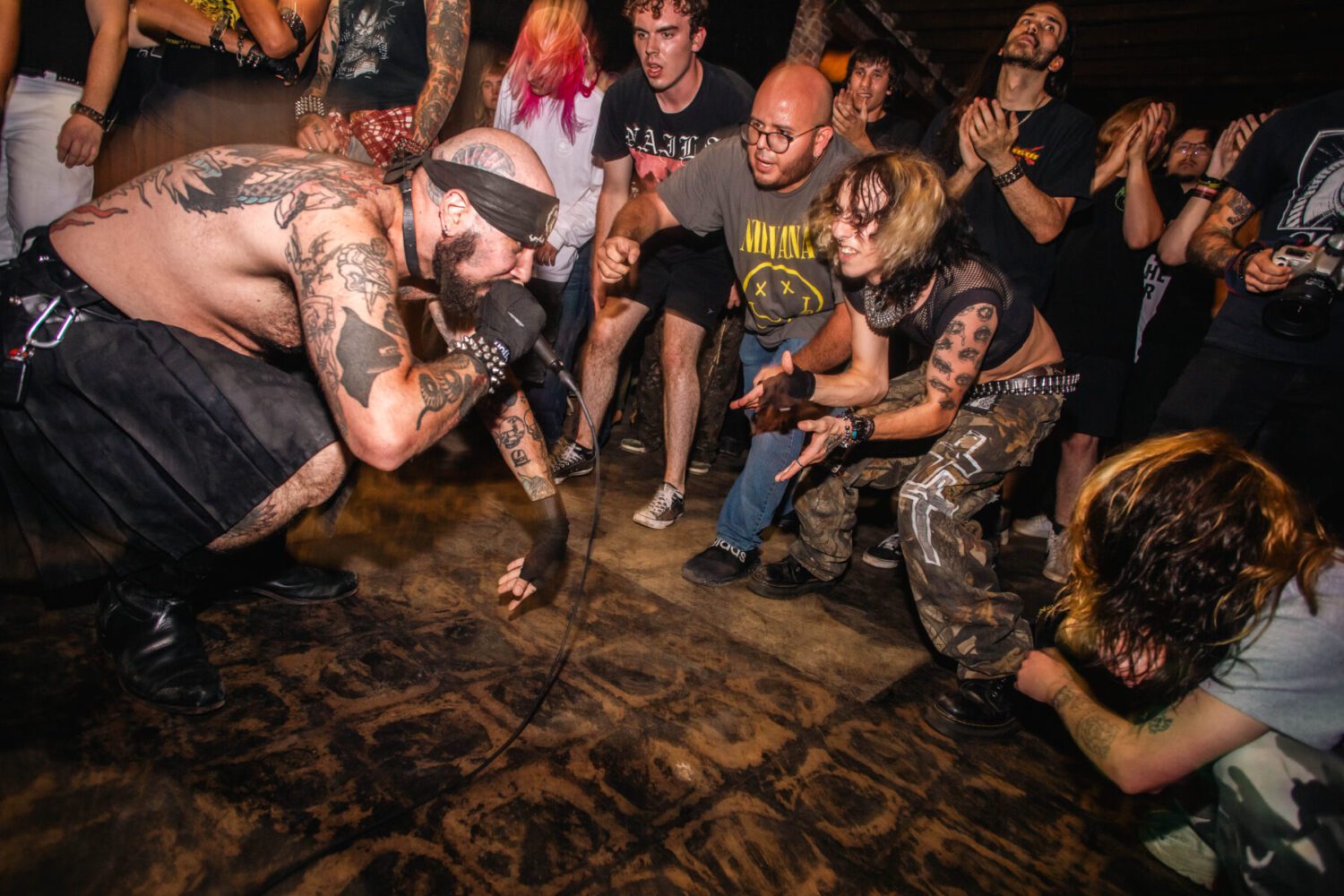
During our conversations, I realized that the symbolism of moral and spiritual struggle were more than just mere concepts or abstractions to Nader. They revealed a man who could live at the epicenter of a paradox: capable of harnessing a frontman’s invincibility, while simultaneously expressing vulnerability over the consequences of his art. Something that is almost impossible to understand unless you have the weight of tradition, culture, and religion shadowing the expectation of your music and creativity.
This conversation has been condensed because Nader and I spoke for almost two hours on what was supposed to be a 45 minute interview. There were just too many human moments to capture fully, even while we touched on old and new controversies, which, truthfully, I found to be less compelling the longer our conversation went on. While important, those also serve to rage bait at the expense of understanding the deeper, more complex truths of creating art from within the paradox.
As Haram continues on their European tour to support their new album: Why Does Paradise Begin in Hell, hopefully your sense of what punk, art, and culture is can expand beyond the narrow horizons we typically reduce ourselves to.
Great to chat with you again, apologies for the hustle and confusion. How’re things up in New York?
I’ve been pretty good. We got through the weekend where we met [in Richmond], it was a big weekend for us. That was our first album we put out in almost six years. So for us, it was a very emotional and rewarding. You know busy and hectic, a whole ball of emotions.
But I’m really proud of what we got done. And now we’re getting ready for this three week tour in Europe and Turkey. So we’re gearing up for that now.
Can you walk me through the European tour?
So it started off where we wanted to tour the Middle East. There’s not much of a blueprint for that in terms of punk bands playing [over there]. We had this dream of taking the band to the Middle East, playing Arabic punk music that is also recognized in Western scenes. And I think in a way it’s misunderstood and not fully broken down in terms of what the band actually means.
The band is very taboo for traditional Arabic culture in general. When you’re playing to a Western audience, it’s kind of hard to nail that. It’s not the same perception. I’m always trying to alter people’s perceptions and to challenge the audience; take them out of their comfort zone and not give them all the answers. I don’t like that about modern punk music, it’s very cliché and almost mimics other mainstream music.
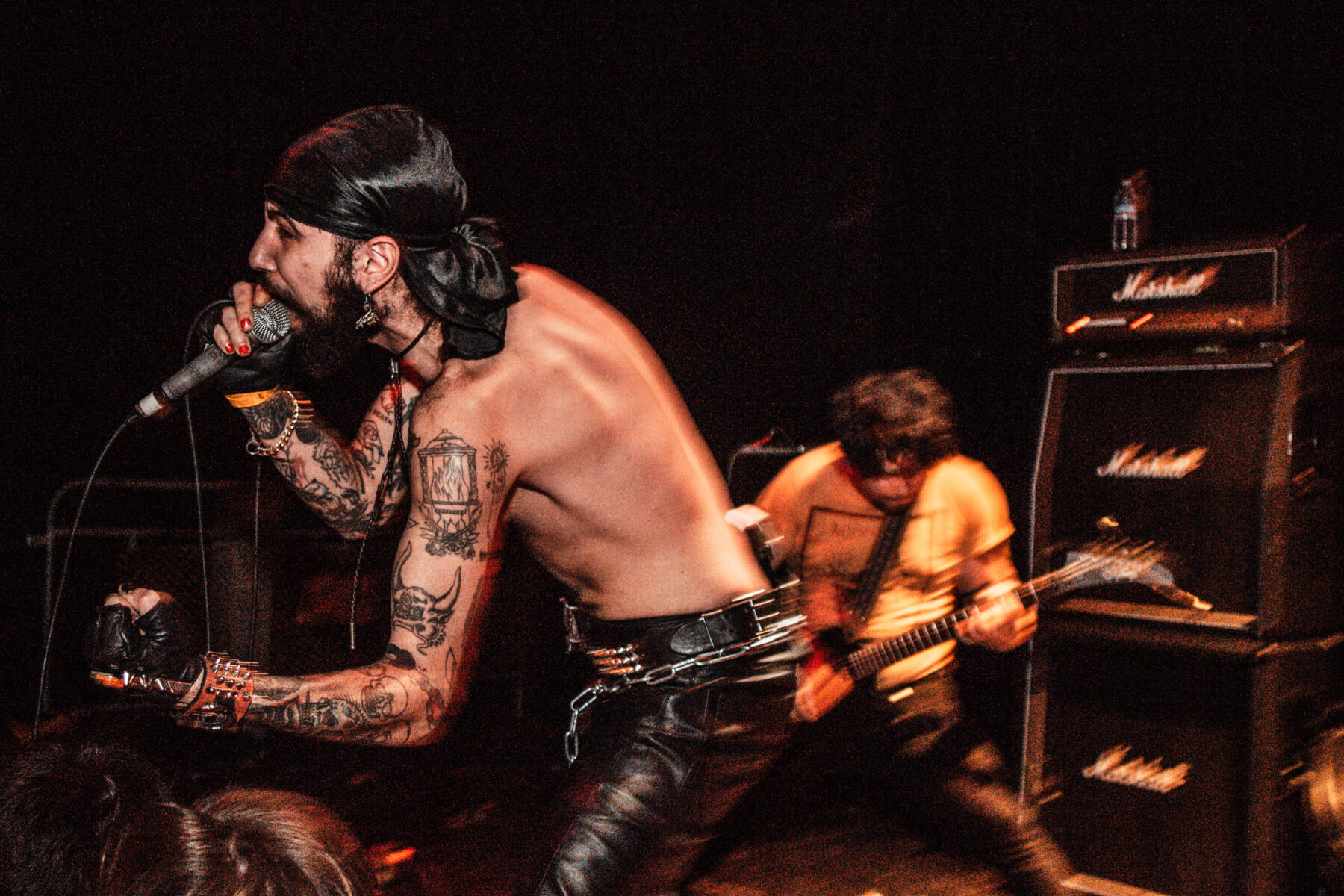
Haram’s always served this purpose of trying to challenge your perception of music. We’re not an answer. We’re more of a question. In a sense, it’s not understood via Arabic in a Western audience. So we always had this dream of playing the Middle East because that would bring the band’s challenge to the forefront. That was the plan, but we didn’t get there.
How far did you get in actually planning a Middle East tour? The phrase, Haram, obviously means something very important to the Arabic world.
We didn’t get super far, but we through out a wide net. Like where is this possible? My family’s from Lebanon, from Beirut, and I grew up in Lebanon for the first ten years of my life.
The downtown Beirut scene is really strong. There’s a punk scene there with a punk house, a DIY house, called Dajje, which in Arabic means noise, like annoying noise. It’s like static, you know, which is awesome for a punk venue.
But my family got wind of this happening and we’ve had years of no contact because of the band. And I’ve done a lot of work to repair the relationship, between me and my younger brother, so I didn’t want to risk that. So we turned down the show.
We also tried Jordan, Egypt, and were even talking to someone in Kuwait for a second, but it just doesn’t exist. The threat of law enforcement and shutting down the show was real.
That’s a real concern in the region.
We have this dream of building this connection, building this scene over time, it just wasn’t going to happen on this tour. So we’re playing mainland Europe and Eastern Europe. We start in Spain, head down to Morocco, then Italy and down to Greece, and over to Turkey. That’s the rough itinerary.
I think nowadays there’s a need for a band like Haram to be out there. Everyone is feeling a certain way, and what I think you have done so well as a band leader is give voice to that frustration and anxiety.
Thank you!
One of the things I’m really interested in is the process of writing and singing in Arabic. Most people probably don’t realize that the Arabic language is very poetic, already quite lyrical. How does that map onto your music when you write and perform?
When we first started the band, there was no rubric. I didn’t have another Arabic punk band to reference. I was really into lyricism in general, even just hip hop and reggae. I was very interested in the art of writing words to music, but I didn’t have a clearly defined example. It was a mess. It’s like Arabic [laughing].
Growing up in New York, I was raised around so much different music in the 90s. It had a giant influence on me. I was around a lot of different people too, and most of them were artists in some sense.
When I started getting into punk, which was late, I was like 17 or 18, I’m not ashamed to say that. I wasn’t someone listening to punk at 12 years old, I wasn’t exposed until high school, like late high school. When I got more into punk, I started listening to a lot of Italian punk. A lot of Japanese punk. And just taking phonetically how foreign language punk, whatever you want to call it, matched this aggressive music. How did they do it?
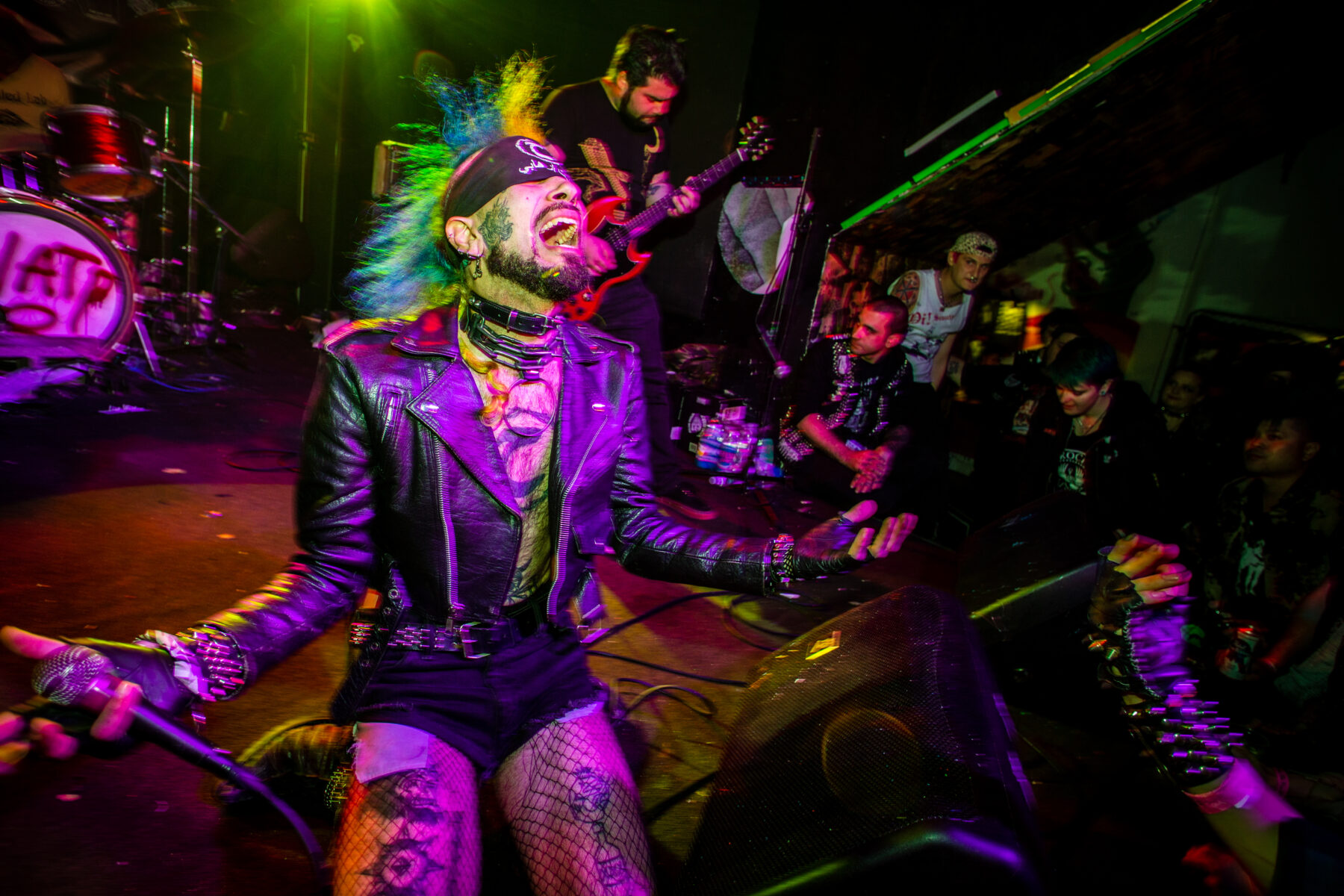
And that’s loosely what I base my Arabic lyrics around. How do these punk bands from Japan take Japanese and put it into to a Dbeat song or whatever, how are they matching, phonetically words to notes, loosely based on that.
Balancing the distance between singing in Arabic or English, does one come more naturally than the other in terms of what you’re trying to express lyrically?
Surprisingly, I have a much easier time in Arabic. I did an English speaking project called ISO, a couple of years ago. We did one demo just to try it out. I just wanted to do something different, it was post pandemic. And I sang in English and I was like, ‘man, this is so not me.’ I can’t do it.
There’s something about how clunky English is. It doesn’t feel like I’m expressing myself well. I have this defined way of singing in Arabic that works really well for me and matches the music that I listen to and end up writing. I sang in English a few times and then one of my friends was like, ‘you know Arabic is your first language, why don’t you try that.’
So I trained myself to write Arabic punk. Right away at the first practice, I knew this was special. The whole band agreed.
Haram is a culturally significant word in Arabic. Can you talk a bit about the meaning of the word and has that meaning changed as you’ve evolved as a musician, a performer?
It has not. To be frank, I felt like the band from the start was different. I had the idea to call a project Haram because the word is very, very, very strong in Arabic—it’s not a light word. It’s one thing to say, ‘that’s a sin in English.’ But when you say something is Haram [in Arabic] it is 100 percent forbidden. You will burn in hellfire.
I grew up as a Shi’a Muslim in New York City. I led my life in this duality of halal and haram. For me, when something was haram, it was forbidden to the point where it shook me to my core, I was fearful to do anything that was considered haram. So when we wrote the music, it was like, ‘what makes sense for an Arabic punk band?’ What word makes sense. And Haram made sense.
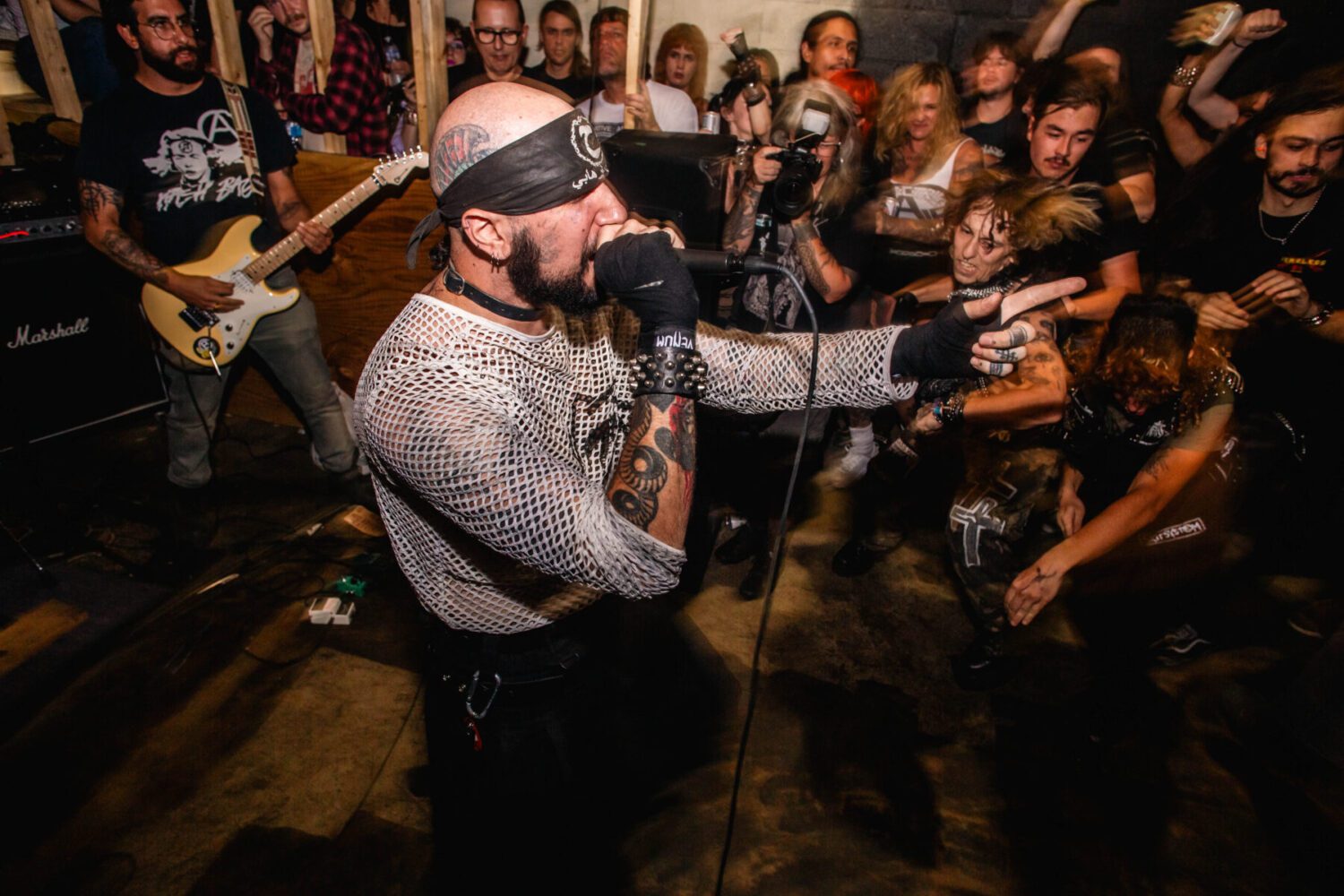
Collectively, it describes the music as being cutting edge, going against traditional values. Especially along this progressive route that fights for a different place in the punk scene; that’s number one, and in the world; that’s number two. Unfortunately, think 99 percent of the things I’ve done in my life are considered haram. And that has a very special place in terms of my lived experience.
As an Arab American, that’s a very unique experience. It’s extremely conservative and rooted in tradition. In my opinion, there hasn’t been a progressive movement in Islam. We haven’t seen any different form of Islam that’s more accepting. I haven’t seen anything that makes me feel more comfortable in my own skin as someone that still wants to practice Islam or feel connected to the faith.
I think that I would be barred in general from most Muslim places of worship just because of the way I look and what I do. So I fight for that; I fight for a more progressive form of Islam.
Do your fans know what Haram means? Are they inquisitive or is it just part of the punk landscape at this point?
Some people do. There’s a lot of weird dialogue around the band. Some people are stupid and say stupid things and I have to navigate that. The conversations I entertain is something I take a lot more seriously now. I’ve had to deal with a lot of demagoguery, Arabic punk guy stuff. My identity was fragmented to the point where no one would even ask me my name. I was just the Haram guy. I’ve had to take a step back; I’m still my own person. I need to preserve that.
If I allow myself to just take any questions asked, any interview, it puts me in a dangerous position. And it could bring me or my bandmates harm.
As a musician who has carved out space for Middle Eastern voices and culture, have you found the kind of solidarity you were hoping for in the punk scene?
I have in a way. But I’ve also stopped looking for that. My name is Nader. My family isn’t from here. I already had a lot of things working against me growing up in the US. When I first went to school, I was alienated and othered. This is a default state I carry from childhood, and it used to bring me a great deal of pain.
I have to prove to everybody that I’m worth their time. When 9-11 happened it got fucking worse. I went into the punk scene with the same mentality. I had to prove why this band should be liked, why this band should belong here.
And what I learned through my thirties is that it doesn’t matter. My values have changed: instead of how do I get you to like me, it’s more like, why the fuck should I even look at you? That’s been a massive shift in mentality for me. The band as a performance is a ritual, in a sense. If you’re there, you know. If you have a question, ask. I don’t know if we have an answer, because the band is a question.
Ten years ago you were investigated by the Joint Terrorism Task Force in New York City for the headband you wear. Can you draw a parallel between that experience and what your seeing now in America?
Things are only getting worse, that has not surprised me. I feel like we are at the apex of hanging by a thread. We don’t know what could happen at any moment. I think the world has just been biting their fingernails waiting for something to go down. That’s just the macro level.
On a micro level, I do expect trouble, unfortunately. I do feel like something is going to happen to the band, or me, if we stay this loud. But that doesn’t intimidate me. The weekend we met, Charlie Kirk had just gotten shot in the neck; political violence is something that is normalized. We saw that on our phones, and it’s crazy to think how normalized that is. And I feel like we have a very bloody and violent history in this country.
We just had this giant controversy, the day before the Richmond show, we played in New York City, a launch show. During our set, which was outside, a group of kids brought a hand painted Israeli flag and burned it while we were playing. And the next day, while on the way to Richmond it had gone super viral. 500,000 views and comments up the fucking ass. The headline was ‘Arabic punk band burns Israeli flag’, with pictures of me in front of the flag.
I don’t give a fuck about the Israeli flag burning in an objective sense. We’re all anti-Zionists, but it made the band have an intense internal dialogue. The other thing we talked about: four other bands played during that show, four. I’m telling you this because this is an example of something we’re dealing with as a band.
Those kids didn’t feel compelled to burn a flag during any other band’s set. Why? The logic was an Arabic band is about to play, let’s burn this flag in support of them. In reality, they put us in a very dangerous position where someone online could see this and completely misconstrue what happened, blaming the band. And that’s what happened.
I really appreciate you taking the time to speak with me Nader. I feel like could talk for hours, especially about the Middle East. I count myself lucky that I get to meet and interview interesting people like yourself.
I love connecting with people that are interested in punk but also have their own fucking experiences. I have a personal interest in learning about someone that was also in the Middle East and saw it from your perspective. I’m very curious about that.
We’ll save that for next time.
It was a pleasure to meet you. It was great talking to you. Thank you so much.
Photos by Photo by Michael Thorn of razorblades & aspirin
Support RVA Magazine. Support Independent Media in Richmond.
At a time when media ownership is increasingly concentrated among corporations and the wealthy, RVA Magazine has remained one of Richmond’s few independent voices. Since 2005, the magazine has provided grassroots coverage of the city’s artists, musicians, and communities, documenting the culture that defines Richmond beyond the headlines.
But we can’t do this without you. A small donation, even as little as $2, one-time or recurring, helps us continue to produce honest, local coverage free from outside interference. Every dollar makes a difference. Your support keeps us going and keeps RVA’s creative spirit alive. Thank you for standing with independent media. DONATE HERE.
We’ve got merch HERE
Subscribe to the Substack HERE
And Reddit HERE
And YouTube HERE