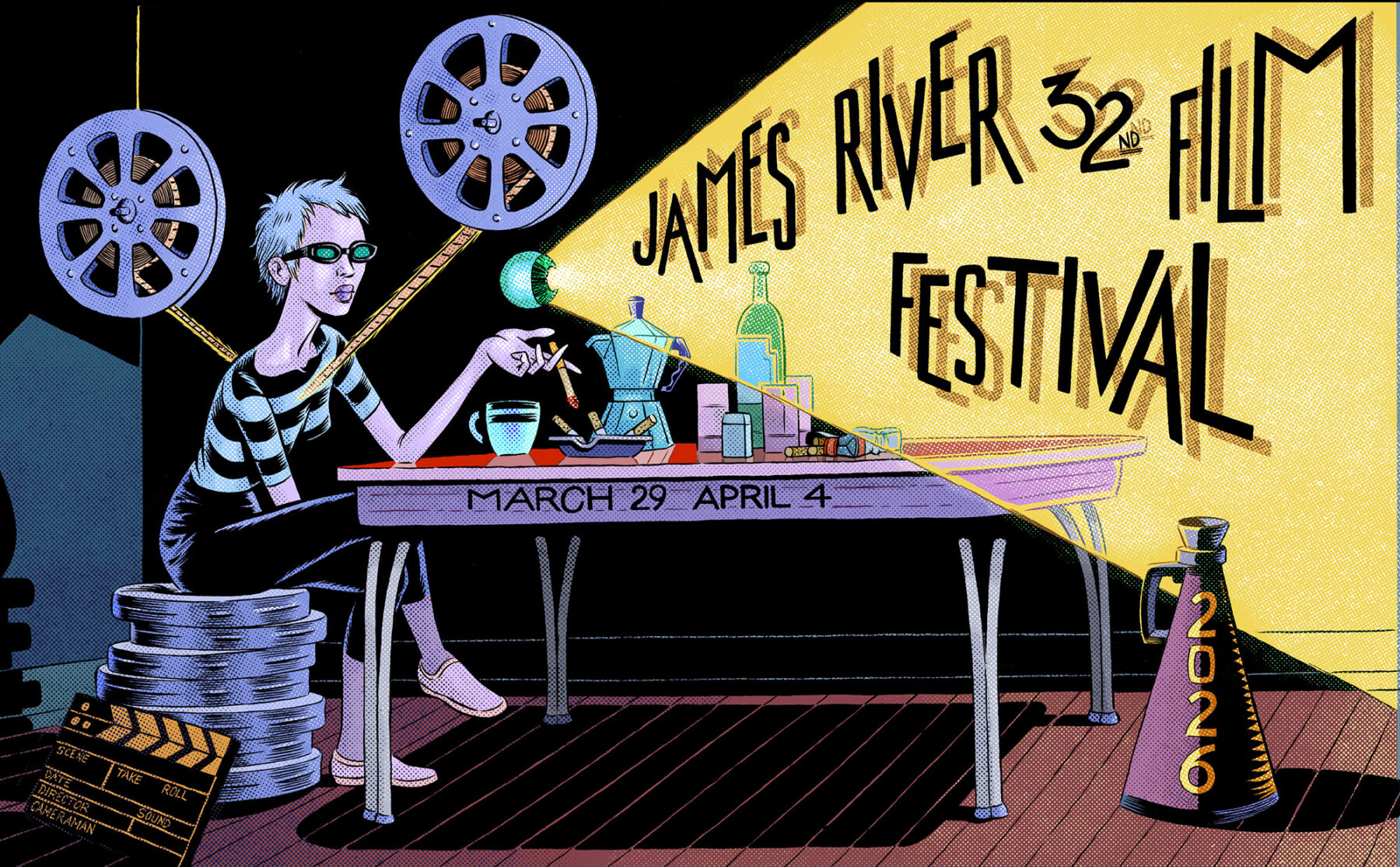
Every spring, I look forward to one of Richmond’s best film traditions, the James River Film Festival. With the mantra “Eclectic Celluloid for the Cinematic Soul,” the James River Film Society curates programs spanning a wide range of subjects and styles. It’s always enlightening, informative, and inspiring. This year, the festival will run from March 29 through April 4. The full program can be found at HERE.
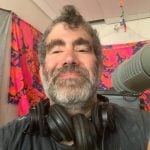
I was able to chat with Richmond film mentor Mike Jones about this year’s lineup.
Trav: How many venues are you in this year?
Mike Jones: This year we’re in four. We’re at the Virginia Museum of Fine Arts, the Grace Street Theater at VCU, Studio Two Three, and the Richmond Public Library.
Trav: And what are some of the highlight events at those locations this year?
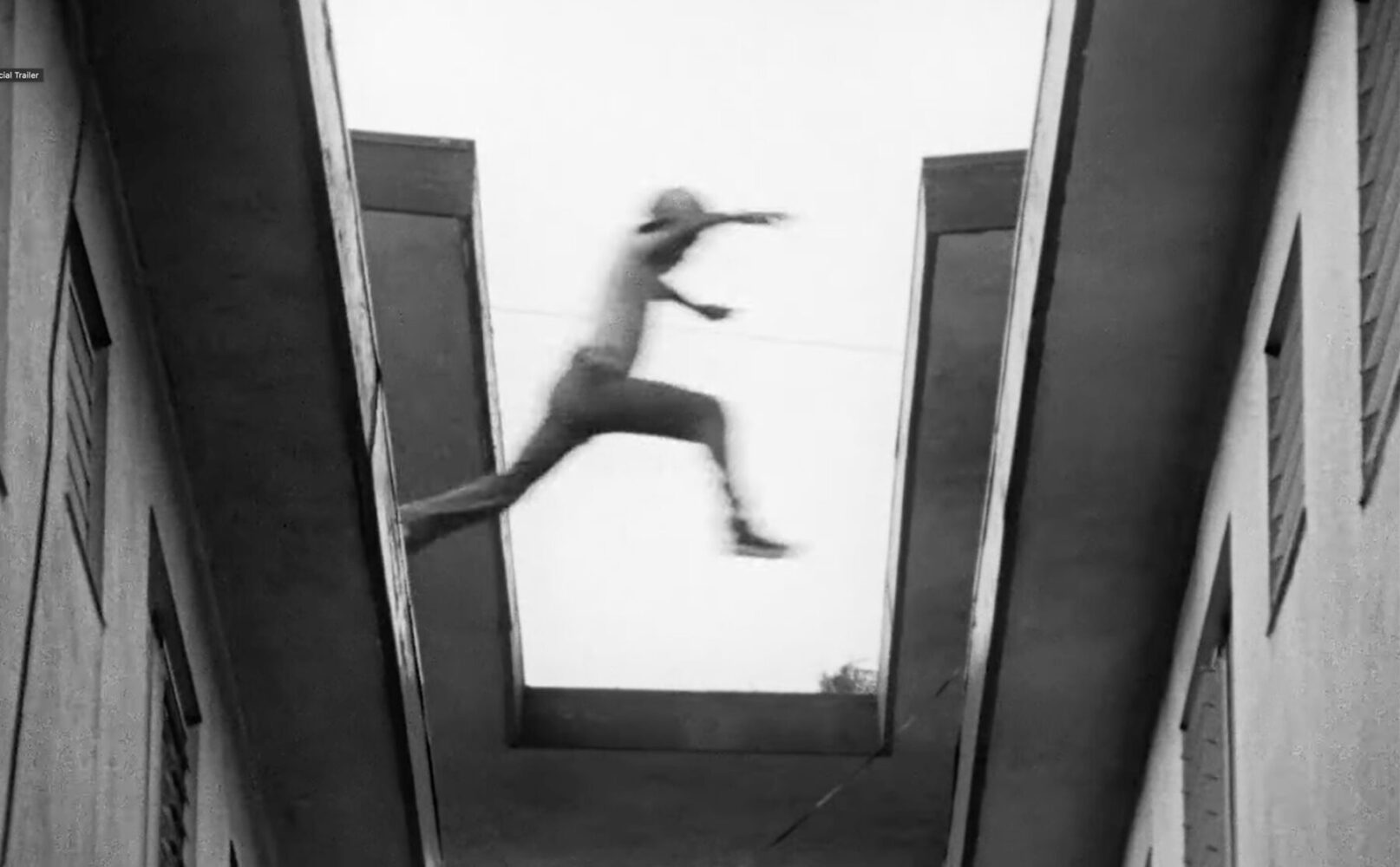
Mike Jones: Sunday at VMFA starts with a showcase of four VCUarts Cinema films produced during the Summer 2025 intensive. Then we’ve got the anniversary celebration of Charles Burnett’s Killer of Sheep, which he started in 1973 and originally released in 1977. He was a festival guest back in ’02 or ’03. Along with Killer of Sheep, we’re also showing a short film on the art of Dewey Crumpler, who was doing art for the Black Panthers and was a teacher of Kehinde Wiley. It’s a short documentary called Post-Atlantic: The Art of Dewey Crumpler.
Trav: That’s great. I first saw Killer of Sheep at JRFF in 2007, paired with one of David Williams’ documentary films, and I’ve since brought it into my teaching. It’s such an incredible film.
Mike Jones: I was telling my class about the first time I saw Killer of Sheep when Charles Burnett was coming. I hadn’t seen the film because it couldn’t be distributed. You had to contact him directly. Either he brought it or he sent it to you. So he sent it to us in advance as a 16mm copy, which we used twice over the years.
I was screening it here in my living room, and the film reels and heads were mislabeled. So I started with reel B, which picked up in the middle. Then I put on the next one, and the title Killer of Sheep came on. That’s when I realized I had been watching it out of order.
But if you think about it, it doesn’t really matter, because there’s not much chronology. Each little incident feels somewhat separate and isolated. I remember telling Charles Burnett about that. I said, “I thought it was weird there were no titles, maybe they had been cut off or something.” He said, “You probably didn’t notice any difference.”
Trav: What is the other major program at VMFA?
Mike Jones: We also have a program called The Magic of Méliès. Georges Méliès was a silent cinema magician, a creator of special effects, and a master. We’re showing several of his shorts along with a live magic act. Magician Dan Dalton will be performing. We’re also showing a slideshow of the Méliès Museum in Paris, which was compiled by James Parish.
Trav: There are some virtual online screenings this year too?
Mike Jones: During the week, we have several free online programs, including filmmaker Kevin McNeer’s documentary Stalin Thought of You and Christopher Holmes’ film The Lost Colony, which was filmed in the Nags Head area of the Outer Banks.
We also have local filmmakers who previously played at Flicker and the James River Filmmakers Forum.
Trav: What are some of the old Flicker and James River Filmmakers Forum showcase films?
Mike Jones: We’ve got about six filmmakers and their short films. Kevin McNeer has one called The Blind Owl. Jere Kittle has three she made for Flicker: The Doorstop, The Best Part of My Morning Commute… & Sometimes My Day, and Walnuts.
I have some films I made that played at Flicker as well, my typewriter film Non Compos Mentis, Les Taches de Souvenir, an homage to the New Wave, and Dead Friends: When Blue Turns Red. Ted Salins’ film The New Friend also played at Flicker long ago.
Paul Turano’s film Footprints in the Snow, a beautiful black-and-white Plus-X film, reminds me of something Joan Strommer would have made. And Wallpapers by Jennifer Scully-Thurston and Jeff Roll. These are all films that were part of the Filmmakers Forum, the James River Shorts Jury Show, or Flicker.
These films, along with the two documentaries Stalin Thought of You and The Lost Colony, will be online for free during those three days of the festival, Monday through Wednesday. They can be found on our website: https://www.jamesriverfilm.org.
Trav: That’s great to have the work of the festival find its way into home screenings now. What is going on at Studio Two Three?
Mike Jones: Thursday, April 2 at Studio Two Three, we’re showing Put Your Soul on Your Hand and Walk, a film by French Iranian filmmaker Sepideh Farsi. She’s communicating with a Palestinian journalist who was in Gaza and couldn’t get out. The whole film is constructed through phone interviews. The subject and her family were killed by a drone strike the day after the film was accepted into the Cannes Film Festival.
Trav: Are there showings projecting 16mm? What’s happening at the Grace Street Theater this year?
Mike Jones: Friday, April 3 at the Grace Street Theater, we’re showing a double feature of Michael Snow’s Wavelength and Stan Brakhage’s Mothlight. Both will screen on film, roughly a 65-minute program. After that, we’re premiering Sasha Waters’ new film Mary Oliver: Saved by the Beauty of the World, about the poet Mary Oliver, with Sasha Waters in attendance.
Trav: What are the weekend screenings?
Mike Jones: On Saturday, April 4, at the Richmond Main Public Library, we’re showing Josef von Sternberg’s last collaboration with Marlene Dietrich, The Devil Is a Woman, which was later remade by Luis Buñuel as That Obscure Object of Desire. It’s originally based on Pierre Louÿs’ novel The Woman and the Puppet.
We’re also showing Steve Segal’s Futuropolis along with some of his short films. We’re really honored to have him there with Tom Campagnoli. Steve came out of VCU’s Communications Arts Department, winning prizes at the Ann Arbor Film Festival and making films independently. He also originated the History of Animated Film course in the Art History Department at VCU, which I currently teach.
Steve handled the camera work, and Phil Trumbo designed the sets. Phil went on to work with Pee-wee’s Playhouse, and Steve did some work with Sesame Street before heading out to California to work for Pixar, where he also taught animation for years. He recently retired and said, “I’m back to doing independent animation.” Those screenings are free as well.
We’ll finish up Saturday night back at Studio Two Three with an interesting juxtaposition of music and film. Starting at 7 p.m., we’re showing Land of Look Behind, a documentary by Alan Greenberg about Jamaica. It originally began as a record of Bob Marley’s funeral but became something broader, a documentary that doesn’t tell you what to think or where to look.
Then at 9 p.m., we’re showing Head, starring the Monkees, along with appearances by Frank Zappa and Annette Funicello. It’s the 1968 Bob Rafelson cult film, written by Jack Nicholson. Rafelson created the Monkees for television, and this film turns into a kind of pop psychedelic satire.
In between those two screenings, we’ll have a set from local band The Wrong Worshippers at 8:30 p.m. They’re a bass-and-drums duo. They make a lot of noise, but they’ve got a sense of humor about it.
Trav: That’s a great set of programming for this year. It’s always such a special collection and timely set of screenings.
Mike Jones: We’ve had different mottos over the years. You’ll remember this one, “Films for the Independent Minded,” and then later, “The Art of Cinema Since ’94.” Lately, we’ve been using “Eclectic Celluloid for the Cinematic Soul.”
But what really sums us up, we were laughing about it, is that we’re the “No Red Carpet Festival.” We don’t roll out the red carpet, even though there have been people and guests who probably deserved it, like Ray Harryhausen and Kelly Reichardt. That’s not what it’s about for us.
We’re really into the nuts and bolts of the art of cinema. Not the glitz and the parties. It’s about the films and the filmmakers.
Trav: It’s a celebration of the work. How can people support the James River Film Society?
Mike Jones: This is our 32nd year, and we’ve had a couple of precarious ones, though we’ve always managed to put together some free programming. If people like what we’re doing, the best way to support us is by buying a ticket, picking up a T-shirt, or making a donation online.
Find more information on the James River Film Festival HERE.
Support RVA Magazine. Support Independent Media in Richmond.
At a time when media ownership is increasingly concentrated among corporations and the wealthy, RVA Magazine has remained one of Richmond’s few independent voices. Since 2005, the magazine has provided grassroots coverage of the city’s artists, musicians, and communities, documenting the culture that defines Richmond beyond the headlines.
But we can’t do this without you. A small donation, even as little as $2, one-time or recurring, helps us continue to produce honest, local coverage free from outside interference. Every dollar makes a difference. Your support keeps us going and keeps RVA’s creative spirit alive. Thank you for standing with independent media. DONATE HERE.
We’ve got merch HERE
Subscribe to the Substack HERE
And Reddit HERE
And YouTube HERE