
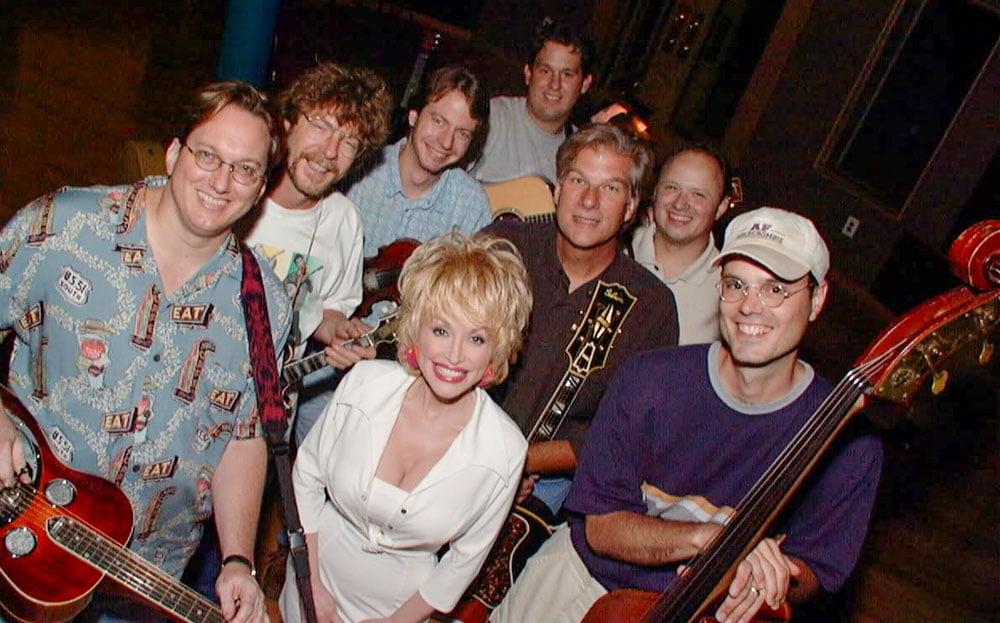
Richmond-raised producer Steve Buckingham has spent more than five decades working with some of music’s biggest names. He talked with us about Dolly, Dionne, Sinéad, Clive Davis, Chet Atkins, James Brown, the record business and a life in music.
Are you a legend if you build legends? Steve Buckingham doesn’t think so, but he is just being modest. There are legends that live out loud, and then there are legends behind the scenes.
Buckingham is a Richmond native raised in Lakeside who produced everyone from Dolly Parton to The Muppets. He was vice president of A&R at Columbia Records and Senior Vice President of Vanguard Records and Sugar Hill Records. He has worked with everyone.
He was a good friend of Dolly, went to all the award shows with her, saw her real hair, met her husband, was there when she lost the Dolly look-alike contest and lost. He has won four Grammys, has 24 gold and 17 platinum records, and has tons and tons of stories to tell, not only about Dolly but about working with music icons like Clive Davis and Dionne Warwick and how the industry has changed since he started out in the ’60s.
I was able to talk to him on the phone and wow, wow, wow, what a legendary voyage he has been on.
S: Hey, are you calling from Richmond? I noticed the 917 number.
C: I used to live in New York for like 20 years. I just moved back to Richmond.
S: Oh, I know the area code very well.
C: Are you in Nashville now?
S: No, no, I retired in 2016. I grew up in Richmond and I moved back to Virginia Beach at the end of 2016, and I still go back to Nashville. Mostly for funerals now.
Dolly used to say, “You’re the only one who could write the real book about me,” and I would say, “Yeah, but we’d all have to be dead first.” That was kind of a joke we had. But here we are.
C: When I looked you up, I was like, man, this guy has worked with everybody. So you’re a legend, you’ve got Grammys, you’ve got platinums, multis, you’ve got multi-golds, but can you walk down the street without people knowing who you are?
S: When I moved here to Virginia Beach and people said, “Oh, you’re famous,” and I said, “No, I’m not famous. I worked with famous people.”
Unless somebody reads liner notes, like we used to do when I was a kid to see who played on what, who produced what, who wrote what. Nobody does that anymore. I’m not famous, but I did work with a lot of famous people.
C: So you started with a band in Richmond?
S: Well, I was born in Columbus, Ohio, but my parents moved to Richmond when I was a child. So I think of Richmond as my hometown. I went to school there, elementary, junior high school, and the University of Richmond.
I started the band when I was at Brooklyn Junior High School. I don’t know what it’s called now. I think it’s a middle school or something. I had a buddy, Ronnie Moody, and it was the night that The Beatles played on the Ed Sullivan Show in ’64, and like 100,000 other guys and girls in the country, I wanted a guitar the next week. And I did, and I stuck with it.
I started talking to Ronnie and said, you know, let’s start a band, like everybody else back in those days. And we did. I remember seeing in a history book the word “centaurs,” and I thought, that’s a cool name. A centaur was half man, half horse.
We had five of us that grew into a big nine- or 10-piece band by the mid and late ’60s, when soul music was so big in the Southeast, which somehow became to be known as beach music, although we didn’t call it that then.
Then I said to Ron, let’s change the name to Ron Moody and the Centaurs, because back then, there were all these Black bands in Richmond. Stacy Henry and the Majestics, Zeke and the Soul Setters, and then down here in Virginia Beach, there was Bill Deal and the Rhondels, who were the band.
C: You worked with the Rhondels?!
S: Yeah, we played with them a lot. William, Bill, you don’t call Bill Deal “Bill.” If you knew him, you called him William. William and I were great friends. I still stay in touch with his widow.
So we had a big nine-piece band, big horn section. Everybody wanted to be like The Temptations or James Brown. Every white band in the Southeast was playing Black music. And we didn’t call it beach music. We called it rhythm and blues or soul music in the ’60s. And we were playing Black music.
Our band got this reputation. We did choreography, we had outfits and everything. And then we caught on as a backup band for Black groups. Back in those days, in the ’60s, most Black artists did not have the money to have their own band. Ray Charles had his band, James Brown had his band. But a lot of those groups used what they called pickup bands, like The Drifters.
There was a big group from Norfolk called The Showmen who were hugely popular in the Southeast, in colleges, and they would just carry maybe a guitar player and then use pickup bands. But we became known as one of the best pickup bands in Southeast Virginia, the Carolinas.
We would do our set with Ron singing lead, but then we would bring on the headliner, whether it was The Drifters or The Impressions or Jackie Wilson, and we would back them up. We would back up the headliners, you know, the Black artists.
So we were playing integrated clubs in the ’60s. If we were playing at colleges, it was usually white colleges or the Black colleges. Occasionally, in the ’60s, it might be integrated dances, but they were pretty rare back then, even though we were playing with Black groups. I was this white kid playing with Black artists in the ’60s when that was kind of taboo.
C: I’m sure there was a lot of aggression. What situations did you have to deal with?
S: There were incidents, of course. There were incidents. You know, stopping in a truck stop at 4 o’clock in the morning to eat, and it was 8 or 9 white guys with 5 Black guys. You know, it raised eyebrows, but we never had any shootouts or anything like that. I mean, there were tense moments at times. We knew enough to know when to get up and leave.
C: Were there times when it was like, okay, y’all stay in here so you’re safe, and we’ll go out to get the food?
S: No, we would go in together. It never was one of those things like, you guys stay on the bus and we’ll go in and get the food. No, we would go in together.
And by the late ’60s, early ’70s, we were still playing this kind of music, but by then, we’d let our hair grow out. And here come these long-haired white guys with Black people. Obviously, it drew attention, but nothing that I want to dwell on. But there were times we just knew, okay, time to leave. But that was a minor thing. We did it because we loved the music. And we loved playing with the artists we played with. My plan was to do that. I stayed in Richmond, went to college, but when we were still in college, we went to Baltimore.
In 1969, we recorded our first record with a fellow who became my lifelong friend in the music business, George Massenburg, who ended up being probably the foremost recording engineer in the world at this point. And he also produced Linda Ronstadt, Emmylou, and Dolly on the Trio album. He engineered Earth, Wind & Fire.
S: He engineered our first record. It was called If I Didn’t Have a Dime. We ended up on Columbia Records. We kind of became local heroes.
But when we did that session, it was on a Sunday in 1969, and everybody went home that night to go back to school or to their job. George said, “I’m going to mix the record tomorrow. You want to stay over?” I didn’t even know what he meant, to mix the record. But I stayed over, went to the studio the next morning, and these guys came walking in with guitar cases and drums on a Monday morning.
I said, “Who are these guys?”
And he said, “They’re studio musicians. They’re probably here to play on somebody’s record or commercial or whatever.”
It’s literally that thing where the light bulb went off over my head, and I’m thinking, it’s Monday morning, all my buddies have gone back to school this morning or back to their jobs this morning, and these guys are coming into the recording studio to play on records all day and get paid for it.
So we mixed the record that day. I literally took a Greyhound bus from Baltimore back to Richmond that night to my parents’ house, called the guys in the band, said, “Come over and listen to the mix.” I put on my tape recorder and played the mix for them 10 times.
Then after everybody left, I told my parents that I’d decided what I wanted to do in life. I wanted to become a studio guitar player.
I grew up in Lakeside, which was a little suburb of Richmond, and in 1969, for some kid to say to his parents, “I want to become a studio musician,” that would be equivalent to saying, “I want to become an astronaut.” You know, except maybe that would be more feasible.
And thank God, my parents said, “All we ask is that you just finish college.”
And I said, “Okay, I will.”
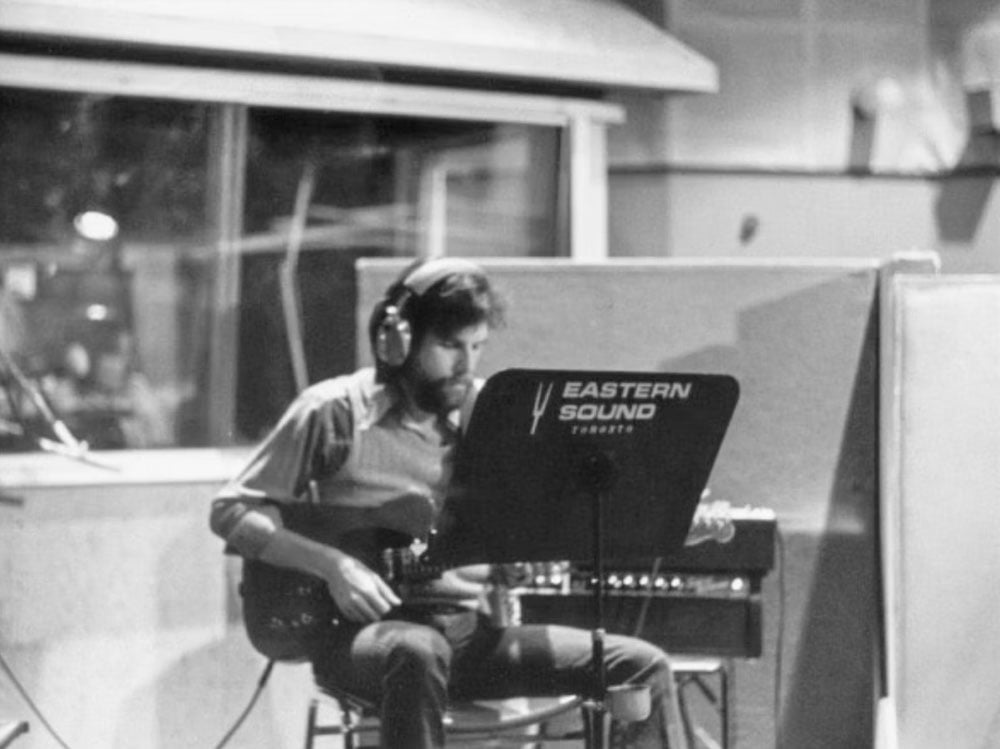
And I did. But as soon as I was finished with college, I was gone. I had already had things lined up to move. I moved to Atlanta, near an area called Muscle Shoals, Alabama, and became a studio guitar player.
C: And so you taught yourself music, right?
S: Mm-hmm. Except for one thing. When I was in my late teens, there was a music store in Richmond named Don Warner Music, owned by a man, oddly enough, named Don Warner. [Laughs]
Don saw something in me, and he hired me. I was always hanging around the guitar store, and he asked me if I would like to start teaching.
I said, “You know, Don, I play okay, but I don’t read.”
He said, “I’ll teach you to read.”
They gave me these books on reading music and music theory and stuff like that. And I used to joke that I’d stay about 3 weeks ahead of my students. You know, I’d look in my book and see what’s coming up in the next 3 weeks. Let me learn that. And then by the time I got to it, I could teach them that, but then I’d have to get ahead of them again.
But I learned music theory because of Don Warner and the books he gave me, and that’s what really gave me a background and the foundation of becoming a studio guitarist.
I first moved to Atlanta and started playing recording sessions in Atlanta in 1973, and Muscle Shoals, which was back then a big recording center for especially Black music. And because of the theory I’d learned, I’d learned to read any kind of charts. And in the South back then they used, well, we still call them number charts.
Are you a musician at all?
C: No.
S: In the South they came up with this thing called the number system in Nashville, and instead of saying the key of C, and then the chord of F, it would be 1, 4. It’s just the scale. So, like, C, D, E, F, G would be 1, 2, 3, 4, 5.
So I immediately picked up on it because Don Warner had given me books on music theory in Richmond. I picked it up immediately and had no problem transitioning into playing number sessions.
Then I got some kind of a reputation, started getting called to do sessions in L.A., in Toronto, and places like that.
And then in 1977, I was working a lot for a producer in Atlanta named Bill Lowery, who was the biggest music man in the Southeast.
He called me one day and he said, “You remember that girl you did some demos with a few months ago, Alicia Bridges? Well, I’d like for you to take her in and cut, as they would say, 2 or 3 sides on her. In other words, 2 or 3 songs. Because she liked the way you led the session that day.”
I wasn’t the producer. I was just the leader of the rhythms.
C: Is that how you transitioned from playing to being a producer?
S: This was it.
C: It wasn’t a goal? It just happened to you?
S: It happened. When I was playing sessions, I was taking over more and more as the session leader, doing the charts, doing the arrangements, kind of getting everything together. You know, doing a lot of the behind-the-scenes. I guess that’s why Alicia went to Bill.
And we were so busy, the studio players, the only time we could cut was on a Sunday. The band was basically 2 or 3 of the guys I knew from Atlanta, and the rest of the guys were from Muscle Shoals, Alabama. And we went in, and literally, on that Sunday morning, the first track we cut was a song called “I Love the Nightlife,” which didn’t get picked up. We didn’t get a deal at first.
C: I wanted to ask you about this song specifically because in an interview I saw, you talked about how you wanted it to feel. You wanted it to feel like New York on a rainy night, wet streets of New York. And that hit me. I was like, when you were describing what you were producing, do you use scenes?
S: I did that day. When we cut the track, Alicia and her partner, Susan, understand, this is 1977 in Atlanta, and Alicia was openly lesbian, as was her partner, Susan Hutcheson, who co-wrote with her. She looked like David Bowie in 1977 and was totally open about it, and that stood out.
She sang very soulfully, and they played me this song they’d written called “Disco Round.” And as we were going over it, I said, “This has nothing to do with disco. It’s more, to me, an Al Green Memphis type of R&B record.”
And I slowed it down, changed some things, and changed the feel. And I said, “You know, the hook, as they say, of the song is not ‘Disco Round.’ The hook is the first line of the chorus, ‘I love the nightlife.’”
So I said, “If it was me, I’d change the title to ‘I Love the Nightlife.’”
And the wet streets of New York thing, we cut it live, and the only thing I overdubbed was a couple of background singers and an alto sax with a fellow named Jay Scott. And I told Jay, I said, “I want this solo to sound like the wet streets of New York.”
And when you listen to the record, you get that wet streets of New York feeling to me. I mean, it came out a year later, and it became a world hit, and that opened a lot of doors for me.
Because of that, I hooked up with, by the grace of God, Clive Davis. He loved the record, and the next thing I know, I go to New York and I’m hooking up with Clive Davis, and I’m producing Melissa Manchester. Before I’m through with that, he’s calling me to produce Dionne Warwick. So that opened up all the doors for me.
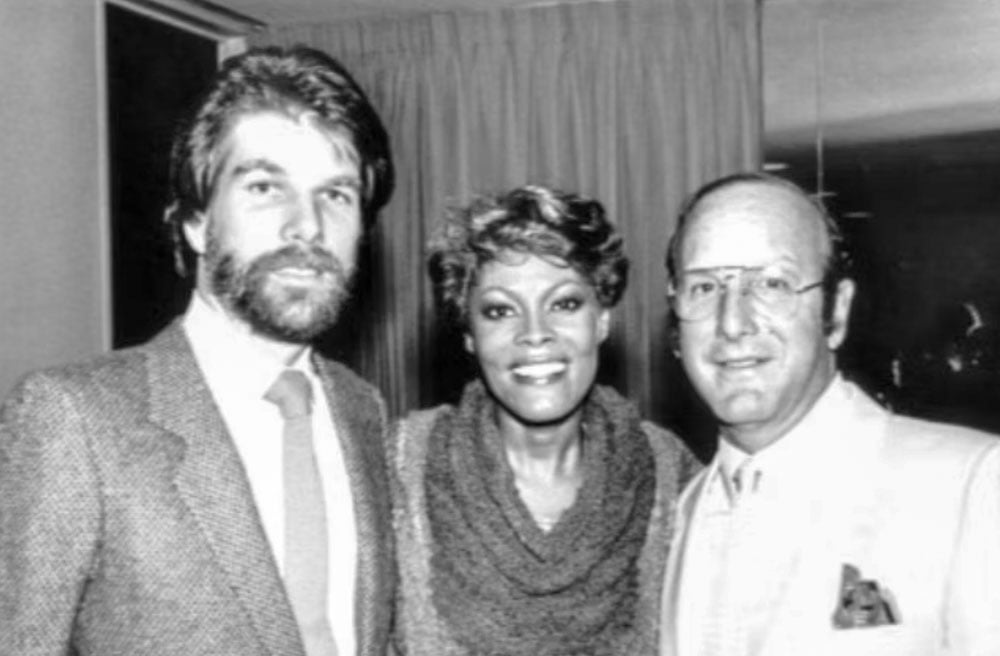
C: How was Clive to work with? Because that’s a groundbreaking genius there.
S: He was great to me. “I Love the Nightlife” didn’t get picked up right away. So I went back to playing sessions, and then about 9 months later, Bill Lowery called me and said Polydor is going to put it out.
And the next thing we know, it’s flying up the charts, and they’re saying, “Get in there and finish the album,” because we didn’t have an album. So we cut the album. We went on tour to promote it. And then we went to Europe. At the end of ’78, it was a world hit.
And I thought when I got back, my phone would be ringing off the hook, and it didn’t.
So I went down to Bill Lowery’s, got a directory of record companies, and just started calling record companies trying to pitch myself. And I guess the first company I called was probably ABC, and got nowhere.
And the second label I called was Arista in New York, and I went through my pitch. “My name is Steve Buckingham. I produced ‘I Love the Nightlife.’” I had my little pitch, and they put me through, miraculously, to the A&R department.
And I went through my pitch again, and this guy said, “Yeah. Clive’s been looking for you.”
And next thing I know, I’m on the phone with Clive. And he told me how much he loved that record, and he said, “The next time you’re in New York, I’d love to meet with you.”
And I said, “Look, Alicia’s nominated for a Grammy. She’s going to open the Grammys. I can come to New York immediately after that.”
Long story short, I did. I mean, literally went from LaGuardia to Clive’s office at Arista with my suitcase and sat there with him for hours. And he played me songs, and he’d say, “Do you think this is a hit?”
C: It must have been so flattering for Clive to want your opinion.
S: I was too green to be nervous or self-conscious. I was just shooting from the hip. He’d ask, “Do you think this is a hit? Why not? Why? Uh, here’s a demo we’ve got cut. What would you do?” It was like taking my college board exams or something.
We got through the meeting and he said, “Find me some hits. You find me some hits and I’ll find you an artist.”
So, at that time, I didn’t have that many connections as far as songwriters were concerned. But I had a couple of friends in Muscle Shoals, a couple of friends in Atlanta. And I got like 5 songs together, sent them to Clive. And as it turns out, he loved whatever it was, 3 of the 5 or 4 of the 6 or whatever it was.
And I found out later that you could send Clive 200 songs and he’d throw them all out. So for him to like 3 of the 5 or 4 of the 6 or whatever was miraculous.
He flew me back to New York. We went through songs and went through songs. And he said, “I’m putting you on a plane tonight to fly you to L.A. to meet with Melissa Manchester tomorrow in L.A. because I want you to produce her next album.”
And that was it. I was on the plane the next day. Melissa was kind of like, “Who is this guy?” And then we became lifelong friends.
The first album became a hit, and before I was even through with that album, I would have to send rough mixes to Clive. I’d have to overnight reel-to-reel tapes to him every night of rough mixes.
And halfway through the album, I got a phone call one day from Clive, and he said, “I want you to produce the next Dionne Warwick album.”
So that opened up all those doors for me. And then I was getting calls from Motown. But I wanted to live somewhere where I had a farm, and I knew if I went to L.A., I couldn’t buy a farm.
So I decided to move to Nashville at the end of 1979, not to get into country music, just because I wanted to be somewhere where there were studios, where I didn’t have to be on the road all the time. And one thing led to another, and by, I guess, osmosis, I got drawn into the country music scene.
C: And so then how did you meet Dolly?
S: Well, that was much later. In 1980, when I got to Nashville, by the end of ’79, I was still producing pop and R&B music. But I was approached by someone named Rick Blackburn, who was the president of CBS Records in Nashville.
When I moved to Nashville, it was like somebody coming from Mars. It doesn’t raise an eyebrow now that somebody from pop music moves to Nashville, but back then…
Rick called me one day and he said, “Have you ever thought about doing country music?”
I said, “Well, I certainly, as a studio musician, have played on a lot of country records. And I certainly know it.”
He said, “Well, who’s on our label who hasn’t had a hit in a while that you think you could cut a hit on?”
And I said, “Let me think about it tonight.”
So I came back the next day and said, “I could cut a hit on Tammy Wynette. She hasn’t had a hit in a while.”
And again, one thing led to another. And the next thing I know, CBS, Columbia and Epic hire me as their director of A&R and staff producer.
And that led to me producing more acts for Columbia and Epic besides Tammy, Ricky Skaggs, Sweethearts of the Rodeo. Eventually got Mary Chapin Carpenter and Ricky Van Shelton.
By that time, the 2 big labels in Nashville were us, CBS, Columbia and Epic, and RCA. Everybody who was not on CBS was basically on RCA, except Loretta Lynn, who was on MCA.
C: I adore Loretta Lynn. Did you hear that album that Jack White produced? I’m sorry to cut you off, but you know when you have an album you can listen to from front to back? Van Lear Rose, it’s great, it’s my front-to-back. Do you have a front-to-back album that you could listen to every single track?
S: Yeah, going back to the early Sinatra albums in the ’50s, which to me were the first concept albums. I tried to make my albums tell a story. Like I used to say, if you put the needle down on side one and then turn it over and play side two, you’ve heard a short story or a small novel type of thing.
S: One thing led to another, and I think it was in the late ’80s. I was moving up the ranks at CBS. We were bought by Sony around, I think, ’89. And for some reason, I get a call one day from Chet Atkins, and he said, “Could you guys use an old guitar player over there?”
I said to him, “Are you saying what I think you’re saying, that you are thinking about coming over here to Columbia?”
And he said, “If you guys will have me.”
I said, “Yeah, I think we could find room for an old guitar player.”
Anyway, Chet came to us at Columbia, then Dolly, then Waylon Jennings, then Willie. And then we just got this influx of all these great artists from RCA, which included Dolly.
In the ’80s, she had gone out to L.A. and tried to cut these pop-type albums, like “Two Doors Down” and “9 to 5.” Those things became successful. But then she was doing these albums that I guess you would call pop albums in L.A. that were not successful.
And she came back to Nashville to cut a country album, and Ricky Skaggs was going to produce it. And ironically, I was producing the next Ricky Skaggs album. I’m in one studio with Ricky producing an album that became known as Kentucky Thunder, which he ended up naming his band. And he’s across the hall producing this album with Dolly, which ended up being called White Limozeen.
And so obviously, you know, we’re back and forth across the hall. I’d be over there talking to them, they’d be over there talking to me. That’s how she and I met around ’89.
Ricky’s album came out, and the first single was called “Lovin’ Only Me,” and it went to number one. Dolly’s album came out, and it did okay. But then a few months later, I got a call from her, and she said, “Can I come in and talk to you about my next album?”
C: So Dolly came to you. I’m loving it.
S: By this time, I was the vice president of A&R at Columbia and their main producer. And she came in and she talked about wanting to do a country album. She wanted to use her own band and produce herself.
She said, “All the bigwigs say I can’t do it. They want me to work with people I don’t care for,” and this, that and the other.
And I said, “Well, for what it’s worth, I’m one of the bigwigs now. And if I can’t trust you to do a country album, who can I trust?”
And she said, “Will you help me?”
I said, “Sure, of course I’ll help you.”
Thinking I would just kind of be a cheerleader. She goes in with her band, she gets her songs. I show up every day or two and wave the banner and say, “You’re doing great,” that type of thing. So I gave it the green light.
And then it was the day of the first session on this album, and I left my office, walked into the studio, and I’d never seen that look of panic in Dolly’s eyes in my life. But that day when I walked in, the look in her eyes was like, “Help.”
It was a disaster because she had her road band trying to make an album, producing it themselves. And I could tell, this is not going to work.
And so during the break, I called her out and I said, “I think you’ve got a great idea, and you certainly got some great songs. But this ain’t the road to be on.”
And she said, “What would you do?”
I said, “I’ve got to bring in some ringers.”
C: So what is the difference between, like, why would a road band not be able to pull it off like a studio?
S: Because everybody who plays in a road band wants to be a studio musician. Basically. That’s it in a nutshell. Everybody who starts out in L.A. or New York or Nashville, you start out, you go there, you try to get a road gig, and then you try to build up to become a studio musician.
C: So not to say that they couldn’t play, but they weren’t as crisp, I guess?
S: Not as crisp, not as good, and mainly not nearly as fast. And so I said, “Yeah, we can make this work. But I’m gonna have to bring in some of my guys.” And so I did.
C: Wow, that must have been hard for Dolly because she’s such a sweet person. I can’t imagine her having to tell these people that they couldn’t be in the studio.
S: I had to do it. And I did not make, to this day, any friends with her road band, most of whom still were playing with her at the end when she was still playing. And I think they always resented me because I replaced them.
The guys who could do it, you know, it was, it’s a difference. There was a studio group in Los Angeles called The Wrecking Crew.
C: I wanted to ask you about that, too.
S: Yeah, I knew all the Wrecking Crew, and I worked with them. They could go in and, in three hours, cut three hit records. When they recorded “Mr. Tambourine Man”, it was the Wrecking Crew. It was Glen Campbell playing the electric 12-string.
C: How did you get involved with them?
S: That’s a whole different story I’ll get into. But it’s a difference between you get the Wrecking Crew to come in and cut three hit records in three hours, or you bring The Byrds in and spend three weeks and get a mediocre track, you know?
Now everybody can do anything they want with their home studio and their Pro Tools and take their time. It’s not like the days when the clock was running and you had eight or 10 musicians watching the clock. I mean, we had to produce quickly. And not just quickly, but it had to be excellent.
C: Because there’s money going down every second that you take.
S: Lots of money back then. And so I brought my guys in and we cut the album.
And Dolly played me a song by her brother Floyd, who’d written a song called “Rockin’ Years”. And she played it for me.
I said, “Damn, that would be a great duet.” And she said, “Who could you hear doing it with me?”
And at that time, I was producing another artist that I had signed, oddly enough, from Virginia, named Ricky Van Shelton. This was in the 1980s, and Ricky had become the biggest artist on Columbia Records. He beat Randy Travis for Male Vocalist of the Year one year. He was that big. Everything was a number one single or a platinum album.
And I said, “Let’s get Ricky Van Shelton. He’s the hottest thing going right now.”
And she actually said, “Do you think he would do the duet with me?”
“I’m pretty sure if I ask Ricky Van Shelton to do a duet with you, he’ll do it.”
C: I love how modest she was.
S: Humble about it. “Do you think he would do it?” And we did.
And I can remember at that time the president of Sony Columbia Records in New York was Tommy Mottola.
C: Oh, famously married to Mariah Carey.
S: Once a year they’d come to Nashville and do their sweep and, you know, check on things. And they called me out of the studio one day and said, “Tommy and the gang are here.”
I was in the studio with Dolly doing this album, and they called me down. And he didn’t want me to do it. He said, “I think you’re wasting your time. You should be working with the younger artists rather than with an older artist who’s over the hill.”
And he was wrong about that.
And I said, “Well, we just cut a song with her and Ricky Van Shelton, and I think it’s a hit. She’s writing great, she’s singing great.”
Jokingly, I said, “You know, and if I’m wrong, when you come down here next year, you can tell me I was wrong.”
And he looked me right in the eye and said, “If you’re wrong, you won’t be here next year.”
C: Oh, I love it.
S: I walked out of there and went back to the studio thinking that if I wasn’t producing every platinum act on the label, I had signed every platinum act on the label, and I thought, if I’m that dispensable, what the fuck.
As soon as I walked into the studio, Dolly took one look at me and called me aside and said, “What happened?” And I told her, and she said, “Well, if they’re that crazy, we’ll start our own label.” Which led to another thing.
C: Well, tell me about the other thing.
S: Long story short, “Rockin’ Years” went to number one and went platinum. So I got ready to do the second album, and I’ll be damned if Mottola didn’t call me the second time and say, “Don’t think lightning will strike twice.”
And it did, with the second album.
C: What was the first album called? What was the second?
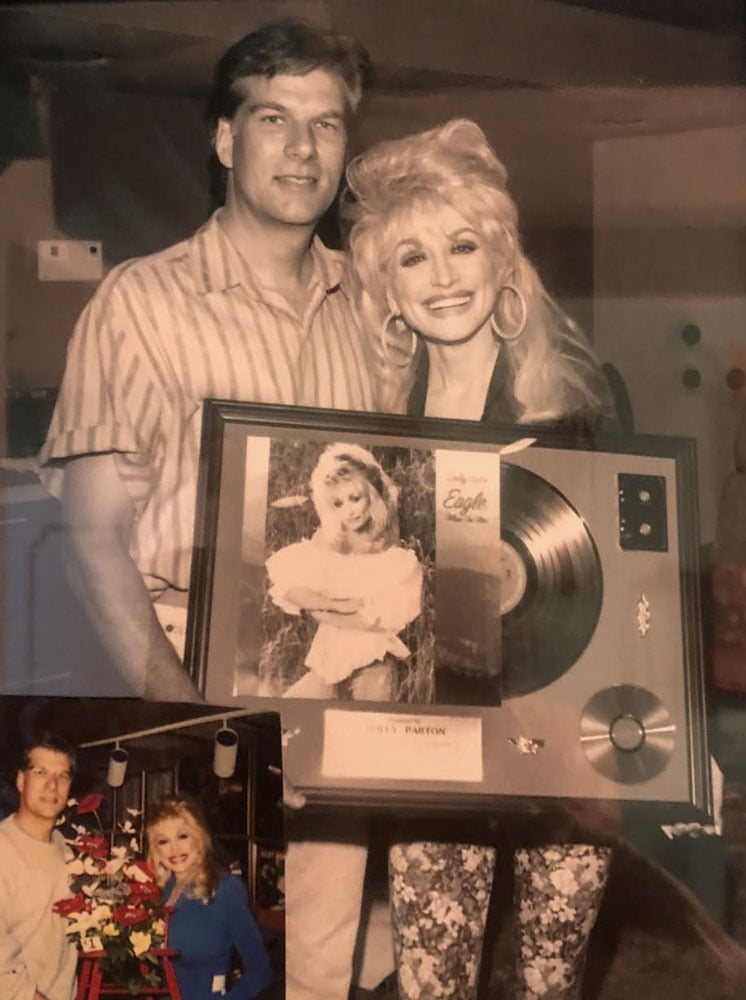
S: The first album was Eagle When She Flies, and the second album was called Slow Dancing with the Moon. And they both went platinum. So then that was it. Dolly and I were solid. And then we just became, not just working partners, we just became great friends. I mean, she loved to get dressed up to go to dinner. And of course, her husband Carl was a notorious recluse. And in fact, in the 40 years I knew her, I only met him twice.
C: I love that, though, for him.
S: He literally would drive her up to Columbia, pull up out front, she would say, “Can you come out and meet me?” Because he wouldn’t even get out of the car. I’d walk her in, reach through the window, shake his hand. He’d come back later, pick her up, and wouldn’t come in. I’ve only met him two times. I even went to their house and never saw him.
He did exist. I know that. That’s how rare I ever saw him.
C: Did you ever see Dolly with her wig off?
S: Oh, of course.
C: Is her hair brown?
S: No, it was like a short version of her kind of wigs. I mean, she had her hair dyed, of course, and stuff like that. But I mean, I’m not going to get into the real color of things like that.
C: Right. I just found it so fascinating that she was able to exist outside of the fame bubble, you know what I mean?
S: She always said, “I’m going to always be photo ready because if somebody sees me for the only time in their life, then I want to look like they think Dolly Parton should look like.” And she did. I know artists who would go out with no makeup, their hair up in curlers and sweatpants. You never saw her like that.
C: But then you got to see the real Dolly.
S: In the house, not in photographs. And she didn’t, like, she said she didn’t want somebody to go home and say, “Oh my God, I saw Dolly Parton at the grocery store and you won’t believe how bad she looks,” or something like that.
“If they only see me one time in their life, I want them to say, ‘Well, she looks exactly like you think she looks.’”
C: Is there any, like, stories? Because she was just so, the way she spoke. She made an impact on people with one-liners, and she was really funny. Is there anything that really resonated, because you guys had a friendship for so long? Anything she said that you always look back on and you’re like, best Dolly advice I ever got?
S: Well, I used to tell her, “If you hadn’t been a great songwriter, if you hadn’t been a great singer, if you hadn’t been a great entertainer, you would have made it as a comedian.”
Because she had the quickest, funniest mind I’ve ever come in contact with. I mean, she had her standard Dolly-isms, like, “It costs a lot to look this cheap.”
But then I saw her come up with stuff, whether it was with Johnny Carson or Leno or wherever, and she could come up with lines off the top of her head that were just as funny as anything I’ve ever heard.
Honest to God, she could have been a comedian because she had a quick, quick, funny mind.
C: What is your favorite Dolly memory?
S: Oh, my God. You know, I’d have to give that one some thought and get back to you because we’re talking about probably thousands of memories. I mean, in every situation you can imagine. I’d have to get back to you on that one.
You know, when she asked me to be her escort to the Kennedy Center, that was a huge deal. I went to every award show you can imagine with her and performed on every award show with her. But when she was inducted into the Kennedy Center Honors with Spielberg and Smokey Robinson and Zubin Mehta and Andrew Lloyd Webber, and she asked me to be her escort that weekend, that was one of the most amazing weekends of my life.
C: Since you’ve seen people develop from, like, you started their careers and worked with them until they were famous, do you think fame changed a lot of people? Like, Dolly would be Dolly and then go home and be normal Dolly. And she was always kind of the same person. But have you seen people that have changed when they got famous and switched personalities?
S: Oh, of course. More often than not.
C: You don’t have to say names. But you can if you can give me some explanation.
S: I won’t give names. But of course, we call it “selective amnesia.” Somebody starts out with nothing, and then they become big, and then suddenly they kind of forget where they came from and who got them there.
I think she’s the opposite of that. Not that way at all. Don’t get me wrong, everybody thinks Dolly was always Dolly. Joking, fun-loving, you know, lighthearted, and that’s Dolly. But you don’t get to be that serious of a songwriter, writing songs with lyrics that deep and thinking that deep, and that deep of a businesswoman, without having an edge.
And believe me, she had an edge. You had to have an edge. She had a strong personality, but she could make it seem light, if that makes any sense.
One of her famous Dolly-isms was, “I look like a woman, but I think like a man.” And that’s the truth.
C: Getting back to Richmond, did Richmond influence your taste with music, like what artists you chose to work with?
S: In the ’60s, Richmond was part of what they called the “Chitlin’ Circuit” in Black music. And the “Chitlin’ Circuit” was where Black artists could play anywhere from New England down through the Southeast. But Richmond was definitely on the circuit.
When I was living there, it was called The Mosque, and then it became the Altria Theater. It was one of the main spots on the old ’60s Chitlin’ Circuit.
I saw James Brown, Otis Redding, you name it, I saw them there. I saw every great Black act. There was Sam Cooke. I was totally immersed in Black music.
And I was exposed to more in Richmond because Richmond had some great Black nightclubs. And I was one of the few white guys my age who would go to Black nightclubs and take a chance. But people realized, “Hey, he’s okay, he loves this music,” and I would sit in and play with Black groups and stuff like that.
So I think the fact that Richmond was a very important part of the “Chitlin’ Circuit,” of the Black music touring back then, especially James Brown, that had a huge impact on me.
When I saw him in ’65, that changed it. I went back and told our band, “We got to change everything. We got to get outfits, we got to add horns, we got to get choreography, we got to get a show.”
James changed my life.
By the time I left Richmond to become a studio guitarist, I studied and practiced and played a lot of different types of music: country music, Black music, pop music. And it prepared me to play sessions.
When you’re playing sessions, you go in one day, you don’t know what you’re going to play on. It could be a gospel session, it could be an R&B session, it could be a country session. You never knew. If you knew who the artist was, you could guess.
You play your charts and you do your part and you move on. And that prepared me to be a producer.
C: Do you still play instruments at all? You don’t produce anymore.
S: I’m looking at probably 25 guitars.
C: So you still fuck around! So is there, like, a song that you worked on that’s, like, your favorite?
S: I’ve produced between 450 to 500 albums, believe it or not. And when they ask me, “Can you narrow it down?” I say yes.
Number one was an album I did with Linda Ronstadt. And it was actually an old friend that I knew in Richmond who taught guitar with me at Don Warner Music. Her name was Ann Allen. She’s now known as Ann Savoy. She’s been in Louisiana for decades. She’s the foremost Cajun music specialist in the country, and she married the foremost Cajun accordion maker in Louisiana.
So Ann and I and Linda Ronstadt did an album in 2005 called Adieu False Heart. And we did it in Louisiana, and that’s my favorite album.
Linda and I have been friends since the old days, and we still talk. Of course, she can’t sing anymore because of her Parkinson’s, but we stay in touch. That’s my favorite album.
My next two albums are my two bluegrass albums with Dolly, The Grass Is Blue and Little Sparrow. They both won Grammys.
Third would probably be a girl named Mindy Smith, independent artist. And I did an album with her called One Moment More.
I did an album with a great Motown artist named Bettye LaVette, a flat-out R&B record that’s called Right in the Middle. That’s one of my top five.
And then there’s a saxophone player, Kirk Whalum, who was Whitney Houston’s musical director. I did an album with Kirk, this kind of pop-jazz album with these great singers and songwriters, and it’s called In This Life.
Those are my top five. Two of them won Grammys, and the other three were nominated for Grammys. They weren’t my biggest sellers, but they’re my favorite albums. Out of 500, they would be the five.
C: Is there anybody that you wish you could have gotten in the studio with that you never could make work?
S: Sam Cooke and Otis Redding.
C: Out of everybody, who was the most inspiring? Like, went in a room, you were like, I’m blown away.
S: You mean I was blown away by the artist I was working with? Never. Because I couldn’t. I couldn’t go there. I couldn’t walk into a room and be blown away. I had to walk into a room and be in charge. It’s a different kind of head. I mean, I certainly walked in and had respect for Dionne Warwick, and I certainly had respect for a lot of people I worked with.
C: I want to talk about Dionne Warwick. What was she like?
S: Well, everybody warned me that she was a diva. We never had a moment’s problem. When we see each other to this day, we still hug and talk about the old days. And she was a total pro. Knew music inside and out. She had actually been a music teacher, so she could hear as well as any musician.
C: It was that same professor’s interview I mentioned earlier where you were talking about her. And she had heard one chord that was, like, slightly off.
S: Michael McDonald had written a song, and it was called “Dedicate This Heart.” And it had dozens of complicated chord changes, and it was fast as hell.
And we’re roaring through this thing. I had the best musicians, as I always did. And right in the middle of the tape, Dionne stopped us and said, “Wait a minute, wait a minute, wait a minute. There’s a wrong chord in there.”
And I had this great guitarist, Larry Byrom, who was one of the top players from Muscle Shoals. And Larry and I had done the chart together.
And as we were walking over to the piano to check the chords, I looked at Larry and I said, “How sure are you of the chart?”
He said, “I’d stake my reputation on it.”
We play back Michael McDonald’s demo and, sure enough, there was one chord that had one note that was a half step off. Instead of being a C, it was a C-sharp in the middle of a chord.
I’m not talking about the entire chord. I’m just talking about one note, one note in that chord that was a half step off. And she was right.
And we all just kind of looked at each other like, okay, you got it.
C: Taken to Dionne Warwick’s class.
S: She has a reputation for being, like, such a diva, but I guess she never had it with me. There were so many artists that they told me, “Oh God, you’re in for it with her.”
Like Sinéad O’Connor. Never had a moment’s problem with her.
C: Oh my God, you worked with Sinéad O’Connor. Tell me about her.
S: I was in Dublin, and everybody was saying, “Oh my God, are you in for it.”
And not only did we hit it off great in Dublin, then when she would come to New York, I always had to find a bar where you were still allowed to smoke in the bar because she was a chain smoker.
C: Oh, what year was this, you think?
S: Early 2000s. You know, I can only think of a couple of artists. One artist that I threw out of the studio, and then one after I threw out of the studio. That’s it.
C: Maybe you’re just very easy to chill with. Maybe it’s your work ethic, and some people just are bossy and other people don’t like it.
S: I think it has to do with if people know that you know what you’re doing and you’ve got people around you that obviously know what they’re doing. And I always surrounded myself with the best engineers, the best musicians, the best songwriters. So there were no chinks in the armor.
I over-prepared as a producer. I spent as much time on pre-production as I did on the actual production in the studio. So when I got in, there were no surprises. But I also left room for improvisation.
That was the main thing. When you have a room full of world-class musicians, I didn’t want to say, “Okay, here’s the chart, play it exactly like this.” I was open to their suggestions. It was a room full of world-class players, and if somebody said, “Hey, what about this?” You listened, right? And more likely than not, you tried it, and we played off of each other that way.
And now people make records, for the most part, in some guy’s room. He sends his part to another guy in another studio, he sends his part to another. It used to be seven, eight or nine of us in one room together. Sometimes I’d come with an entire orchestra together. But those days are pretty much gone.
C: Are there any musicians that you are into now?
S: I’ve always said it, I produced far more female artists than I did male artists.
C: I love that. As a feminist, that was one of the things I liked when I looked at your Wikipedia. I was like, he is here for the ladies.
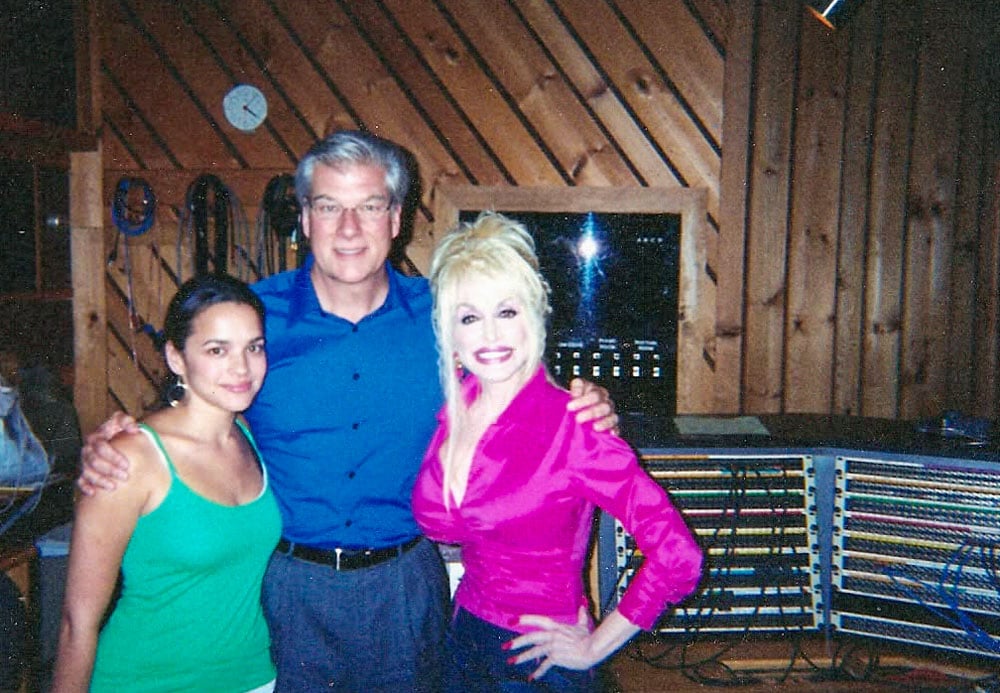
S: The first time I heard Norah Jones, I thought, that’s it, she’s it. And then I ended up working with Norah.
The first time I heard Adele, I said the same thing. She’s the real deal. The first time I heard Billie Eilish, I told my wife, she’s the real deal.
I mean, I can spot them, and they’re out there. And there’s some male artists I feel the same way about. It’s just done so much differently now than the way we used to do it. You’d have a room full of world-class studio musicians, and you did it mostly live. And you would add background vocals or strings or whatever later, but you did most of it all, as we say, off the floor. It’s not done that way so much anymore.
C: Do you think that takes away from the production?
S: It makes it different. I’m not going to say it takes away because obviously people are buying it. But maybe that’s because I don’t think they have a yardstick. The yardstick of excellence is a lot shorter than it used to be.
But it’s the way it is. People are not going to go back to using million-dollar consoles in studios that cost $5,000 a day with musicians that cost $5,000 a day and that type of thing. The budgets aren’t like they used to be.
C: Well, I guess they don’t make the money like they used to either.
S: People talk about, well, but they got 10 million streams. 10 million streams comes down to, we’re talking about 3 or $4,000, where if you sold 10 million albums, we’re talking about tens of millions of dollars.
People are not buying albums, they’re buying tracks. 99 cents, and the songwriters get .0003 cents and, you know, that type of thing. Just the way the business is now.
C: How do you feel about people using AI?
S: I think there’s a lot to AI that even I’m using. I compose cinematic instrumentals and things like that, and I certainly can incorporate AI into what I do. To me, it still needs the human element.
Some of the stuff you can do with it is pretty much beyond belief, and it’s going to get crazier and crazier. But rather than fight it, I hopped on board and said, “Okay, if this is the way it is, and if I want to sit here in my studio and compose cinematic themes, film and stuff like that, I’m going to use it.”
C: I generally feel bad about it because I feel like it’s taking jobs. It’s going to take my job eventually, I’m sure.
S: Don’t sell yourself short. I don’t think if I sat here with an AI generator, it would be coming up with the same questions that you’re coming up with. Because I answer something, and then that triggers something for you to ask me something.
C: I wanted to talk about the class that you taught, “Rhythm and Blues Tore Down the Walls of Segregation”.
S: I think it was Christmas morning, 2006, and I woke up and saw that James Brown had died. I saw James Brown in Richmond at the old Mosque in 1965, and it changed my life.
His band, that 18-piece band, it was like a machine. I mean, I’d never seen anything like that. Nobody had. And everybody wanted to be like that. Every white band and every Black band wanted to be like James Brown back then.
But when I woke up that Christmas morning and saw that James Brown had died, it hit me. And I was working with this young girl who went to Belmont University in Nashville, and she called to wish me Merry Christmas.
And I said, “Well, thank you. But it’s actually a pretty sad day for me because an artist who had a huge impact on my life died.”
She said, “Well, I’ll come by today and cheer you up.”
So I had these videos of James Brown back in the ’60s with his band. When she got there, I put this tape on of James Brown in his prime. And she was a 22-year-old girl sitting there with her jaw dropped. She’d never seen anything like James Brown. The dancing, the 18-piece band. I mean, it was overwhelming.
And she sat there literally with her mouth open. “I didn’t know anything like this ever existed.”
And I said, “Well, you gotta understand, it wasn’t just James Brown back then. It was Jackie Wilson, there was Wilson Pickett, there was Otis Redding. You know, everybody had to be great. But it was also a very rough time because of lynchings and segregation. I can remember the first time I went to see Sam Cooke, they literally had a rope down the middle of the Mosque with white on one side, Black on the other, that type of thing.”
And she looked at me. This girl was no dummy, she was magna cum laude. And she said, “Was that legal?”
And the light bulb went off over my head. And I thought, you know, if I don’t talk about this, who’s gonna talk about it?
That’s how I came up with my idea for “Rhythm and Blues Tore Down the Walls of Segregation.” And I started putting together this course with all this footage and interviews and things. I had artists through the decades, going back to when Benny Goodman integrated his band in the ’30s.
And then I approached the University of Richmond. I was still living in Nashville, but I approached the music department and went up there, presented it, and they brought me up there and I taught it for a semester.
And then Vanderbilt invited me to come there, and I taught there for seven or eight years.
C: And do you still teach?
S: No, I quit that when I moved. I left Nashville at the end of 2016 and moved to Virginia Beach. Unfortunately, now I just go back to Nashville, and this is not a joke, but I go back for funerals.
I was just back a few months ago. Don Schlitz, who was one of my best friends, who wrote “The Gambler” and a bunch of other songs, died suddenly. I was back for his funeral.
Of course, Dolly’s thing was private, but I’ll be going back for some kind of a deal with that. And it’s just the way it is now.
C: Any regrets from anything you did, like, from moving to producing? Do you regret not staying in a band?
S: Oh, no. That was not my goal in life, to stay in a band. As soon as we did that record in ’69, my goal was to be in the record business.
I wanted to push myself. I wanted to play with the best musicians. I wanted to work with the best songwriters, the best artists, the best engineers. I wanted to put myself out there and see if I could hang with them.
And I came along at such a great time. All those legends were still there. Chet Atkins, Owen Bradley, Fred Foster, who worked with Roy Orbison. I mean, all these legends.
And not just legendary producers, legendary songwriters, legendary musicians, legendary artists. They took us under their wing because they could see that we were serious about what we were doing and we were damn good. And so unless you were damn good, you didn’t get your foot in the door.
We were on the tail end of that generation, of the Chet Atkins and people like that, to mentor us and teach us. I guess maybe the mid to late ’90s, it started fading out and started changing dramatically.
I’m not going to put down the way anything is now. It’s just different.
C: Well, you’ve been an amazing conversation. Thank you so much for even taking time to talk to me.
S: I’m just trying to think. You were asking me about Dolly stories. So many funny things.
Like, I remember being with her the first time she saw her plaque in the Country Music Hall of Fame. They let us in alone just to see her plaque for the first time.
I was standing behind her and looked at her looking at her plaque hanging up in the Hall of Fame for the first time. And then I walked over and I said, “What do you think the young Dolly would say to that?”
And she looked at me. “I think she would say she did okay.”
I particularly remember, you know, the way she looked at that plaque. And she had a way of crossing her arms and the way she would cock one foot out to the side. The way she looked at it.
And I was just wondering, what is she thinking? You know, thousands of hours with somebody, you pick up on things. And I was one of the luckiest guys in the world.
C: I’m really sorry for you because you clearly lost a best friend, and I am truly sorry.
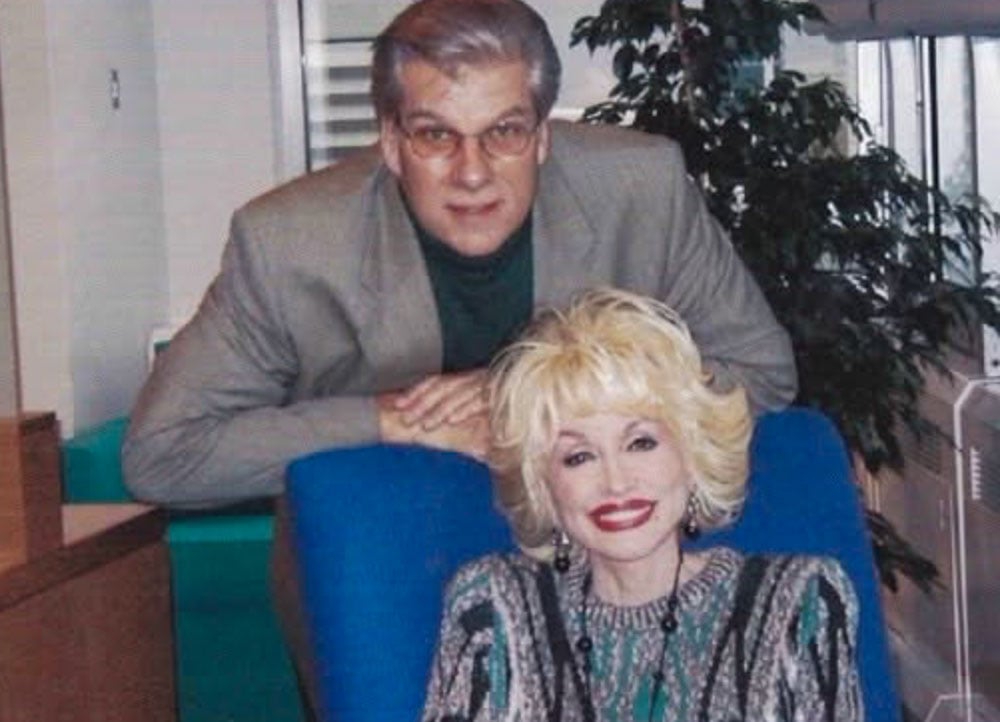
S: I think it was two years ago, she did her 50th anniversary of appearing on the Opry. And she invited us to that.
And then last year, she debuted her Broadway musical, Dolly: A True Original. There’s two different Broadway shows. This one debuted at Belmont University in Nashville, and she invited me to that.
And it was shortly after. And that night I told Carol, my wife, “She looks fragile to me.”
And then it wasn’t long after that that she was booked to do a residency in Vegas this September. And she cancelled it a year ago because of health things.
And I told Carol, “Something is definitely wrong, because Dolly does not cancel something, much less a year ahead of time, unless something is really going on.”
I can remember her telling me one time her childhood friend was Judy Ogle. They grew up together from third grade on. They called each other sis. Wherever you saw Dolly, you saw Judy. She had that copper-colored hair, and they were just best friends. She was her assistant.
But unfortunately, Judy is now an invalid.
But Dolly told me years ago, she said, “Judy and I have a plan that if I ever get really sick, we’ve got a place that she’s going to take me and I’m just going to go there to die and not tell anybody about it.”
I said, “Well, for God’s sake, you gotta let me know what’s going on.”
But that was her way of thinking. She wanted to keep it that quiet. That was years and years ago.
Obviously, Judy is not in any position to take her anywhere this time because Judy’s in bad shape. But that’s pretty much the way she handled this. Even her whole family didn’t know how sick she was.
C: I’m really sorry for your loss. I mean, it hit me, but I can’t imagine how it hit you.
S: I was here that day and by myself. And Carolyn called me, and I hate to say it’s become so common when I get a phone call from Nashville, it’s usually, “Well, you won’t believe who’s died,” type of thing, right?
And Carolyn called and said, “You better sit down for this one.” And when she told me, I just couldn’t believe it. And, you know, life goes on.
And it’s funny, I ain’t even told Carolyn this, but I was going to tell her today that I’ll find myself sometimes wasting time, not doing something all the time, not working on my music or not researching something, you know, doing something constructive.
And it’s almost like Dolly’s in my head saying, “Get your ass in gear.” That’s the way she was. Let’s get our ass in gear and get to work.
And it’s almost like over the past few days, I heard that voice saying, “Get your ass in gear and let’s get to work.” And I don’t know if she’s telling me about writing the book or working on my music or exactly what it is.
C: Well, her meaning will come to you when it comes.
S: I appreciate you having interest in Dolly and in any of this stuff. I don’t know how much I contributed, but I hope I contributed something.
C: Oh, a lot. I loved all of it. Every single second. You made me cry at the end there. Thank you. And you are a legend.
S: No, I worked with legends.
C: No, that makes you a legend because they wouldn’t have become who they became if you didn’t produce them. Don’t sell yourself short.
S: Thank you for saying that.
He called me a couple days later to let me know he had sent the pictures, and we ended up yapping some more. And he did have a couple more Dolly stories to tell me.
S: One time Dolly and I were in L.A. She had a home in Beverly Hills. And they were having a Dolly drag show look-alike contest.
And she said, “Let’s go. Let’s go to that.”
And I asked if she wanted to take security.
And she said, “No.”
Usually when we’re in L.A., we rarely, if ever, used security. If we were in New York or overseas and places, we always had security.
Well, I always carried a pistol, so I told her, “If I have to use it, I’ll be the one going to prison to defend you.”
So we went to this Dolly Parton drag contest. And she got up there and didn’t win.
C: I heard that rumor, but I wasn’t sure if it was true.
S: No, no, it’s true. She did not win.
And one time, they used to have these Halloween parades in West Hollywood. And she said, “We’re gonna, let’s go to that Halloween parade this year.”
This is way back, and she had costumes made for us to go as Sonny and Cher. We had the black wigs and the whole bit. And there she is with the Cher hairdo and the clothes, and I’ve got the Sonny hairdo and the clothes, the damn fur vest and that whole thing. And to look at her, you’d never recognize her, unless if you glanced down and saw those 6-inch heels, you might get a tip.
I thought she was unrecognizable until the first time she said something. And then I heard this girl behind us say, “That’s Dolly Parton in a black wig.” They didn’t recognize her until they heard her voice, and then it was all over and we had to leave.
We took so many trips up and down the Pacific Coast Highway in California, up to San Francisco, down to San Diego. I remember every time we passed Cher’s house in Malibu up on this cliff, Dolly would wave and say, “Hey, Cher!”
C: That’s adorable.
S: We traveled so much together, and not just on business. We would take week-long road trips in Tennessee and on the East Coast, and especially in California. We would take all these informal pictures.
I’ve got this one great one. We were driving along some road one day, and there was an abandoned sofa on the side of the road. And she said, “Stop, stop, stop.”
And she jumped out and laid on the sofa and threw her hand back in just dramatic fashion, and had me take a picture of her.
And then she said, “Now you go sit on the sofa.”
And I went and sat on the sofa and took out a newspaper like I was reading it. And she took a picture of me. And those are the kind of pictures I want to publish and tell the stories behind them.
You know, just how fun she was to go out with and do things like that, or show up in places where people weren’t expecting her and all of a sudden there’s Dolly.
I’ve got hundreds and hundreds of these informal pictures. Some of the few pictures of her without a wig, but never without eye makeup or lipstick. Whatever time of day or night you saw her, she always at least had on the lashes and the eyeliner and stuff.
But we hung out so much together, you know, casual, cookouts and picnics and things like that. And those are the kind of photographs I want to publish and tell the little vignettes behind each one. It’s a side that people have never seen of her.
My wife and I drove down to Wilmington, North Carolina, the day before yesterday to see James Taylor play because I have a lot of friends playing with him. And we went down to visit, and I told him, “You know, I really needed just to get away.”
You know, I’ve been grieving for 2 weeks, and that helped me, getting away for a couple of days and going down to see James Taylor and my old friends, you know.
C: That’s the thing about grief. You don’t know how long it will take hold of you, and it never really stops.
S: When she told me she had a plan that if something ever happens to her, that Judy knows where we’re going to go, my suspicion was always that she’d go back to what she called her Tennessee mountain home, the cabin that she grew up in and restored.
And I thought she’d go there. Judy is incapacitated, so obviously that wasn’t going to happen. That’s the way she wanted it.
Usually when famous people in Nashville die, they always do the big memorial service at the Ryman Auditorium. When Bill Monroe died, you’d go to the memorial service, up on the stage, there’s a stool with Bill Monroe’s white Stetson hat and a stand with his mandolin in it.
When Chet Atkins died, there’s Chet’s guitar up on the stage. It’s like that for everybody. That’s the way they always did it.
She didn’t want any of that. There was no memorial service. It was her family. And that was it.
Like putting her guitar up there, and I can’t imagine they would put a wig on stage, but they, knowing Nashville, they probably would have. I mean, she didn’t want any of that kind of thing.
Now, they’ll probably throw some kind of memorial service for her, but it won’t be under her blessing.
She and I went to a lot of funerals for people. I mean, you name it. We went to Tammy Wynette’s funeral. They had Dolly singing at the private service, and Tammy’s husband was crying and howling, and Dolly couldn’t even finish the song.
And she didn’t want one of those spectacles.
C: Aww. Well, I love talking to you. Get on that book.
S: Also, her upbringing. We went to her cabin that she grew up in. She ended up buying it back from whoever owned it eventually, and then kind of making it into her version of it.
And I remember the first time we went there, and it was like a movie set by then, the way she had it. But she said, “You got to understand, we lived like marmots. We were mountain people. We almost starved.”
I mean, you can’t imagine. They’re in an unheated cabin. I mean, you know, you can’t imagine what they grew up in.
I mean, I had grandparents in North Carolina in the 1950s, and they didn’t have running water, and they didn’t have electricity, and they didn’t have central heat and air or anything like that. And that was the 1950s. And Dolly used to talk about how it could have been the 1850s, and she said it was the same way for them.
She and I talked about that, you know, where they’d lay in the bed in the morning and nobody wanted to get up because the house would be freezing. Literally, if you had water in a bowl in the kitchen, it would be frozen. During the night, the fire would go out. And they just were sleeping like 3 and 4 to a bed.
Well, thanks. I mean, just the fact that you even have an interest in her or any of this impresses me. Her life was like nobody. And I’ve known everybody. I’ve never known anybody like her.
There’ll never be another person like her.
C: Well, hopefully I’ll talk to you sooner rather than later.
I got off the phone with the low-key legend, and I felt like it was one of those six degrees of Kevin Bacon type things. I had talked to a close friend of Dolly. I had answers to questions I had always had. Did she really do the drag show and lose? What did her hair look like? Was she really that fucking nice?
And I also learned so much about a legend that I did not know existed, a legend that made legends.
He better write the book.
Get in touch or learn more stevebuckinghammusic.com
Support RVA Magazine. Support Independent Media in Richmond.
RVA Magazine has remained one of Richmond’s few independent voices. Since 2005, we have provided grassroots coverage of our artists, musicians, and communities, marginalized or otherwise, documenting the city’s culture that lies right under the surface and beyond the headlines.
But we can’t do this without you. A small amount, even as little as $2, one-time or recurring, helps us continue to produce honest, local coverage free from outside interference. Every dollar makes a difference. Your support helps keep us going and keeps the local creative spirit alive. Thank you for standing with independent media, and thank you for reading.
Show your SUPPORT HERE
Also, subscribe to the newsletter HERE
We’ve got merch HERE
Subscribe to the Substack HERE
And Reddit HERE
And YouTube HERE