
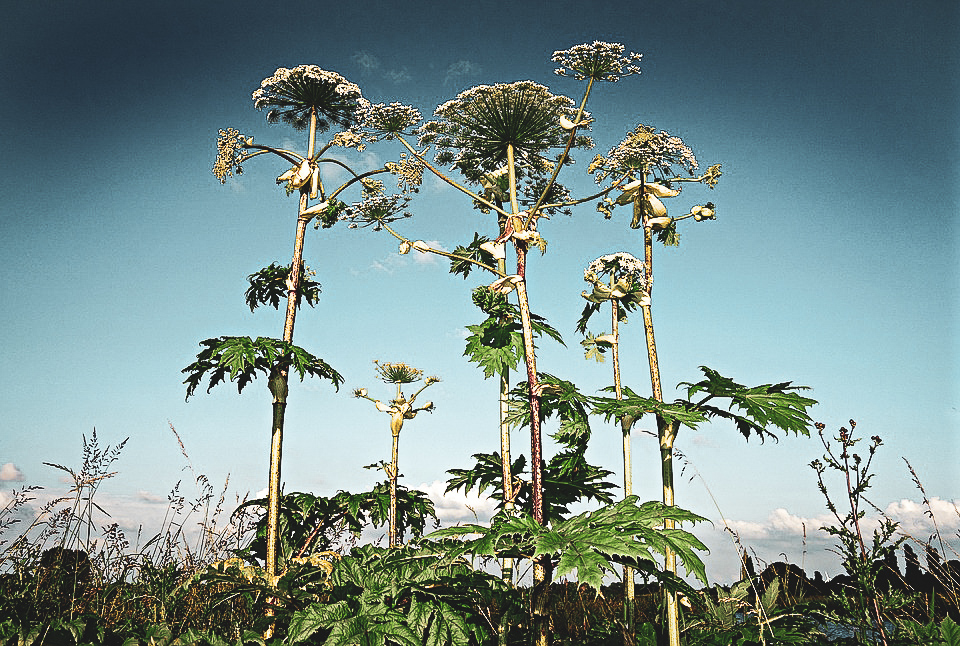
Giant hogweed is the stuff of nightmares. While having a towering stalk which supports a benign looking white flower flanked by crispy green shrubbery, this terror plant actually causes skin burns, phototoxicity, and giant blisters that can last for months if its toxic sap so much as grazes a person’s skin. Among that litany of botanical trepidations, phototoxicity might be the most dreadful; causing the victim to experience potentially severe skin damage when the sap from the plant comes into contact with the UV rays from the sun bringing about blisters and scarring.

Victims of Hogweed’s Phototoxicity
The Department of Environmental Conservation in New York has described this vegetative condition in stark terms: “In brief, the sap prevents your skin from protecting itself from sunlight which leads to a very bad sunburn. Heat and moisture (sweat or dew) can worsen the skin reaction. The phototoxic reaction can begin as soon as 15 minutes after contact, with sensitivity peak between 30 minutes and two hours after contact.”
And now this foliage-based fear-fest has come home to the Commonwealth. According to Virginia’s Department of Agriculture and Consumer Services (VDACS), the giant hogweed also known by its scientific moniker of Heracleum mantegazzianum has been spotted in Clarke County – on the border of West Virginia. The statement claims that this herbage based horror was planted by the homeowner for “ornamental purposes” (how the zombie apocalypse starts). In cooperation with the VDACS, the giant blistering pestilence plant is now being eradicated from the homeowners’ property.
VDACS classifies this weird weed as a Tier 1 “noxious weed”, meaning it has never been seen in the Commonwealth up until now. Originating in the Caucus region of Central Asia, the poltergeist plant can grow up to 15 feet tall with leaves that span up to five feet which blossom flower pods that contain 50-150 rays at a time. The plant was first introduced to Europe in the 19th Century as a form of ornamentation, eventually displacing native plant species and reducing certain wildlife ecosystems – making its way to the US in the early 20th Century. In the UK it has been illegal to grow the plant since 1981.
Should you see this monstrosity of evolution, VDACS advises potential victims to take a “digital photo of the leaf, stem, and flower” and report it to the Virginia Cooperative Extension.
Good luck out there Virginia.