
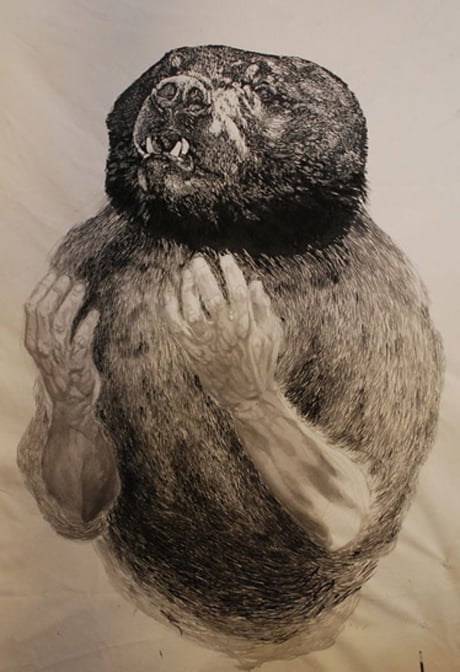
Throughout the history of street art there have been those who give voice to popular sentiment and radical thought, and those who prophesize, who paint a universal Ides of March warning to a societal identity of royalty and entitlement. They pierce the veil of specificity with timeless symbolism and mark the shoulders of our blinded road to destruction with the quiet specters of a conscious undercurrent, personified harbingers that, like highway signs, alert us inarguably to the direction in which we are moving. Gaia is an artist of the latter category, his messages more intuitive than explicit, which makes them difficult to dispute, and more cautionary than accusatory, which makes them hard to resent. There is almost a sense in his wheat-pasted block prints that we are meant to continue upon a dubious trajectory while they watch, unnoticed in the background. That they are deliberately uninvolved, witnessing in solemn testimony to our own ignorance of their silent proclamations our descent into chaos and ruin.
Throughout the history of street art there have been those who give voice to popular sentiment and radical thought, and those who prophesize, who paint a universal Ides of March warning to a societal identity of royalty and entitlement. They pierce the veil of specificity with timeless symbolism and mark the shoulders of our blinded road to destruction with the quiet specters of a conscious undercurrent, personified harbingers that, like highway signs, alert us inarguably to the direction in which we are moving. Gaia is an artist of the latter category, his messages more intuitive than explicit, which makes them difficult to dispute, and more cautionary than accusatory, which makes them hard to resent. There is almost a sense in his wheat-pasted block prints that we are meant to continue upon a dubious trajectory while they watch, unnoticed in the background. That they are deliberately uninvolved, witnessing in solemn testimony to our own ignorance of their silent proclamations our descent into chaos and ruin.
Already a renowned international artist for both his street and gallery work, Gaia, currently in art school, has cultivated an aesthetic voice that blends the esoteric with a stylistically urban sensibility, and geographically relevant nature imagery in a coherent, if mysterious, expression of an underlying, eternal consciousness. His work captures a rising interest in ancient spirituality, and echoes the increasingly prevalent perception that our first world lifestyle is unsustainable. This attunement to the philosophical and perceptual pulse of civilization makes Gaia’s work particularly poignant, and lends itself to the overriding sense that the things he paints have existed long before he began to paint them, like the channeled spirits of paved hallows. It is the voice of a spirituality as deadened by our religious consumerism as the soil that rests beneath the concrete he repurposes as canvas.
Gaia exhibited artistic inclinations early in childhood, but it wasn’t until his senior year of high school that he decided to seriously pursue a career in the arts.
So as a senior in high school I went to Prat pre college, and I realized, I just gotta commit to going to art school. So I started working on my portfolio for the first time, actually genuinely painting and developing a body of work, which was sort of scary because I only had like three months to do it. So I developed that, and around that time I had actually been writing graffiti for a little bit, even though it was fuckin’ horrible.

After posting some of his throw-ups on Myspace, Gaia began cultivating relationships with other artists in the street scene. He met Cheekz who introduced him to the work of artists like Swoon, wheat pasting techniques, and graffiti culture.
I set up a Flickr account because of him, and started doing stickers, which were also horribly whack. And I was putting them up all over the place in Manhattan, uptown. Once I got accepted to art school, for my scholarship portfolio, I sent them my first linoleum block that I did. That was super large, and it was just of a buffalo head, and it was very, I guess, primitive in comparison. It was four years ago. After that I started wheat pasting all over the place.
He hasn’t stopped. The pieces that define his aesthetic signature are still pasted to the walls of sleeping cities, they grow in the corner of the public eye, nocturnal guerilla installments, a solitary rogue artistry that would eventually catch the light of the art world establishment.

It’s pretty lonely endeavor because I didn’t really have anyone else to get up with. But it was actually kinda nice, because I didn’t have to wait for anyone, or have to develop some sort of master plan. I could just go out and do my thing. And the final lead up to college I just got up really hard, and just kept cutting blocks, and basically just cut one every three weeks. I was still pretty slow. That continued for a while, and then I made a last ditch effort before bouncing to art school in Baltimore, and just got up as much as possible in key areas where everyone else gets up, like SoHo, and then I bounced, and that was it. After dipping, I took some time to get up in Baltimore, but everything slowed down. By that time I had established enough of a presence in the city, and there was enough of an infrastructure of galleries, that when I was 18 I started showing. When I was 19 I had my first show ad hoc. And then it was on from there, basically.
Gaia’s emphasis is on the street, but he doesn’t see gallery work as a contradictory undertaking as some graffiti artists do, nor does he see street work as cheap and juvenile, as much of the art world does. Choosing to view the two outlets instead as mutually supportive facets of a more complete expression, harnessing the accessibility of street work and the prestige of the fine art community, Gaia’s portfolio is reasonably balanced between streetlamps and track lighting.
I’ve been working at the Irvine Contemporary, and the director there, Martin Irvine, actually, he’s someone that I really love working with, because his approach to exhibiting street artists, and to people from a greater context throughout art history, is that the street work is an extension of the studio, and not in opposition to studio and gallery practice. And that is something that I really take to heart as well, to see the streets as being a generation of content, and a generation of determined work, and the real place of experimentation. The streets are a place of real freedom, and give the artist full agency. And the only sense in which there is a real wall between the artist and the exhibition of their work is the law. And then the buff is something that silences the work, but it’s a retroactive response to the work, versus stopping it before it happens. There are no curators, or community boards, or landlords, or gallery directors who are saying “This isn’t appropriate. You can’t do this. This isn’t what we want in this space.” That sort of conversation happens through a dialog of action. If the work isn’t appreciated, it disappears. Or someone destroys it. If it is, in fact, it’s preserved. Or at least it’s preserved as much as it can be, as paper can be.

At the same time, with that freedom, I’m also not opposed to presenting work in the gallery, because like I said, I see it as an extension, basically. It’s a place where I can experiment, work with different materials, work with different skills, and then bring it back inside the space. But it has been really difficult for me as of late to really produce work that isn’t boring when the street is absent from that process. And a lot of the gallery work that I do is so referential of the street, it utilizes materials from the street, either with found objects, or torn posters become a part of the composition. The street becomes aesthetisized, which is totally fine, but it does lack something. And that something is that lack of connection between the piece and its location. Basically a lot of the gallery work that I do is a reiteration of the pieces I’ve done on the street. And because a lot of the American work that I do is also super ambiguous, it’s not site generated, but site determined, it’s more just site appropriate. Because of that transience, because of where the work can be applied, it makes sense in a gallery, but at the same time it does have a certain emptiness there. A certain dryness.
This emptiness can perhaps be attributed to Gaia’s artistic identity, and its firm basis in the conceptual medium and inherently sculptural nature of the street. As an artist whose target audience is the general public, the gallery’s restrictive accessibility serves to intellectualize the work, but also alienate the pieces from their larger purpose. It is this larger purpose of imparting a universal truth that gives Gaia his handle, as well.

I chose the name Gaia because it was a confluence of Greek mythology, the Goddess of earth, but also because it’s a James Lovelock theory, it’s called the Gaia Hypothesis, and it’s that our world is one giant living organism, and it’s trying to basically purge us, because we’ve become this con-urbonic massive overgrowth, we’re basically this giant virus, and the earth is trying to get rid of us by heating itself. So there’s two avenues. It began with environmental consciousness, and then went down this formal route, but it was always sort of pointed and guided by the notion that practices of globalization, and the world we live in today are unsustainable. So the work was generated from a formal desire to actually just make beautiful work on the street, and became spaces with an aesthetic of decay and neglect, so it was an attempt to reactivate space, but also existing space that it would continue to live in, versus getting buffed or getting torn down immediately. So over the years I’ve been trying to steer in a political direction, but [make it] simultaneously beautiful and accessible. I don’t want to make one line of work, I’m not interested in political graffiti. So I’m creating these sort of mythological creatures that are these quiet messengers expressing the end of the world, or that the path that we’re on is a dangerous trajectory. So recently I’ve been, naturally as an extension of working on the streets, doing a lot of research about the architectural industry, especially in Baltimore, and making generated work about the industry of segregation and the infrastructure in Baltimore. But that’s taken four years to finally get to this place.
This emphasis on well-researched regional relevance is another element of Gaia’s work that sets him apart from many of his contemporaries. The auratic merit of any public art is a major contributor to its appeal, but Gaia elaborates upon the environmental specificity inherent to street art by incorporating traditional aspects of local culture. While working in a residency in Seoul, South Korea, he adapted his style to an aesthetic language accessible to the local population.
The intention was to go out there and do five major, huge wheat paste posters, each one around 20×15 feet. And I’d do one every week. But because of time constraints I left one, I couldn’t finish the last one. So I did four. And they were associated with Obang, certain directional energy values of Korea, you know, East, West, North, South. And each has its associated color, and associated meaning and significance. So I used that as a structural project for placing work in that city. So instead of just finding spots and getting up, it was more more that I had to go to a neighborhood that really fit in that directional navigation, and make it work for that place, for that site. It was really nice.
The collective American conscious is a bit more elusive. We are symbolically illiterate, largely detached from the traditional spirituality of both our land, and our ancestry. We are skimming a cultural emptiness on a thin layer of obsessive consumerism. Our identity has essentially become a shallow facade. And yet there are still certain forms that appeal to something in our subconscious that has not forgotten the language of nature, that is not completely ignorant to the esoteric language of existence.
It’s a visual strategy and it’s also a theme I’ve been pursuing, as the work has maturated, the visual strategy being the more symbolism that I can utilize and express, it makes the work more complicated, but it warrants for a return. It’s not immediately accessible, it’s a little ambiguous and unclear. It is basically formal work, not the immediate message of political work, so by chancing upon it numerous times, or just spending time with it before it disappears, it becomes something that has deeper meaning to it, and it allows for further investigation.
But also to utilize ancient mythology that is still sort of unlocatable [sic], like I don’t reference much of any other mythology besides Christian motifs, but the whole purpose I think is that I feel like my generation, growing up in a very secular world, with capitalism and being relatively autonomous, we’re a whole host of entrepreneurs that reach a certain socio-economic status that I come from, it’s a very individually oriented generation. But [they’re] also simultaneously aware that the world around them is ending, and that they’ve been left with quite a project to fix. But there’s a certain lack, or vacuum of spirituality that haunts my generation. Growing up without that root, I feel like there’s a real searching process that goes on within all of us. We’re always trying to find some sort of meaning or identity. And I think spirituality plays a large part of that. And so the attempt has been to develop a sort of North American spirituality, where the only animals that I really utilize when I’m doing work in American cities are mostly domesticated animals, like pigs, roosters, cows, various birds. But I keep it very North American. A North American mythology of manifest destiny, or frontiering the west, whatever very shallow history that this nation has, and then combining that with more esoteric symbolism to give it a larger context. A lot of the pieces I was doing in the past were very much oriented around expressions of power dynamics, utilizing domesticated animals, obviously the hierarchy between animals and man, and animals that we have essentially repurposed for the necessities of man. And also they were just very austere, imposing figures, either hunting, or they seemed like they were in a very didactic sort of strong posture. So it’s a reinvestigation of North American spirituality and Christian ethics.

As I’ve gone to other nations, it’s been a lot easier for me to generate street work that speaks to the population, because, take Korea for example, they have such a deep, rich history, and such an identity, and also they’re constantly being challenged by either, currently, globalization challenging their traditional Korean values, or just Japanese colonization, and contending with communism and Chinese invasion. It’s always been really contentious, but they have a really deep mythology, awareness of symbols, and the construction of their identity. So going there, it was super easy to produce work that actually spoke to the people that traveled the streets every day and would encounter the work. And coming back to America, especially New York City, it’s always difficult for me to produce something very specific to the people that are encountering it.
Whether addressing the people of Korea or New York, there is a common message of the impending, an overriding sense that something urgent and vitally important lies just beneath the surface of the pulsing metropolis. Part of the reason for this quality of truthfulness is that his work does not claim to have solutions to the problems it indicates, which allows for it to retain its legitimacy despite its inherent paradox: his work warns of the unsustainable excess of consumerist culture, and yet he relies on the art market, a particularly insidious facet of the modern economy, in order to subsist as a professional artist.
I’m just trying to develop a portrait of that contention, of that personal frustration, because I don’t want to provide an answer, I’m not a scientist, I’m not a real business man, an entrepreneur, the street artist could be seen as the ultimate artistic brand, because not only are they showing in galleries, but they’re also promoting themselves on the street. And of course the people who buy their work are also finance, and it’s all so connected, and everything is so inseparable from one another. And I just want to produce a portrait out of that frustration, or out of that idealism, but I can’t at this point in my life really provide an alternative way of being. I’m not confident in my own faculties to be like “this is the way we have to go. This is the route we have to take.”
And it seems to be working for him. Perhaps it is the role of the current generation not to provide alternatives, but to state emphatically, creatively, and with enumerable voices and methodologies the inarguable need to change the way we live, and the way we perceive the world around us. If so, Gaia’s fulfilling his part in that role quite successfully, with plans in the works for upcoming show Street Studio 2.0 with such famous artists as Shepard Fairey, Swoon, Chris Mendoza, Rostarr, and David Ellis, a few corporate commissions, and shows in Europe, he appears to have touched on something of universal profundity. And he makes it look damn good.
gaiastreetart.com