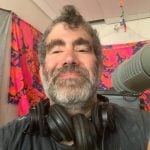

This question and answer session with Robert Beatty was conducted after the presentation of his experimental animation showcase at the Byrd Theater during the 2nd Richmond Animation Festival on Sunday night back in April. Filmmaker Dash Shaw moderated the event while fielding questions from the audience, which are also included in this transcript. It has been condensed and clarified for this format.

ed. note: Robert Beatty (born 1981) is an American artist and musician based in Lexington, Kentucky. Known for his noise band Hair Police and solo project Three Legged Race, Beatty gained prominence for designing album covers for artists like Tame Impala, Kesha, and The Weeknd. Born on a rural Kentucky farm, Beatty’s self-taught artistry was influenced by MTV’s Liquid Television and Mad magazine. Despite never attending art school, his “psychedelic” and “trippy” graphic design style, primarily using Adobe Illustrator and Photoshop, has become highly sought after. Beatty also engages in fashion design, concert posters, and music videos, working with notable clients like Wired and The New York Times.
Dash Shaw: Your work looked fantastic on this big Byrd screen, and, in this context, it made me realize how much like early experimental animation your work is.
Robert Beatty: Yeah, I would say that it’s like 75% of where I’m drawing from, early Norman McLaren, John and James Whitney and all of the experimental films from the ‘50’s and ‘60’s. That I mean basically invented motion graphics more or less.
DS: I was thinking about all the people doing sort of animated Wassily Kandinsky, like Oskar–?
RB: Oskar Fischinger. Yeah. Like the visual thing, the visual music,
DS: It’s about the absolute right abstract shape paired with a sound.

RB: That’s a lot of what I’m doing. Just playing with shapes, form, color, repetition and rhythm. Things that feel like taking something very simple and making it into something a little more complex. That’s one of my favorite things to do.
DS: Do you think because you’re also a musician, it gives you an advantage in finding the right shape or color for a particular sound?
RB: I definitely feel like, especially with that last one, there’s a reason I left that where there’s no music on, because those are all kinds of loops that I’ve made as experiments over the past few years. When I watch them, it’s not necessarily like synesthesia, but you can imagine what the loops would sound like in the way they’re repeating. So I feel like there’s that aspect of what I do. Obviously a lot of it is with music, that is either music videos with other people’s music or where I’m making visuals and then making music for it. So I definitely think about having some sort of aural world that I’m bringing to what I’m doing. Having that be the basis for a lot of this stuff makes the interplay between the shapes feel kind of musical.
DS: I’d love it if you walked us through one? I have a favorite… I know you got a few rock ones in there… The spinning rock one where it’s half one rock and a half of another?
RB: That’s a music video for a friend of mine. Christina Vantzou is a really incredible, ambient composer. So that one kind of relates to the one towards the end, the concrete forms that are floating across. Those are both very similar and use a motion control slider for the camera and mixing several passes of the same scene with different lighting or different treatments applied to them. All of that work is very much inspired by ancient artifacts. I took a trip in 2019 and went to Stonehenge and all these stone circles in England and then also went to Mesa Verde in Colorado, Native American cliff dwellings.
DS: It’s like finding a book that has photos of rocks.
RB: All of this stuff I’m trying to convey some sort of level of “you’re not there”. You’re like one step removed from what’s happening on the screen. Even down to playing with the framing. A lot of the stuff I am doing is kind of boring and made that way to make you notice the frame. And the way things are interacting with each other because when things repeat, you get a chance to lose yourself in them a little bit. I want it to feel like something that wasn’t made, I want it to feel like something that somebody found. I’m treating the stuff that I shoot myself and things that I make like found footage where it’s kind of this transmission from some other place.

DS: I really want to know the steps for that one, like did she send you a track?
RB: That was like a long process, because we had tons of phone conversations just talking about things we liked over the span of two years. Talking about “have you seen this thing?” And we would share images back and forth.
DS: She didn’t have a track yet?
RB: She let me choose from the album that she was working on. That was a discussion between us and finding common ground of what we were interested in. And then developing this language between the two of us that felt appropriate for the music.
DS: She liked rocks too?
RB: Oh yeah. A lot of the way I work is like I’m terrible at planning things out. I just start making stuff even with my illustration or album covers or whatever. I really consider a lot of the work I do collage. Because so much of what I’m doing is making things and then sorting through the pile that I have. In the end shooting tons of footage and making animations, then doing things over the top of that. Once I have everything they gel together.
DS: The animations with the color forms over it, how are they made?
RB: Those are processed versions of some of the stuff that’s actually in the background.
DS: Meaning it starts as a photo?
RB: Yeah, it starts as video and then I’m processing that stuff through different, you know, kinds of processes.
DS: I don’t really know. (Laughs) The only way I understand it is that it’s similar to photocopying something over and over.
RB: Another thing I’m trying to do is emulate these analog processes in a computer. I do everything in the most basic crude way I can. All of the animation is done in Photoshop, I don’t use After Effects. I edit in a Sony program, Vegas, that is weird and ancient. It’s cool that you say photocopies because there was a lot of art made back when photocopiers first existed where people would photocopy the same thing over and over until it just turned into noise and deteriorated. That’s something you can see in a lot of these videos. I’m trying to do that same thing, but in Photoshop with frame by frame processes.
DS: Like running an action over and over?
RB: Yeah that’s how I’m doing it, where it just kind of destroys the image, it’s like incremental changes. So then that’s compiled into an image sequence that then is edited over top of video or thrown together with a bunch of other stuff.
DS: How do you edit things if it is the same action over and over? What is the editing stage of it? How are those shapes put on top of a live action video?
RB: It’s like a weird kind of boring thing to talk about.
DS: Say it quickly. (laughs)
RB: A lot of the stuff I’m doing is emulating optical printing. I love the sixties and seventies television graphics, Saul Bass’s title sequences for Alfred Hitchcock movies. That’s all very saturated where the colors kind of interfere with each other. Like a color would be over the top of another it makes a new color.
DS: I feel like that comes from Bass being a book designer for many years.
RB: It’s definitely me applying graphic design kind of stuff to the video animation world for sure.

DS: I’d love it if you talked about doing this in Lexington, Kentucky.
RB: I am extremely lucky to be able to do what I do and make a living from it. For over ten years now, I’ve been living off of my art and I’m in a place where people don’t think of the music industry or anybody that would do illustrations for The New York Times or whatever. A lot of the way that I’ve been able to make that work and get to this point over the years is really because I toured playing weird music for years and met a lot of people. And those people saw my art and asked me to do album covers for them. It just kind of snowballed from there. And it’s turned into this thing where especially with the Internet, you get one thing and people see it and it just perpetuates itself forever, you know? Like for me, probably the Tame Impala album cover, I did that and people see that. They’re like, “I want to know who did that, where is this person?” And there is some novelty when people find out I’m in Kentucky they think I’m some weird dude that lives on a farm or something. There’s a little bit of a mystery there.

DS: Is there some inspiration in the place itself?
RB: For sure. A lot of what I’m doing is inspired by nature and the world around me. So that definitely plays in there to some extent. And just like the people there I love, it’s a great place, there’s a great community. It’s not like a super vibrant art scene or anything, but there’s enough people doing cool stuff that are informing each other and I love it there.
DS: Please give us all some type tips?
RB: Like Fonts? There’s a website called Fonts in Use that’s a good starting point for somebody that doesn’t know anything about type. You can go there and it has examples from the beginning of graphic design and typography where you can see things and figure out what you like. I’m kind of obsessive about that stuff and have collected typography books since I was in high school. So I’m definitely like a font nerd in the worst way possible.
DS: For the Kramers Ergot 8 cover, did the font come before the shape?
RB: The font that’s on there is used on a lot of stuff that I’m drawing from a ‘70’s Sci Fi paperback kind of vibe. You see a font in one context and it kind of means something and then you see it in another context. A good example is the font that’s on the Tame Impala cover. People call that the Casio font or the Radiohead font or the Police font because it is what is on the side of police cars and says police, but it’s also the Tame Impala font, it’s the font Microgramma. But it’s like this weird thing where I’ve had people criticize me using that font because it’s associated with the police, which I’m not trying to do. But, it’s also the Casio Font and it’s on a lot of ’70’s appliances, you know? So it’s like this weird thing where the same thing can represent all these different things. It’s all about the context of how you use it.
DS: It kind of feels like a ’70’s computer instruction manual. Like old commercials, it’s the hope, the utopian vision, of what computers will bring.
RB: A lot of the work I love is early experimental films that were made by Lillian Schwartz and Stan Vanderbeek at Bell Labs very early on the first computer animation. It’s very crude and psychedelic and chaotic, and there is a lot of that like ’60’s ’70’s counterculture stuff that there’s this utopian approach to things that definitely did not happen, it collapsed. And I love that, I think the hippie movement turning into the ’80’s, like New Age, easy listening thing is one of the greatest ways to sum up America.
DS: I feel that there’s an irony to it now, because now we know what the internet did.
RB: Yeah for sure. And the Whole Earth catalog lifestyle was the start, they all went on to do stuff in Silicon Valley and being heavily involved in all of that stuff that has made our world so messed up.

DS: So there’s maybe some sincerity and some irony mixed together.
RB: I love all that stuff, but I love the way it represents the failure of all of those people and how they thought they were going to change the world and they did change the world, but not in the way they were hoping.
AUDIENCE: You use digital tools to try and replicate analog tools, do you ever try to work directly with analog tools?
RB: Some of the earlier stuff, I collect and have a ton of old cameras and tube televisions and weird video mixers. So some of the earlier videos that are included in this are using that technology. I’ve never really worked with film, which is something I would love to do, but I feel I already do too much. So learning how to use a 16 millimeter camera and shoot on film and do that feels like a thing. I’m happy doing it digitally and making it feel like it’s film. I use anything and everything that’s available to me. I’m pretty thrifty about what I use, up until recently using a computer that was a PC that was 15 years old, still running Windows 7 until like a year ago. That’s a big part of it that plays into my art to use that kind of scavenger mentality and work with what you have rather than trying to find the best tool. It’s more about how you approach things and the way you think about things and the way you make sense of what you’re actually using.
AUDIENCE: Howdy So I just wanted to mention that I also worked with WRFL and Radio Free Lexington.
RB: I always say that I cut my teeth making posters for shows that 15 people were at for five years, and that’s how I learned anything about graphic design was working at that radio station. So, good to hear!
AUDIENCE: Regarding your noise music stuff, how did you working in that zone inform your mindset now?
RB: It’s a huge part of how I’ve been able to have any success I think is the kind of DIY mentality that came out of that. We were doing things completely on our own without a record label or a booking agent or anything. We made all of our own artwork and that was how I started making album covers. With noise music, it’s not necessarily that you’re making something that’s like this abrasive, weird thing. It’s more just like anything can be music and I think when you start to create something, I think that’s a good way to think about it. It’s like you can approach this as a very formalized, “this is what art is and I’m going to make art” kind of approach. Or you can just be like, “I don’t know what this is, and I’m going to try and figure it out as I go”. And that’s still the way I work. Very experimental taking things apart and finding out how they work and developing processes that kind of are built from the ground up. And I think that definitely comes from my music that people don’t like that much. (Laughs)
AUDIENCE: So you’re talking a little bit about sort of deferred utopias and the loss of a lot of hope from the Sci Fi of the 20th century. That being a bit of your influence and I know that your animations follow music, but the music isn’t linear. It doesn’t tell a linear story, at least from my impression. Was there any connection between those two?
RB: You mean like they kind of like that idea of this whole thing collapsing in the way it kind of relates to time based media? Is that what you’re saying, like things that happen in a linear way?
AUDIENCE: The animation and the music together, they don’t create linear stories for me. And so I’m wondering if you have something that is supposed to be a linear story, which is human progress?
RB: I don’t know that anyone seeing this stuff without me saying that would take that away from it. But it’s definitely there in some way. I mean you can probably tell from what you just saw that I’m not really interested in telling a story. What I’m doing is more based on relationships between these images and the way they can transform from one to another and interact with each other. I don’t think I’ll ever make a narrative character based movie. I mean don’t hold me to that, who knows what could happen. I definitely don’t consider myself a storyteller.
AUDIENCE: A lot of your work celebrates the texture and kind of artifacts that come with early technology. So I was wondering if there’s any current hallmarks of technology that you find interesting or give you that same sensation?
RB: A lot of stuff I’m doing is inspired by old advertising. And it’s strange to see the way this has been happening for a very long time where basically everything is becoming commodified because of TikTok and Instagram now. It’s like everything feels like a commercial. It’s kind of repulsive in a way where it’s like you open this thing and your friends are talking about what they did, but it feels like they’re trying to sell themselves to you. And that’s a weird thing that I’m actually working on a lot of new stuff that’s informed by that, playing with that idea. Technology moves so fast these days and everything comes so quickly turned into a product that it’s kind of hard to even evaluate what something means before it’s already been chewed up and spit out. It’s happening with all the AI stuff now. I found that stuff interesting when it first started, and now it’s just been shoved down your throat because it’s moving so fast that it is kind of just turning into this slick grotesque, alternate reality kind of thing, which is very dystopian.

AUDIENCE: What do you feel like makes a good album cover? And do you think at all about the finished product during the creative process?
RB: What makes a good album cover? Having a weird half of a troll, that’s one of my more iconic ones. I think basically something that obviously you want something that is somewhat representative of the music and the themes of what’s going on. More than anything you want something that you can remember, something that when you see it and you’re like, “this is this belongs with this”. The way I usually approach things is trying to make something that feels like, I mean, iconic is an overused word, but something that feels literally like an icon that belongs with this music. That’s kind of the best you can hope for. And I don’t think that everything I do is successful in that way. But some of them I feel stood the test of time and people are still talking about later. I made a lot of album covers of over probably almost 300 at this point. So it’s like it can’t all be good. (Laughs)
AUDIENCE: Do you ever develop your own Fonts? And if so, like, do your process for developing Fonts?
RB: I’ve never made an entire font from the ground up like that I’ve turned into something that somebody else could use. But I definitely do a lot of my own kind of type design for, for logos and stuff for what the project is and how it’s going to be incorporated. A lot of times I will kind of try and figure out an approach that is appropriate for whatever I’m doing it for. I obsessively gather up references, making a whole folder of images that I feel like relates to whatever I’m working on. That I can look back to, to kind of help move things along. Looking at other art and I’m trying not to copy it too hard.
AUDIENCE: You said that your visuals influence the music and vice versa. Would you say that one way is more difficult than the other?
RB: Generally, if it’s something I’m making entirely on my own or I’m doing the music and the visuals, I tend to start with music. Not all of these are done that way, but I think that’s a nice way to have a basis that already has rhythms and textures in it that you can build on top of. That’s generally the way I’d like to work. And sometimes I make the visuals first and the music second.
AUDIENCE: I’ve never seen any of these animations before, so that was really cool. One thing that stood out to me is the sense of video resolution versus the illustrations. The illustrations are very finely detailed and then the animations have sort of like these big chunky details, it’s not necessarily taking advantage of HD resolution. It’s very filmic in that way. Is that something that you were thinking about?
RB: Part of it is I was making things at standard definition for a very long time when everyone else had moved on to HD. So a lot of those early videos I’m doing everything in 4:3 aspect ratio, so it’s not widescreen. So that is a byproduct of the processes, that’s my default way of working. It’s kind of this low resolution lo-fi approach to things. Anytime I have to make something in 4k I usually just make it standard and scale it up.
AUDIENCE: How long did it take to build a visual language? Do you have embarrassing work to talk about from a long time ago?
RB: All the fliers I made for the radio station when I was starting out, I was looking back on some of that stuff. Maybe because I was making things in a relative vacuum and this was very early Internet. So a lot of this stuff wasn’t being seen by anyone outside of Lexington. I started working and doing album covers and posters probably around like 2000 in 2001. And I didn’t really have any sort of success or real notoriety until probably like 2013, 2014. That’s almost 15 years of doing stuff and not really worrying about who was seeing it or how it was being received, figuring out what I wanted to be doing. And I think that’s a huge thing that is kind of missing today is that everybody just starts making stuff and it immediately ends up on the Internet and everybody sees it and it kind of becomes this thing. So you’re just immediately an artist in the world. I think it takes some time and gestation to figure out why you’re even doing or how you even approach figuring out your voice. I wish more people would take their time with things.
DS: I’ve had this thought, too, but I think that everyone has had embarrassing work.
RB: Yeah, It definitely levels the playing field
DS: Everyone will have an embarrassing instagram.
RB: Instagram will probably not exist in like 6 to 10 years so it won’t be there. Just being able to make stuff and I wasn’t making stuff because somebody was paying me to make it. It wasn’t my job. I was working construction jobs and janitor jobs. And I never thought I would make a career out of my art, so it wasn’t even a consideration.
DS: Did you go to art school?
RB: No, I didn’t go to college. I graduated high school and got a job as a janitor at a truck stop and toured with noise bands. So that’s what you got to do, don’t go to college. (Laughs)
DS: One last question. Do we have a really good one?
AUDIENCE: You probably get asked a lot of the same questions so apologies in advance, but I think it’s really interesting that you live in Kentucky. There’s a lot of designers and animators living in the big hubs like New York and L.A. Do you have a daily routine like taking a walk in the woods to start the day?
RB: Yeah, I mean, get up and make coffee. Hang out in my backyard with my two tiny dogs and, you know, start making stuff. That’s kind of where I am these days. I think the pace of life in Kentucky has definitely informed my work and I think patience is a thing that informs things a lot. And people have a lack of these days, you know, do work and slow down. And that’s definitely something that Kentucky helps.
DS: This has been totally awesome. What a great night. And we’d love it if you all came next year, April 2025. Please follow the Richmond Animation Fest Instagram for updates.
All photos by Todd Raviotta