
Editor’s Note: This piece was written by a student at Randolph-Macon College as part of a feature writing course. Thank you to the students and to Professor Seth Clabough, Ph.D., for organizing the project.
Where there was once a forest full of life and hidden history, now sits a grey brick of concrete, pumping out steam from its belly, shadowing the field of Fords below. The Earth is changing, and it’s changing fast.
Pandemics, global warming, and AI are just a handful of the shifts shoved into Gen Z’s hands. With a world where everything is reliant on the internet and the constantly connected devices glued to our hands, some are finding reprieve from technology offline.
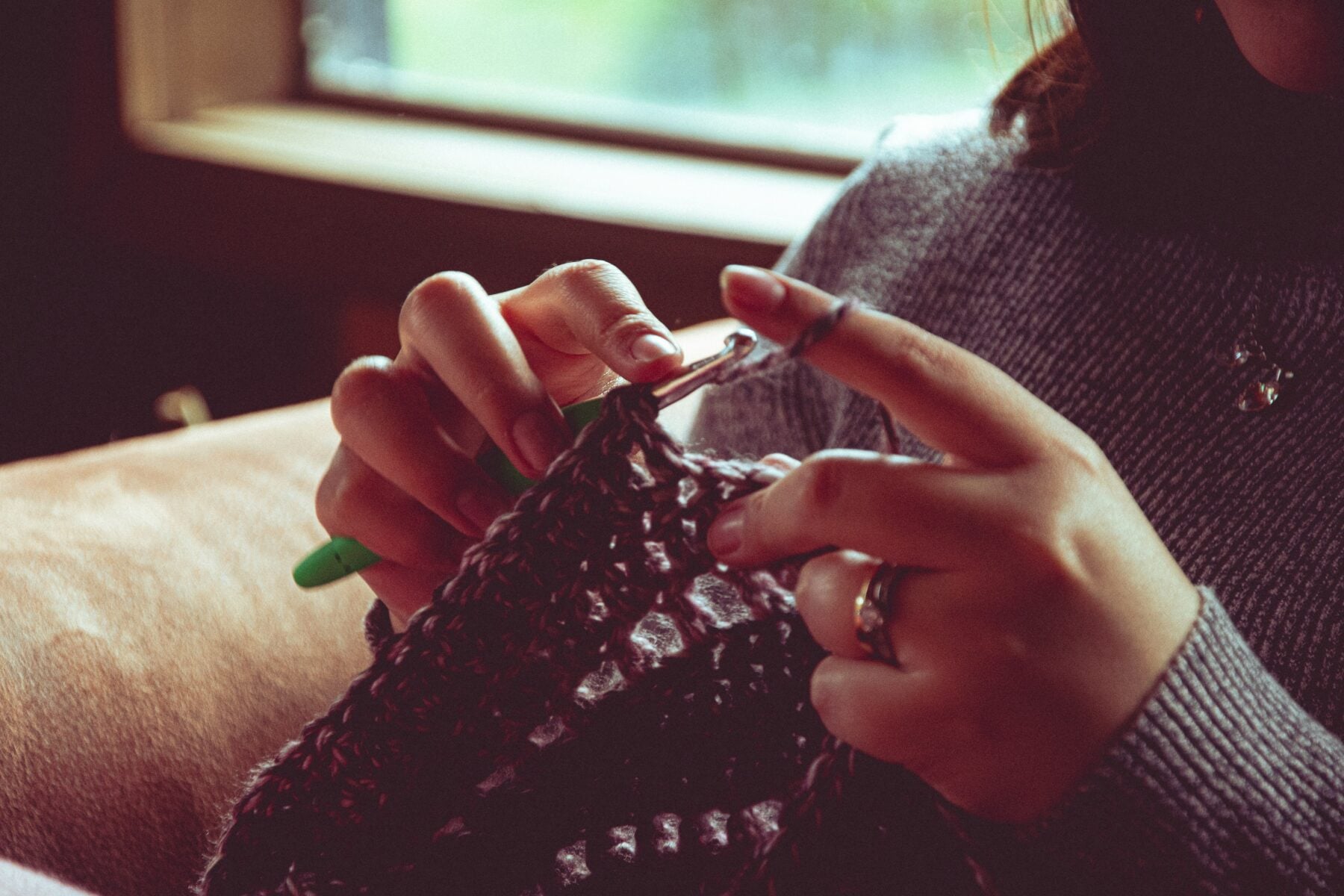
When knitting and crochet come to mind, the image of your grandma and her friends gabbing to each other, their hands whittling away at a new scarf or sweater for you, might pop up. But today, you may find that craft store yarn aisles look closer to a college campus than a living facility.
Foundation Chain
“I know a lot of people that look at me doing it, and they’ll be both fascinated, but they’re also wondering, what is this twenty-one-year-old doing?” said Lindsey Martz, who began to crochet only a couple of months ago.
Offline hobbies seem to be on the rise among young people, spurred on by movements to leave social media or limit its presence in their lives. On TikTok, there is a growing subculture of new and returning readers, taking time that would be used for scrolling the internet and using it to read instead. Along with readers, many other crafts are gaining popularity online, including fiber art.
“I feel like I am seeing an uptick in Gen Z at large,” said Tsahai Barthelmy, who is a member of the Society of Crocheters and Knitters at Randolph-Macon College. “There is a rise in creative handmade hobbies.”
But even though handicrafts are growing, stereotypes still haunt them.
“After I started crocheting, I think I had a birthday card that was like, ‘Happy Birthday Grandma!’” Barthelmy laughed.
Getting Offline
Social media has spurred the creation of a plethora of new terms that refer to its addictive quality, like doom-scrolling, brain rot, and chronically online. All of these point to the mind-numbing capabilities algorithms curated to our tastes have caused.
With the increase in handmade hobbies, Gen Z crafters have found some benefits in knitting and crocheting for themselves.
“I find, sometimes, online can just be really draining,” Martz said. Once you get the hang of crocheting and understand the stitches, you can still turn your mind off a bit, but you’re being productive in the meantime. “My mindset going into it was to find this relaxing thing that’s not doom-scrolling on my phone.”
“It’s a hobby that doesn’t require a lot of energy output,” said Bella Shover, who was taught to knit by her grandma. “It’s something that you can do mindlessly while you watch a movie or show, so you can kind of tune out the world.”
Mindless scrolling on social media provides a similar boost in endorphins, but it doesn’t give you something hands-on to show at the end of it.
Crochet and knit are a source of stress relief for many Gen Z, who find themselves having to confront unprecedented and turbulent times.
“It was the stress relief that became really special to me,” said Martz.
Hand vs. Sword
Mechanization began with the invention of machines that wove fabric quicker, which ultimately took the power of production out of the home and into factories. Today, there are a plethora of machines that can knit, but there are currently none that can crochet.
While there are a few crochet pieces you may find in a department store, they are products of a grueling fast-fashion industry that overworks and underpays their crocheters.
“If you’re doing hourly and then add your skills and materials on top of that, a sweater could easily be like $200,” Barthelmy said.
With a world that’s speeding up, these crafters are slowing it down and taking their time to make each and everything they crochet and knit. It’s a resistance against the machine.
“I think machine knitting takes away from the value of working with your hands,” Shover said. “I think a future of machine crochet would bring the same thing. A lack of originality and the diminishing of hands-on working.”
Like Mother, Like Daughter
In the winter, stores are full of knitwear. Sweaters line every shelf as people brace for snow. But if knits can be mass-produced, why bother spending the time to make something when you can buy it?
For many young fiber artists, it’s the connection it brings them. Passing down the tradition of knitting and crochet is a practice that’s lasted for centuries. Grandma passes it down to her daughter, who passes it down to you, weaving your histories and lives together with the string.
“It was the quality time with my mom,” said Martz. “I feel like it’s created a better connection with her.”
While the push for steel, commodification, and over-consumption is great, this craft that has spanned centuries, tying each generation to the next, battles against it one stitch at a time.
Main photo by David Vilches
Support RVA Magazine. Support Independent Media in Richmond.
At a time when media ownership is increasingly concentrated among corporations and the wealthy, RVA Magazine has remained one of Richmond’s few independent voices. Since 2005, the magazine has provided grassroots coverage of the city’s artists, musicians, and communities, documenting the culture that defines Richmond beyond the headlines.
But we can’t do this without you. A small donation, even as little as $2, one-time or recurring, helps us continue to produce honest, local coverage free from outside interference. Every dollar makes a difference. Your support keeps us going and keeps RVA’s creative spirit alive. Thank you for standing with independent media. DONATE HERE.
We’ve got merch HERE
Subscribe to the Substack HERE
And Reddit HERE
And YouTube HERE