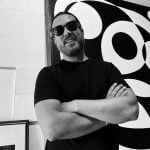
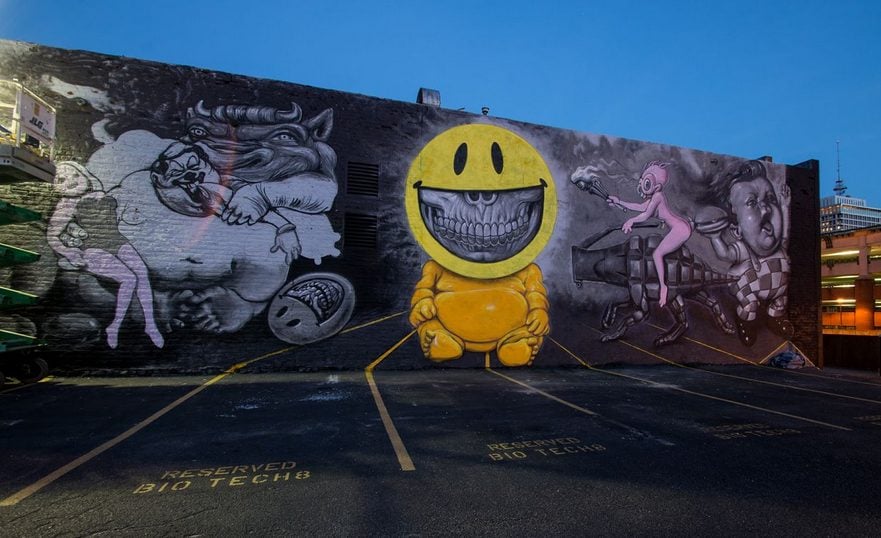
When Ron English, often called the godfather of street art, came to Richmond this summer for the Richmond Mural Project, we knew the stories would be as crazy as his murals. Our published interview captured some of his sharpest insights, but it barely scratched the surface.
English has a way of turning every memory into a parable, every anecdote into a challenge. From hijacking billboards to reimagining Picasso, he has spent decades bending pop culture to his will and reshaping how the public sees art in everyday spaces.
In our full conversation, he gave us far more than we could fit on the page. Here are some of the stories too wild, and too good, not to share.
The Abraham Obama Tour
We went to San Francisco, L.A., Colorado Springs, then Denver, and Seattle. We put the image up everywhere.
And you were playing with the band in each location too?
No. We did a show with the band in Colorado Springs, and it actually kind of ruined it. The guy who was the editor on the movie POPaganda said, “I want to make a movie about this.” It was contained—six weeks on the road—and Obama was either going to get elected or he wasn’t. He thought it was something he could tackle.
So he made a documentary, Abraham Obama, about the whole thing. We weren’t able to sell it. The only person who wanted to buy it was at Showtime. The buyer told us, “This is a really important moment in history. It’s unprecedented that these street artists came together to support a candidate. Not a single artist supported McCain, and it may have been the tipping point in the election. It’s an important moment. But the problem I have with the film is that all the women are either not there—or they’re naked.”
What happened was Yosi Sergant put on a big show in Denver. It was the culmination—we had been on tour, and we landed there. The lineup was street artists, and the only major female street artist at the time was Swoon. They couldn’t get her, so they booked Maya, who hadn’t yet developed the style that later made her famous. She was pissed off. She felt like, “They only got me because they couldn’t get Swoon.”
So she was mad that the artists featured in the show, and most of the people we met on the streets during the tour, were men. Then the guy in my band said, “We want to throw you a party in Colorado Springs.” To show off how hip they were—because, you know, that’s the epicenter of Christianity, right?
Colorado Springs? I didn’t know that.
Yeah. That’s where all the big mega-churches are based. Colorado Springs is where they have their headquarters. I think he desperately wanted me to see that they had a very small hipster population—that they were way more hip, more fun, more crazy than people might expect.
So this guy painted all these women as characters, but they were nude—rabbits, cowgirls, that kind of thing.
So another artist painted your campaign?
Right, right. It was a surprise for me, like when they threw me the party. But then he included that in the movie, and that pretty much killed the sale of the film.
Teenage home movies
I saw an interesting video of you from the ’70s going around a grocery store. It looked like you were hanging out with your friends.
Yeah, we used to make movies.
Are you still in touch with any of those guys?
The main guy died two years ago. We actually saw him a couple of months before he passed, but he never went to college. Basically, if you turn 50 and you’re a laborer, you’re a dead man. His back completely gave out—he couldn’t work anymore. He took meds for his back, drank a six-pack, and started hemorrhaging internally.
Even when we talked to him, we knew his life was at a dead end. There was nowhere else to go.
Did you have a sense you were going to be an artist? Or did you even know you were going to be an artist back then?
I didn’t know what an artist was. There weren’t really artists in Illinois. But yeah, I wanted to be one—I just didn’t know how to do that.
The movies were fun. You can see I was making fake products and putting them in the supermarket when I was 15 years old. I really haven’t changed much.
The chaos from that film back then—it just seemed like you kept going with it.
It actually got seriously bad when I moved to Texas and started making movies again. I began using these speed freaks in the films, and they did some crazy fucking shit.
I went down to this park where they all hung out. You know how it is—you get fucked up and do the craziest stuff, but it’s always in the middle of the night. Back then, the camera equipment couldn’t handle filming in low light.
So I thought: What if we flip the schedule? What if we get up in the morning, start drinking beer, shoot speed, and see who can do the craziest thing in daylight?
A bunch of them showed up. One guy jumped through a plate-glass window. Another jumped out of a speeding car. One even set himself on fire at the mall.
In the end, one of the guys caught fire really badly and had to spend a month in the hospital. And to top it off, somebody stole that movie—so I don’t even have it anymore.
And that’s when you stopped doing those?
Right. And I actually stayed in touch with him forever. He’s the only one still alive from that whole group—the guy who caught on fire.
He went to the hospital, and of course they gave him morphine. There’s no worse pain than being burned. They have to scrub the skin off your legs—it’s horrible. But he told them he’d been doing speed—he was high as a kite—so they cut him off the morphine. Because you can’t have morphine when you’re on another drug, he had to endure the most searing pain imaginable without any medication.
When he got out of the hospital, he never went back to meth. He joined me in college and became one of the first computer guys, and he’s been very successful ever since. All the other kids from that movie are dead. I felt horrible about what happened, but he feels like it saved him. It shocked him, and he turned his life around.
Back in the early ’90s he came to live with us for a while, and as a gift he wrote me a computer virus. If you typed “Andy Warhol” on your computer, the screen would show “Andy Warhol.” But if you emailed it to someone, it would change to “Ron English,” because it had the same number of characters.
It became one of the top ten viruses in the world and was called The Plagiarist. He rewrote it three different times, competing with the people trying to shut it down. It was nerds versus nerds—and many of them were fans of his work. He’s super smart.
I was nervous because there was a computer virus with my name on it, and I don’t even know how to plug in a computer. But it was a benevolent virus—that’s all it did.
That’s almost like culture jamming in a way.
Yeah, that was like his take on culture jamming. He wanted to go to Wall Street and he said we could sit in a car and could hack people’s computers without even going in their room. He was super good at it, and I was just too scared to do shit like that.
Talk show appearances. I saw an old video clip and wasn’t sure if it was real. I should’ve written the name down—you were on with a girlfriend, and she was talking about your lifestyle.
That was my wife, Tarssa Yazdani. We did a whole lot of those shows. I used to watch TV all day while I painted, and cable had just exploded. There were four or five stations, then suddenly two hundred. They needed content—cheap content—and figured out talk shows. It was the cheapest kind of show to make.
They shot them in New Jersey, sent a bus to New York, and filled the audience with whoever they could find—sometimes homeless people. The audience was free, so it cost nothing. I started thinking, wouldn’t it be a good way to promote my career if I went on these shows? But what I figured out was it couldn’t just be about art. It had to have some kind of sexual angle.
So the first one we did, my wife called up and said, “My husband’s an artist, and I support him, but he does a lot of paintings of nudes. I have a professional job, and I don’t think it’s very professional to come home and find naked women in the house who can’t seem to put their clothes back on. Am I a prude? Should I have even called you?”
They said, “Oh no, this is great!”
We called all our friends and told them to phone in with the same problem. One friend said her husband made videos with naked women and she thought he might be sleeping with them. They said, “Oh my god, it’s an epidemic. We’ve started a trend!” They built a show around it.
When we went on, we were in the green room, and as calls came in, the situations got more and more extreme. Finally, the producers said, “We’re bumping Ron and Tarssa to the audience.” They overbook the stage on purpose. That’s why, if you ever watch Oprah do a show on cancer, everyone in the first three rows has the same cancer. They keep reserves in case someone drops out or someone crazier shows up.
So they bumped us. The entire green room stood up and said, “Well, we’re all leaving.” The producers panicked: “This is a live show! Wait—do you guys all know each other?” We said, “Yeah, we’re pranking you.” They freaked, but we reassured them: “Don’t worry. We’ll go out there and yell at each other.”
We did a few of those. We did Jenny Jones, and a weird one called Am I Nuts. On that one I went out and acted like I had an addiction to doing billboards.
The one that I saw was a guy that smoked a lot.
Morton Downey Jr. We did his show twice. One was where he trashed a bunch of artists—“Look at what they’re calling art now!” Then later, he did a show in Chicago where he tried to tone things down, and we did that one too. I think that was the last one we ever did.
My wife was pregnant and tired. She said, “Get one of your friends to pretend she’s your wife, I’m not doing these anymore.”
But Morton was crazy. I was scared shitless, because they were using me as the teaser: “This man’s the most illegal artist in America.” They wouldn’t say what I’d done. The first artist came on, and the audience booed him, threw stuff at him, and he limped offstage. These were artists I thought were heroes.
The next one came on, same thing—booed, pelted, gone. Then it was my turn. They showed some of my billboards, and Morton turned to the audience and said, “And this guy I like.” The crowd was about to attack me, but then they flipped—“Oh, okay, we like him too.” Suddenly they were all into me, and it turned out to be fun.
During a commercial break, I got into a fight with Morton. He said something like, “What about the advertisers? God, I just love those cigarette ads,” because he was obsessed with smoking. I told him, “I only go after cigarette ads.” He flicked his cigarette at me.
When we did his Chicago show, I asked, “Do you remember when I was on before?” He said, “I don’t remember any of that shit. I was so fucking coked up.”
The funny part was, by then he was dying from smoking. He was green. We thought, How’s this gonna work? But if you watch the show, he looks normal. They just adjusted the color so he looked good—and everyone else looked weird. You could tell he was on his way out.
He seemed like an extreme person.
Yeah, he was extreme. But it was all show business to him. All those guys—it’s show business, or at least I think it is.
We were promoting the POPaganda movie in Canada, and I had a really good publicist. He said, “I’ll get you on anything, but do you want to go on a right-wing talk show?” I said sure, and ended up on a radio show. It was like a Rush Limbaugh type of thing.
The first couple of segments they wouldn’t let me on because they thought an artist would be boring. My publicist kept pushing, so finally they said, “Okay, we’ll put him on for a couple of minutes, but then get the fuck out of here.”
So I went in, and the host says, “So what’s the deal with the Democrats in America? Why do Democrats hate their country and Republicans love their country? What’s up with that?” And I said, “Republicans love their country like rapists love their women.”
All the phone lines lit up. People started calling in, screaming. And the host goes, “I like you!”
At the end of it, he said, “You’re from New York—I really want to be in the New York market. Is there anyone hiring down there you might know of?” And I told him, “The only people hiring are Air America. It’s the new liberal station.” And he goes, “Oh yeah, I can do liberal.”
So they’re actors. They’re just show people. We’d go on these talk shows and they’d be our nemesis, yelling at us, but backstage they were just people we already knew from the scene.
A lot of times in the green room they’d even ask, “Which side are we on today?” Some had formed the Young Republicans. Others weren’t even political—they just liked being on the shows and acting like they hated us.
Even Bob Grant, after yelling at me on air, would say backstage, “I think you’re a great artist. But it’s all show business, you know.”
Do you feel like you were part of the show?
Yeah. I mean it was a show. It was a put on.
Ron’s opinions about the current art scene. The artists have been great, and I think the community appreciates that back-and-forth. If you get nothing else from Richmond, everybody here is absorbing ideas.
Except for that one lady who owned an art gallery. She probably felt threatened—she’s part of the old guard. You gotta change, honey—you’ve gotta keep moving on.
Landscaping and puppy-dog pictures have always been big in Richmond.
When I grew up, the artists were painting flowers to show at the mall, and the radicals were the ones who painted barns. Not on barns—paintings of barns.
I went back to my hometown recently, which was a crazy experience. Because of the internet, the whole town was waiting for me—with the local news and everything. We had no idea. We were grungy, just coming from painting murals in Detroit, and were shocked when we showed up at this restaurant and everybody was there.
Then I did a mural, it hit Instagram, and all the kids came down from the college. But when I went to the old gallery in town, it was still the same landscape paintings I remembered. At the time I thought they were impressive, but looking again—they weren’t even that good. The clouds looked like they were about to drop out of the sky, like they were made of concrete.
It was unimaginative, banal shit. And it was because there was no competition. They were the local artists—so everything was considered “good.”
The reason for the Richmond Mural Project is not only to bring in great artists, but also to raise the level of the local art scene. If you want to put your work up next to people like Dave Flores, you have to step your game up.
And I don’t know if you’ve noticed, but the artists are very open about their techniques. They’ll show other artists what they’re doing. If someone comes up and asks, “How’d you just do that?” they’ll actually show them.
I noticed a lot of people wanted to talk to you, and they said, “Ron’s a little standoffish.”
Well, it’s hard to talk when you’re painting—you’re concentrating. But afterwards I thought I was very friendly.
I guess when you’re working it’s like, “Well, he’s probably thinking about stuff.” And it’s hot as crap out there.
The funny part is, when you go somewhere, the most aggressive people are the ones who come up to you. The shy ones—the ones probably more like me—you don’t really meet. They just stand in the background.
Everywhere you go, in school or in life, there’s always the aggressive kid who runs up and talks to whoever’s there. And then there’s that quiet, shy kid in the back who’s probably pretty interesting, but they’re not going to put themselves out there.
Introduction by Marilyn Drew Necci