

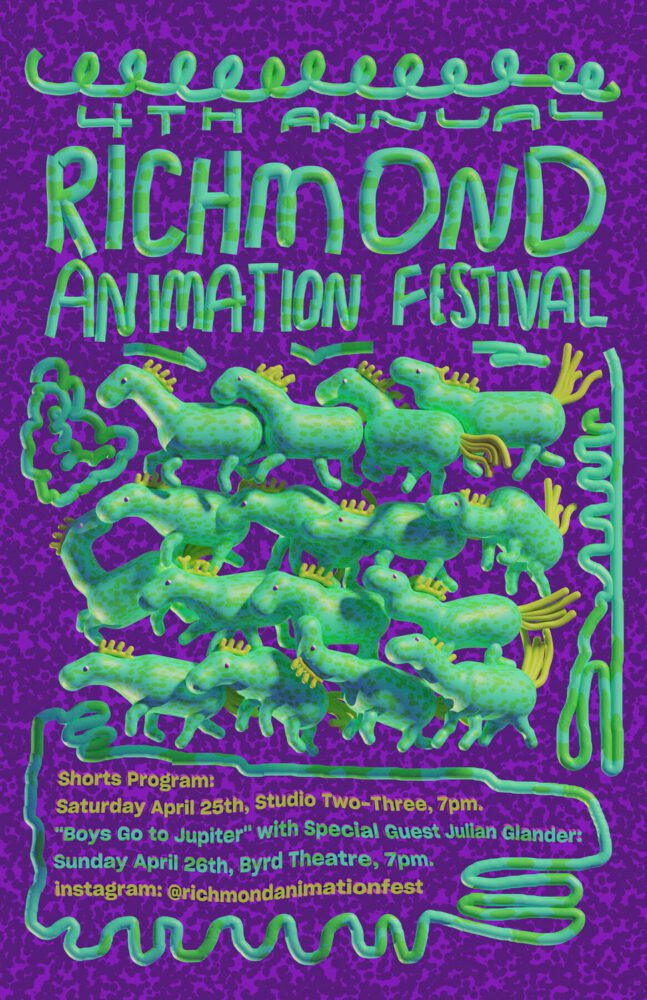
For the 4th Richmond Animation Festival, the program expands to two nights of screenings.
First, on Saturday, April 25th, the Shorts program curated by Jordan Bruner and Zack Williams will screen at Studio Two Three, and the feature screening of Julian Glander’s Boys Go To Jupiter will play at The Byrd, Sunday, April 26th.
Starting in 2023, the festival’s founders, and prolific animators themselves, sought to bring high quality, wide ranging animation from classic, international, experimental, underground, and beyond to a big screen, building a community of animation and cartoon lovers here in our city. I was able to catch up with Jordan and Dash Shaw about details for the shorts program and also find out more about this year’s special guest.
T-Rav: Breaking the show up into the two screenings this year, are you excited to have reached expansion into two nights?
Jordan Bruner: We are! Screening the shorts program and our guest’s films back to back was a lot to take in over a single night, so we’re thrilled to be spreading it across two.
T-Rav: For the Shorts program at Studio Two Three, do you have any comments about this year’s selections?
Jordan Bruner: We have some truly incredible films in this year’s program. If I had to identify an underlying theme, it would be the interplay of good and evil, light and darkness. And there are a lot of eggs in this year’s program. As one of our filmmakers, Nadiia Pliamko, says, they are “the vessel of transformation and divine mercy.”
T-Rav: Any thoughts on the range of animation?
Jordan Bruner: It’s a wide range! We have everything from Kate Renshaw-Lewis’s film Busy Bodies, created using printmaking techniques, to Gabriel Gabriel Garble’s film Well Wishes, My Love, created using an innovative combination of 2D and 3D animation. There’s also claymation, 3D, 2D digital animation, and hand-drawn animation in ink. We’ve got it all.
T-Rav: For Julian Glander’s screening of Boys Go To Jupiter, any special notes to his invitation and welcome to Richmond?
Dash Shaw: Julian’s also an illustrator, a cartoonist, a Jeopardy contestant, and a video game designer, and we’re very lucky to have him here right after his debut movie’s long festival and theatrical run.
T-Rav: What can audiences expect with his film?
Dash Shaw: To me, this movie is to the suburbs of Florida what Slacker was to Austin, TX, in that it’s a chilled-out movie following specific cartoony characters in a dreamy location. We’ve been fortunate to have great audience questions in past years, which is unusual for Q&As. I think that speaks to the intelligence and curiosity of our audience, so I hope that’ll happen again with Julian.
T-Rav: Will there be time for congregating and building community?
Dash Shaw: Yes, as in previous years, we’ll all convene at the NY Deli after the Sunday screening. They’re holding the rooftop for us. I now see a handful of friendly people once a year at this after party. Let’s try to talk to a stranger instead of staring at our screens for a little bit.
Guest Artist Julian Glander
T-Rav: When did you meet Dash Shaw?
Julian Glander: I think we first met at Copacetic Comics in Pittsburgh, one of the great comic shops of the world. Dash was giving a talk, and I cornered him into giving me a crash course on how to pull together a voice acting cast.
T-Rav: When did you start animating? What was the first form of animation you played with?
Julian Glander: I had made flipbooks and little flash animated films as a kid. Every child loves cartoons and animation, of course, and some people just never grow out of it. I tried almost every form of animation before I ended up on 3D puppets, hand-drawn, and a lot of different digital approaches. I love stop motion the most, but it’s so hard and I don’t have the patience for it.
T-Rav: Was there a favorite first cartoon you saw or memory of a feature animation film? Does the claymation rubber style of Gumby have a carryover in how you like to work in 3D “blobs”?
Julian Glander: Gumby is the greatest ever! I love claymation, the more rudimentary the better, because it feels so honest. You can see how everything’s made and how it all sticks together.
T-Rav: What was the size of your team?
Julian Glander: Microscopic — for most of the process, it was me and my producer Peisin taking on 100 jobs at once, and we brought in a handful of animators and technicians as needed.
T-Rav: Do you know how many unique locations and settings were built for the film?
Julian Glander: I just counted — 50! Some of them I didn’t end up using, like a nude beach that ended up not being that funny.
T-Rav: Do you have a favorite character design for the film?
Julian Glander: I love Julio Torres’ character, a gas station attendant who appears as a rectangle with a face. It was a choice born out of exhaustion, but it really works — sometimes talking to someone at a gas station really does feel like that.
T-Rav: Did anything appear in the story that came from the voice performances that might not have been in the script on paper?
Julian Glander: Yes, I think everyone in the cast did at least a little bit of improv. Chris Fleming’s scene in the movie is almost all coming off the top of his head. Pretty incredible to trap some of the greatest minds in comedy in a glass booth and have them come up with stuff like that.
T-Rav: Did you have a personal experience, or with friends or family, with the “hustle side” of YouTube?
Julian Glander: I find it endlessly fascinating and it shows up a lot in my algorithm against my will. If I was a little younger, it would have completely sucked me in. Hustle culture makes a classic promise — that there is a step-by-step way to make your life better and your destiny is in your own hands, and it’s possible for anyone to be rich if they want it bad enough. But at the same time, it doesn’t really ask much of you, they don’t actually want you to put in work and get rich, they want you to keep watching their videos.
T-Rav: Where is your personal placement to economic theory exemplified in the film? What is important in the audience’s takeaway to that subject?
Julian Glander: Each character in the film is kind of defined by their relationship to the economy: we have 21st century hustlers, poser leftists, classic small business owners, gig workers, shift workers, and a lot of people who believe in this new, almost magical form of thinking about money, that it’s something to be manifested and drawn into your life by mystical forces. None of the characters are right, but none of them are totally wrong. It’s kind of like the economy is this giant disco ball, and each of them can only see one facet.
T-Rav: Your GIFs are incredible and quite the dream for motion art form meeting editorial content, is that ongoing? Is there a future you see in GIF animation? (HERE)
Julian Glander: I love GIFs. They definitely had a revolutionary moment in the 2010s, and now they are probably here to stay as part of our lives. Making GIFs is where I learned how to be economical and organized with my storytelling and image-making.
T-Rav: What is up next in your work?
Julian Glander: Top secret!
T-Rav: In dolphin-related lore, have you seen Johnny Mnemonic?
Julian Glander: Yes! I am kind of surprised at how often dolphins come up when you look into conspiracy theories about intelligence, because they are so smart. It’s a very appealing idea that there’s another species out there that could take over if we really mess this up.
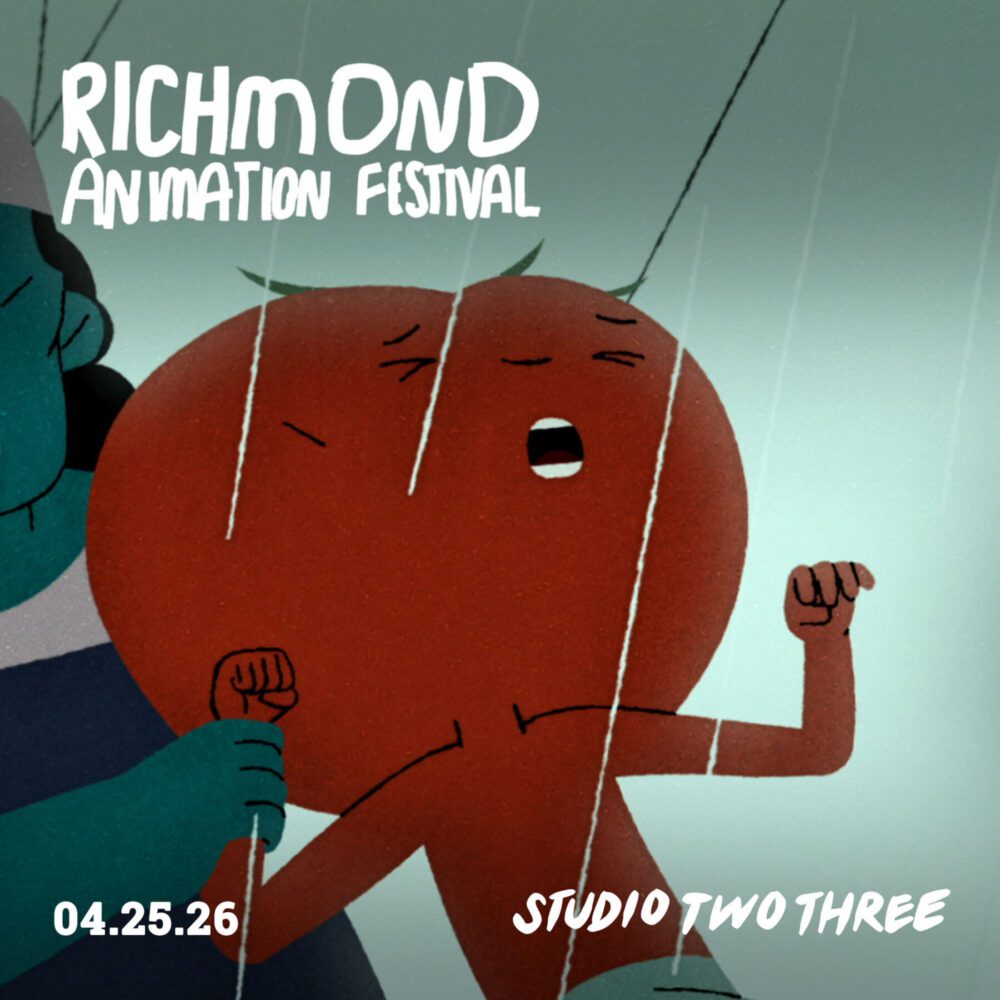
The shorts program
Winston Hacking — Action Bog (1 min, 20 sec)
Kate Renshaw-Lewis — Busy Bodies (6 min)
Meejin Hong — Deluge (12 min)
Vic Kociman — Picnic Girl (2 min)
Gabriel Gabriel Garble — Well Wishes, My Love (9 min)
Maks Rzontkowski — Marty’s Guidebook (9 min)
Junyi Xiao — Tomato Kitchen (9 min)
Nadiia Pliamko — ab mala usque ad ovo (5 min)
Elli Vuorinen — Flower Show (8 min)
Júlia Tudisco — Children of the Bird (11 min)
Main image: Screenshot from Julian Glander’s Boys Go To Jupiter
Support RVA Magazine. Support Independent Media in Richmond.
At a time when media ownership is increasingly concentrated among corporations and the wealthy, RVA Magazine has remained one of Richmond’s few independent voices. Since 2005, the magazine has provided grassroots coverage of the city’s artists, musicians, and communities, documenting the culture that defines Richmond beyond the headlines.
But we can’t do this without you. A small donation, even as little as $2, one-time or recurring, helps us continue to produce honest, local coverage free from outside interference. Every dollar makes a difference. Your support keeps us going and keeps RVA’s creative spirit alive. Thank you for standing with independent media. DONATE HERE.
We’ve got merch HERE
Subscribe to the Substack HERE
And Reddit HERE
And YouTube HERE