
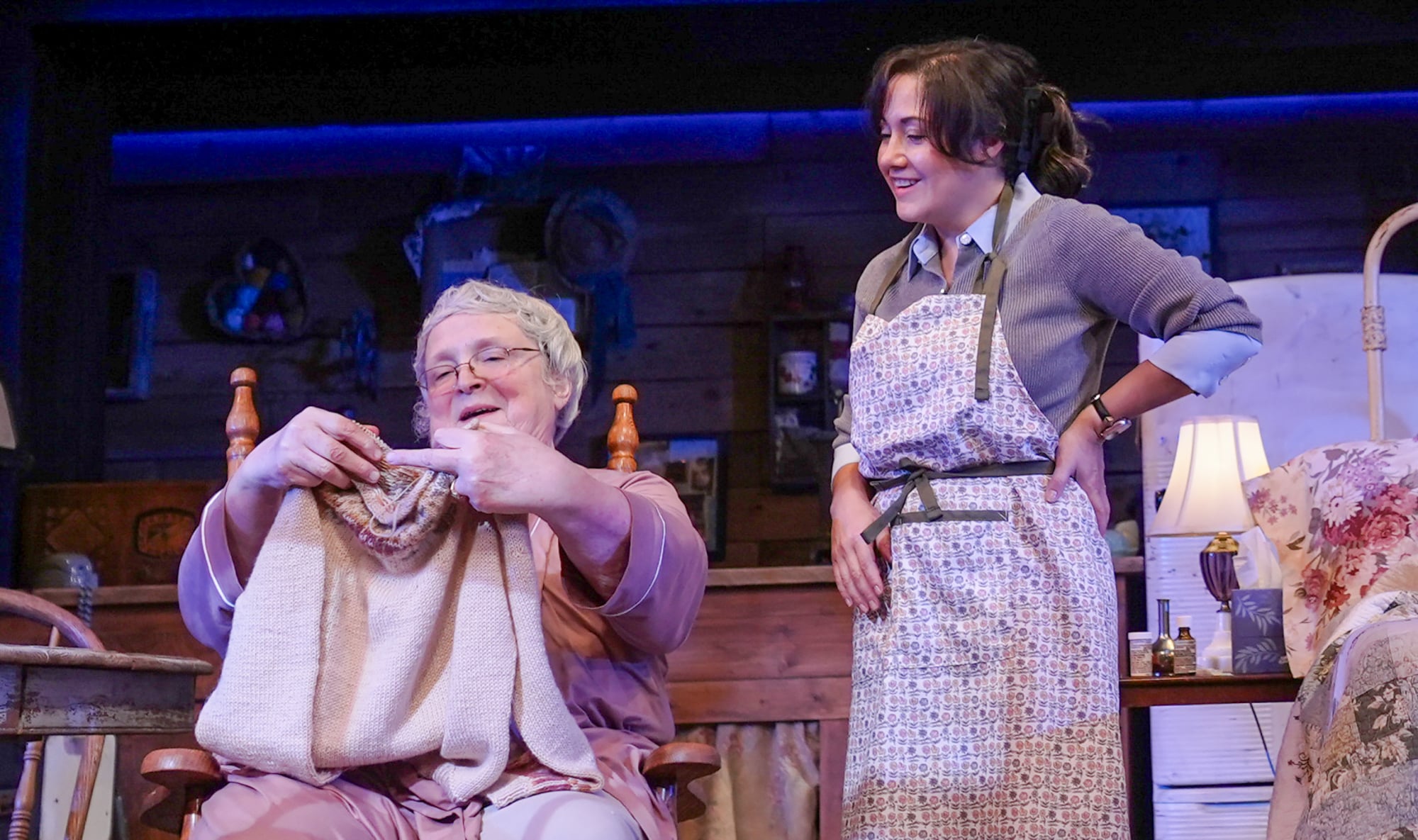
Yes, this is a review of the play Grace and Glorie, currently at Hanover Tavern. It is the Hanover Tavern part of that sentence that I want to focus on first.
I’m probably going to get some side-eye for this, but I completely forgot Hanover Tavern existed. What in the actual hell? This place is beautiful. It predates the United States of America by 60+ years, having been built in 1733. Patrick Henry lived here. George Washington drank here. Yeah, that’s right, there’s a pub. It’s still there! Right next to the restaurant. Lord Cornwallis staged his assault on Yorktown from here. It’s a little corner of Colonial times less than half an hour from downtown. The theatre inside is intimate, cozy, and damn adorable.
Okay, no one is paying me to sell you Hanover Tavern, but I don’t think they’ll mind the shine. I’m just saying. I do this for a living, and I believe, maybe, I came here on a field trip in middle school and forgot it existed. To be fair, I live in the Fan and forget the entirety of Hanover County exists sometimes.
Anyway, enough of that. Let’s talk about the play.
Grace and Glorie, a play by Tom Ziegler, produced by Virginia Rep, and directed by Julie Fulcher-Davis, opened this past weekend at Hanover Tavern. There isn’t any meta subtext in this work. It’s all on the page, and thus, on the stage. There is no counterintuitive message, no counterfactual argument. It is a story about a dying woman, her caretaker, and the spectre of deaths between them. It is about losing in the end. It’s about what you don’t take with you. It’s about what you’ve never had, and that fact not mattering one bit anymore. It is about the value of a life, even one barely lived.
One of the jarring things about it is its bluntness. It plays “Taps” by the numbers, not straying from the sheet music, but also never missing a note. Grace and Glorie will have you staring into Thanatos’ sleepy eyes as the nighttime of the soul settles in.
Faith and faithlessness are brought to battle. Not in the evangelical sense, but in the “Do I get to punch God in the eye when I die, or will I just be dead?” An internal dialectic one tries to shush right before you’re supposed to meet Him (Her?). For such a simple story with a unidirectional trajectory, it covers a lot of ground.
Maybe the fact that it’s simple is the point, though. The air of inevitability never disperses. Death is coming, and no one on that stage can stop it. All they can do is keep busy with whatever takes a short time to complete.
How do you live a life without long-term goals? Without dreams? There is no need to embellish or negotiate the heat death of the universe. It’s going to happen, and we will not be eulogized. The weight of the situation is where the clever emotional strings are pulling from.
Sheesh, let me turn down the Bauhaus for a second. My black nail polish is chipping on my keyboard as I type this. Let’s talk about the performances.

Catherine Shaffner plays Grace, a simple, dowdy old lady that’s barely ever been fifty miles from the place she’s dying in, under the shade of her apple orchard generations of her family have tended to. She lives without most modern conveniences, and quite frankly, doesn’t need them. She’s bright of character, if not of mind and worldly experience.
She’s met by a volunteer hospice worker, Gloria, played by Amber Marie Martinez. Gloria is a recent transplant to Virginia from Manhattan, a successful woman by any measure, and a person completely at odds with the universe. I won’t spoil why. She’s tasked with helping Grace be comfortable in her final days. She’s Charon on the Styx, rowing Grace to shore.
Ms. Shaffner is mind-blowingly good. Pitch-perfect. She IS Grace on that stage. Her performance is so natural as to cause you to forget you’re even watching one. She disappears so completely, I spent a lot of the play just admiring the hermeticism between actor and character.
I don’t really have the language for hyperbole adequate to describe the achievement here. It’s not an easy character either. This is a fully realized person with the grand questions of the cosmos in front of her. Catherine Shaffner doesn’t make it look easy. She makes it look like Mozart sounds. She should teach this stuff (which she actually does, at U of R’s theatre program).
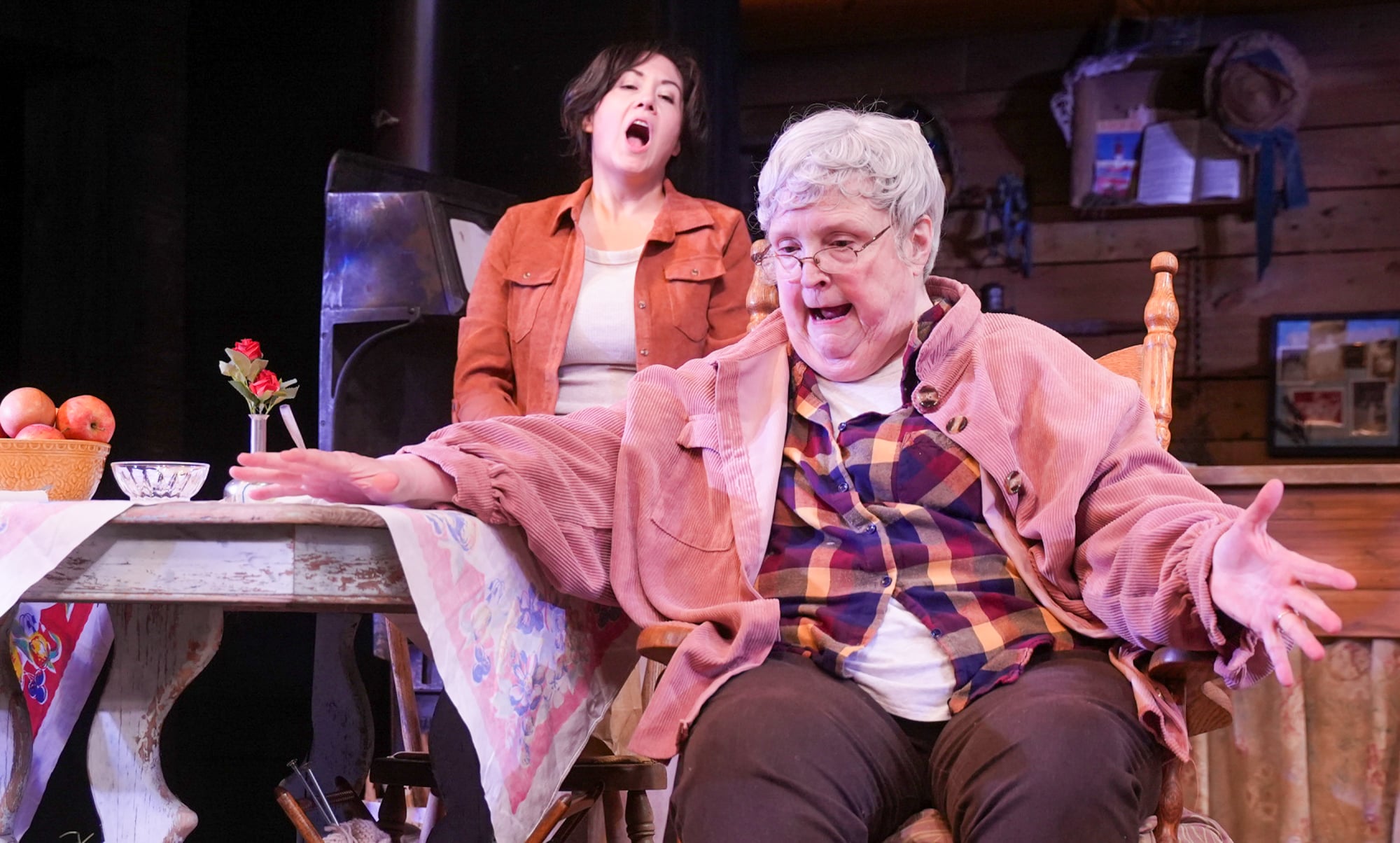
Amber Marie Martinez rises to the occasion, mirroring Shaffner’s method and approach. No frills, all substance. Natural.
I use that term a lot, and it bears some explanation. Stagework allows for melodrama. The audience, while in the moment, bears a suspension of disbelief that cinema does not. Extreme close-ups, multiple takes, establishing shots, and other film devices are nonexistent in the theatre. An actor is given some space to convey their motivations with more metaphorical gesticulation. Their characters usually stand for something bigger than the individual they are portraying, and we, the audience, give them a wider lane to be a little more expressive.
Giving depth to a motivation with a hard set of the eyes, a twitch in the hand, a change in gait, is harder to do when there’s no pause button, slo-mo, or multiple camera angles. To perform on a stage like no one is watching except the crew filming you is a skill. Subtlety doesn’t always serve the purpose of communication when your audience is thirty feet away from your face. It takes effort to look like you’re not expending any.
The play offers every opportunity for that melodrama. And this is why I am harping on this.
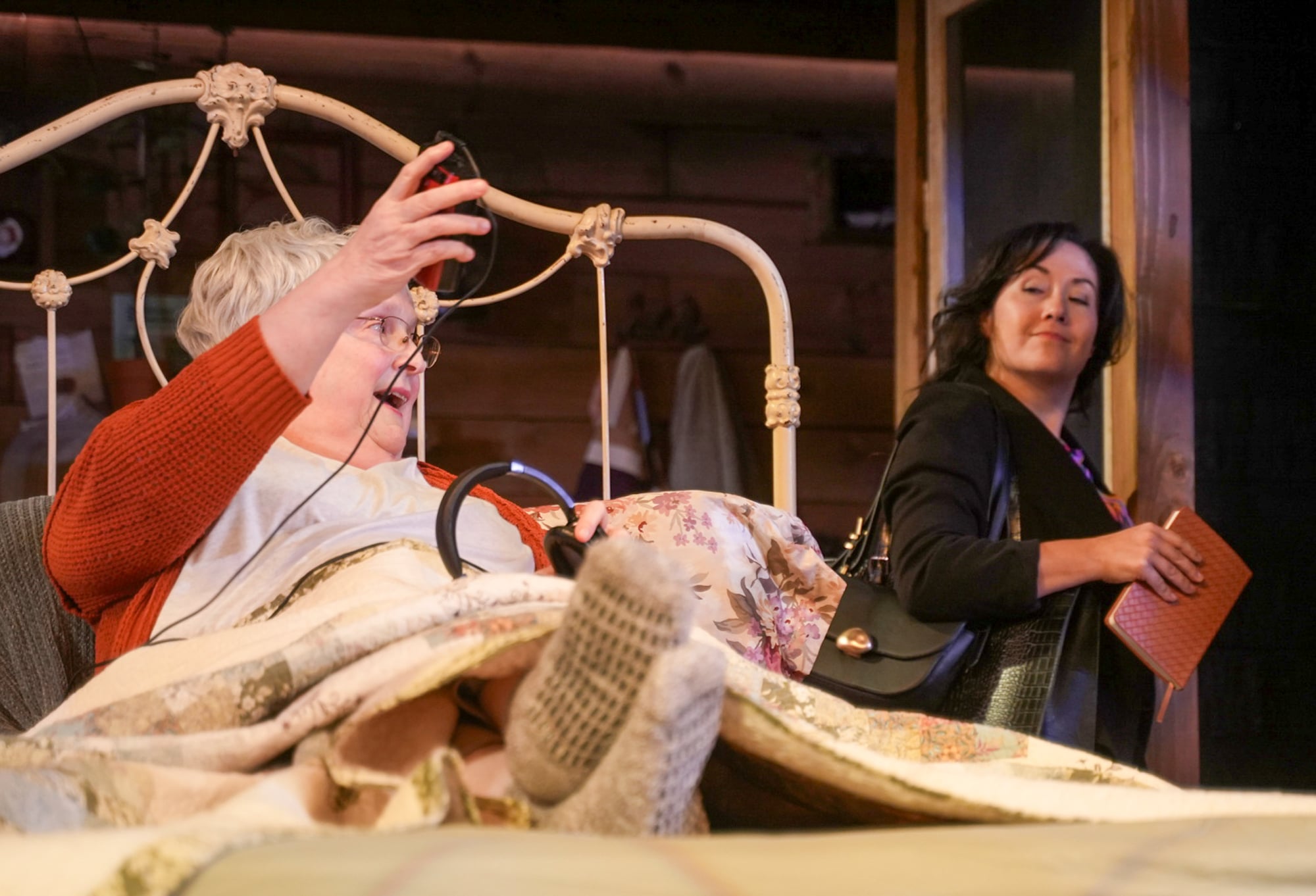
Together, Ms. Shaffner and Ms. Martinez bring two people to life in such a way that the performances are understated to invisibility, if you just showed up to witness a good story at the theatre. If you have to write about that story, and the qualities of the actors delivering it, that naturalism is astonishing.
They deserved the standing ovation they both got. I was on my feet too.
Once again, Daniel Allen and the production team deliver a beautiful set that could have been great with half the attention to detail spent on it. Bravo on that, my dude. You are murdering it.
Go for the venue, which could definitely use your support. Go to see a story told with little mystery and twice the heart. Go see two actors run a clinic on subtlety balanced against getting a point across. I am so happy I did.
Every time I think I’ve seen it all, I get dunked on with a new surprise. This was surprising in ways most of the shows I see don’t have to be. This is a great play to take an inexperienced theatregoer to. There is absolutely no way to dislike it.
Main photo by Jay Paul
Support RVA Magazine. Support Independent Media in Richmond.
RVA Magazine has remained one of Richmond’s few independent voices. Since 2005, we have provided grassroots coverage of our artists, musicians, and communities, marginalized or otherwise, documenting the city’s culture that lies right under the surface and beyond the headlines.
But we can’t do this without you. A small amount, even as little as $2, one-time or recurring, helps us continue to produce honest, local coverage free from outside interference. Every dollar makes a difference. Your support helps keep us going and keeps the local creative spirit alive. Thank you for standing with independent media, and thank you for reading.
Show your SUPPORT HERE
Also, subscribe to the newsletter HERE
We’ve got merch HERE
Subscribe to the Substack HERE
And Reddit HERE
And YouTube HERE