
There was a time for me growing up when Frankenstein was just a green guy that chased Scooby-Doo around. He adorned a cereal box of strawberry-flavored sugar that my mother would never buy. He slowly lumbered after my favorite mid-century comedy duos. And that was the entire story of Frankenstein.
Literally that. Neck bolts, forehead stitches, lift boots, and a somnambulant groan summed up the character pretty well for the purposes of any audience still entertained by the conceit.
At some point, we would grow up and realize there was a book about this guy. We’d seen the movies already, the cheesy ones and the funny ones. They introduced us to the melodrama of scientific hubris. All morality tales of the consequences of playing God; very “behave, or God’ll gitcha.” Prometheus as told in Sunday school.
He also did a killer rendition of “Puttin’ on the Ritz” in a top hat and tails.
Most of us remained there in our appreciation for the very story that invented modern science fiction. In recent decades, there’s been a push to remind non-readers that there was yearning in those moans and something real those outstretched, patchwork arms were reaching for.
Guillermo del Toro’s film adaptation of the novel, released last fall, capped the effort with a multiple-award-winning and mostly faithful-to-the-text film by the same name. The story was illuminated in the zeitgeist that led to new interest in the character. No longer a simple avatar for the doom that follows ingesting the Edenic apple from the Knowledge Tree, Dr. Frankenstein’s “son” was reanimated with a prismatic spectrum of protagonist perspective.
For context, Mary Shelley was a talented and fairly “modern” woman embodying Romanticism’s reaction to the Enlightenment. She ran in the bohemian circles populated by her husband (poet Percy Bysshe Shelley) and his coterie of libertines. They reveled in breaking ossified molds of morality and living deliciously ahead of the wake of miseries their selfish freedoms would churn.
The Marquis de Sade hung like a shadow of influence over the extreme individuality and moral relativism they would champion, maybe with some reservations.
Mary and Percy would elope in a breathless, corset-busting adventure that culminated in the suicide of Percy’s devastated, pre-existing wife. The romance and drama of the free-spirited couple would be chained by the all-too-real tragedies of her impending miscarriages and deaths of three of their children together. All attempts at sealing their love with creation were met with guilt, sorrow, abandonment, and loneliness.
Percy continued to philander, and her womb continued to produce nothing but mockeries of her desire for motherhood. She interpreted these coincidences of fate as consequences of faithlessness. Herein is where the themes of divine abandonment and the horrors of unholy birth would haunt her from the wings of her consciousness.
Critics have been deconstructing Frankenstein from overstuffed leather chairs in mahogany-walled libraries for the two hundred years since its publication. That discussion’s volume rarely reverberates through the walls to the Spirit Halloweens where Frankenstein truly “lives” in our pop culture.
An even more academic reading of the novel would highlight the autobiographical rhymes to Mary Shelley’s tortured existence. That’s where we begin with David Catlin’s adaptation for the stage and Richmond Shakespeare’s rendition of it.
Catlin stages the legendary salon-bound storytelling contest Mary has with her husband, Lord Byron, his lover (and Mary’s stepsister) Claire Clairmont, and Dr. John Polidori, who would subsequently write the first modern English-language vampire story, The Vampyr.
This was about as much of a night of revelation and profundity as one can imagine in the arts. One of the most consequential gatherings in literary history as exists in related memory.
Director Foster Solomon opens the show with our cast’s shadows projected onto a veil between audience and stage. A stratagem I interpreted as highlighting the nature of storytelling at its most primal. A callback to the Platonic Allegory of the Cave, where dancing shadows are confused for realities never beheld.
The idea, compelling in theory, extended beyond the understanding and patience of an audience beginning to wonder if this was how the whole play was going to go. ’Too much of a good thing and all.
When we do finally meet the cast, it is in their egos as the fated writers and poets licentiously and drunkenly trading ghost stories on a dreary Swiss evening. They succeed in drawing back the curtain on what is passed down as a significant scriptural moment in erudition to the clumsy double entendres of myopic fops.
Sara Delaney’s Mary Shelley deftly elevates the conversation by challenging the idea she, a woman, could not possibly create a more chilling tale than her male counterparts. Not only is she about to do exactly that, but she’s about to make them peer through the lens of her regret, anger, and protracted scream at the heavens.
We watch Chandler Hubbard’s Percy swing dick like a Regency-era lothario while Lord Byron and Dr. Polidori strive to catch it. All are over the top, but if you have ever watched the very self-satisfied characters in 1990s pseudo-philosophical pop cinema, you realize that, yeah, this is the precedent for it.
The postures are so common as to lose all authority of grace and descend into ickiness. Even Rachel Garmon-Williams’ Claire Clairmont is too drunk and smug to perceive her own prosaic place in the tale. Everyone loves the idea of themselves so much they’re incapable of noticing the struggle Mary is having with their company.
If you took any of that as a criticism, don’t. It is exactly in these layered milieus where real theatre happens. Motivations and actual relationships are suppressed under postures fit for Glamour Shots at the mall (if you’re under 40, Google it). David Catlin provides the outtake shots between smiles that scan more as grimaces, if you can see them.
The cast’s representations of this are broad but hint at performance bearing the weight of insecurity. Well done in my book.
The play has the partygoers take on roles of Mary’s emerging story: Percy as Dr. Frankenstein, Mary as the embattled Elizabeth Lavenza, Claire as a number of ancillary characters, including Victor and Elizabeth’s (step)mother, Lord Byron as primarily the Creature, and Kieryn Burton taking on Polidori, Henry, and the rest.
This is a fun concept. We see the cast possess and release their metaperformances with excitement, gleefully re-enacting Mary Shelley’s increasingly immersive tale.
Something I loved about this whole thing is how the popping in and out of Mary’s narrative from the gathering at the Swiss cottage of legend blends and synergizes so well. Like a polyrhythm finding cohesion, the dual settings morph into the proper story of Frankenstein as written before you realize it has. Neat trick, that.
What resulted for me is a unique theatregoing experience (which is my favorite). If there was anything I would have done differently, it would be to rely less on the transatlantic, cultivated, high-laryngeal tremolo voice (often used to mock theatre and fainting-couch dramatics) on display here.
If there was anything taking me out of the experience, it was that. A stylistic criticism some may not agree with me on, but that’s my two cents.
Otherwise, I felt Chandler Hubbard and Travis Williams led with strong portrayals of a reluctant deity and his uncomprehending/tortured creation. The tension between them felt real. The moments where Rachel Garmon-Williams and Kieryn Burton get to break that tension as grounded, uninvolved contemporaries of the duo arrive like an available drink during a conversation lapse. Sara Delaney gives the simmering seethe under the guilty forbearance of circumstance one could imagine the actual Mary Shelley enduring.
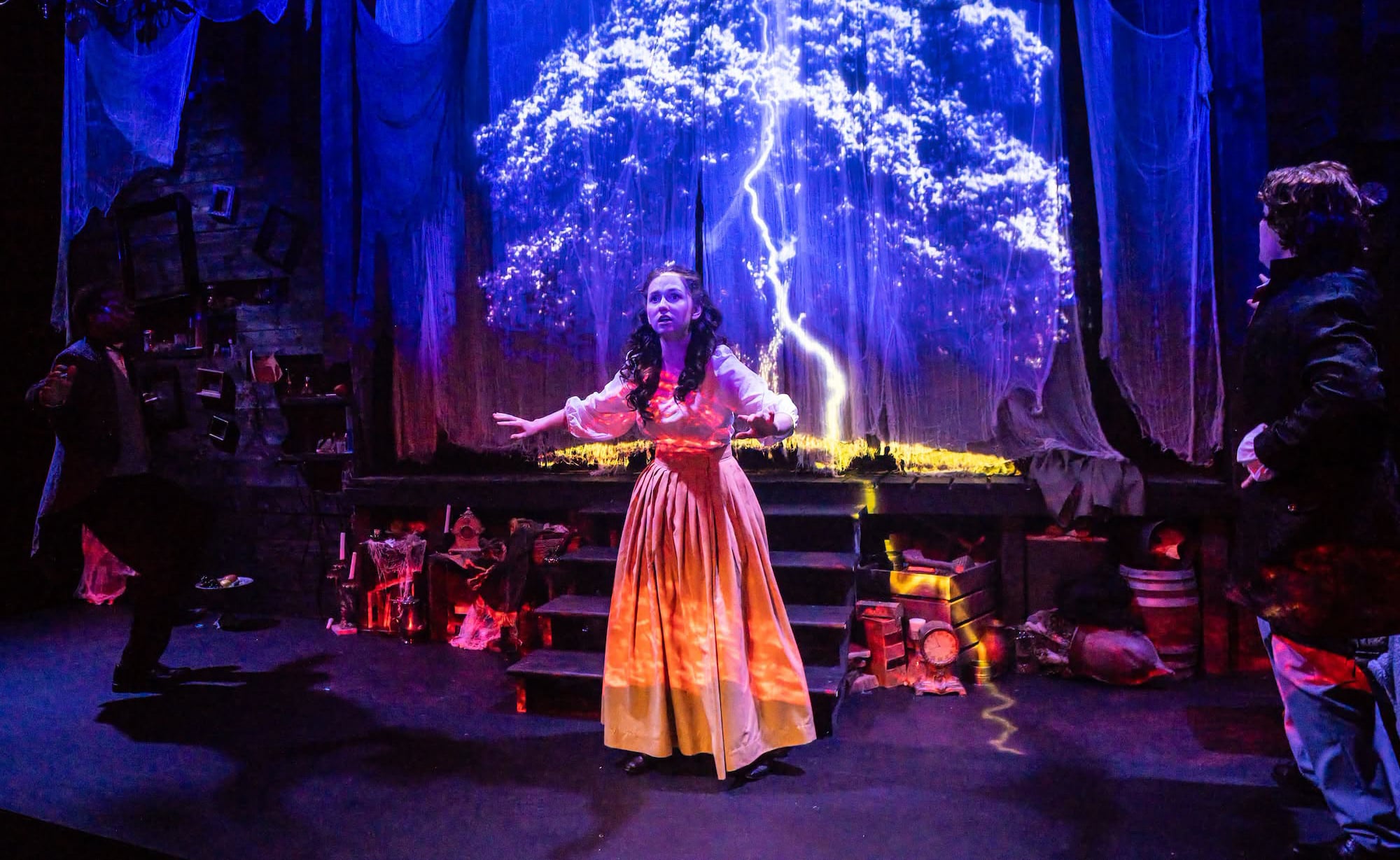
The set design is phenomenal, minus the unfortunate placement of a light source aimed a little too close to the audience’s retinas. I want to shout out Daniel Allen for a string of some of the most imaginative and cinematic stages I’ve seen in recent memory. He makes a space feel like a hall, plucks grandiosity from a corner of black-walled theatre.
David Catlin’s Frankenstein, in the hands of Foster Solomon, is one giant, throat-rending shout at the clouds from a spurned child of God. It insists, like the titular creature, on being understood and accepted whole. It is different, unique, and worthy. Just like every one of us.
I’ll give it an Ebert thumbs-up for the metacritics and the lovers of the supernatural.
Get your tickets HERE
Main photo by Aaron Sutten
Support RVA Magazine. Support Independent Media in Richmond.
RVA Magazine has remained one of Richmond’s few independent voices. Since 2005, we have provided grassroots coverage of our artists, musicians, and communities, marginalized or otherwise, documenting the city’s culture that lies right under the surface and beyond the headlines.
But we can’t do this without you. A small amount, even as little as $2, one-time or recurring, helps us continue to produce honest, local coverage free from outside interference. Every dollar makes a difference. Your support helps keep us going and keeps the local creative spirit alive. Thank you for standing with independent media, and thank you for reading.
Show your SUPPORT HERE
Also, subscribe to the newsletter HERE
We’ve got merch HERE
Subscribe to the Substack HERE
And Reddit HERE
And YouTube HERE