
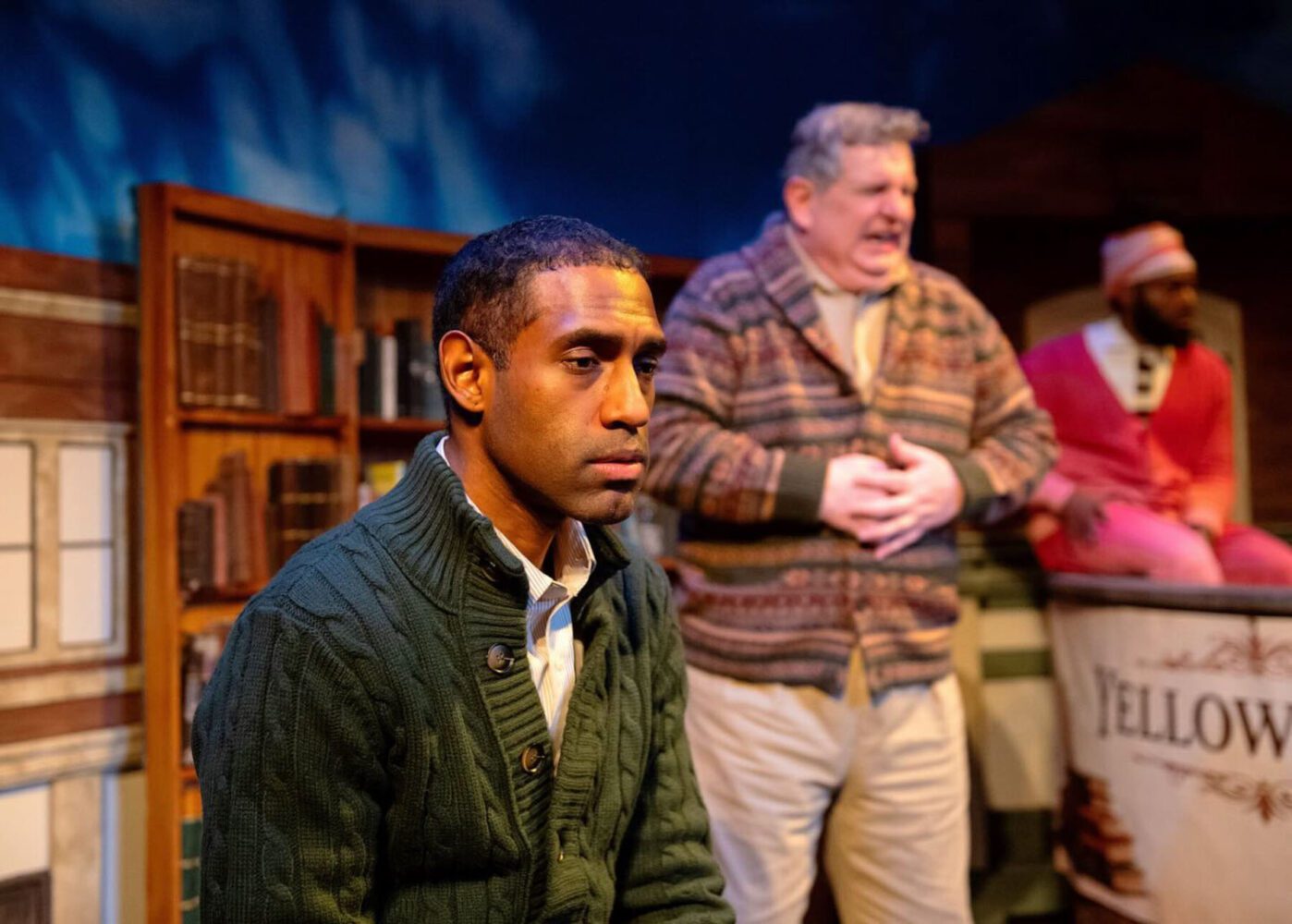
I am prone to hyperbole. While my enthusiasm for local theatre runs hot, believe me when I tell you Primary Trust is the best production I have ever seen in Richmond. I mean that. It’s perfect. On every level. In every performance. Pacing, set design, lighting, sound design, hell – even the costuming was impeccable. Every single aspect of this play was perfectly faceted into a resplendent rainbow of emotion, gravity, humor, pathos, concern, and catharsis. This is a new high bar, and I feel blessed to have witnessed it.
Primary Trust leads you through the story of Kenneth, a 38-year-old survivor of intense childhood trauma compounded with an existing neurodivergence. Kenneth is equally charming and worrisome, unintentionally ‘problematic’, but kind. The plot skips carelessly on a cliff’s edge, placing Kenneth’s future in the hands of people struggling to understand him. He loses a twenty-year-long career working in a family-owned bookstore early in the play. His life is left in limbo, and he’s clearly at a disadvantage. In the workforce, his off-putting behavior and reliance on an imaginary friend for companionship threaten his prospects. The drama begins there and goes nowhere you expect it to.
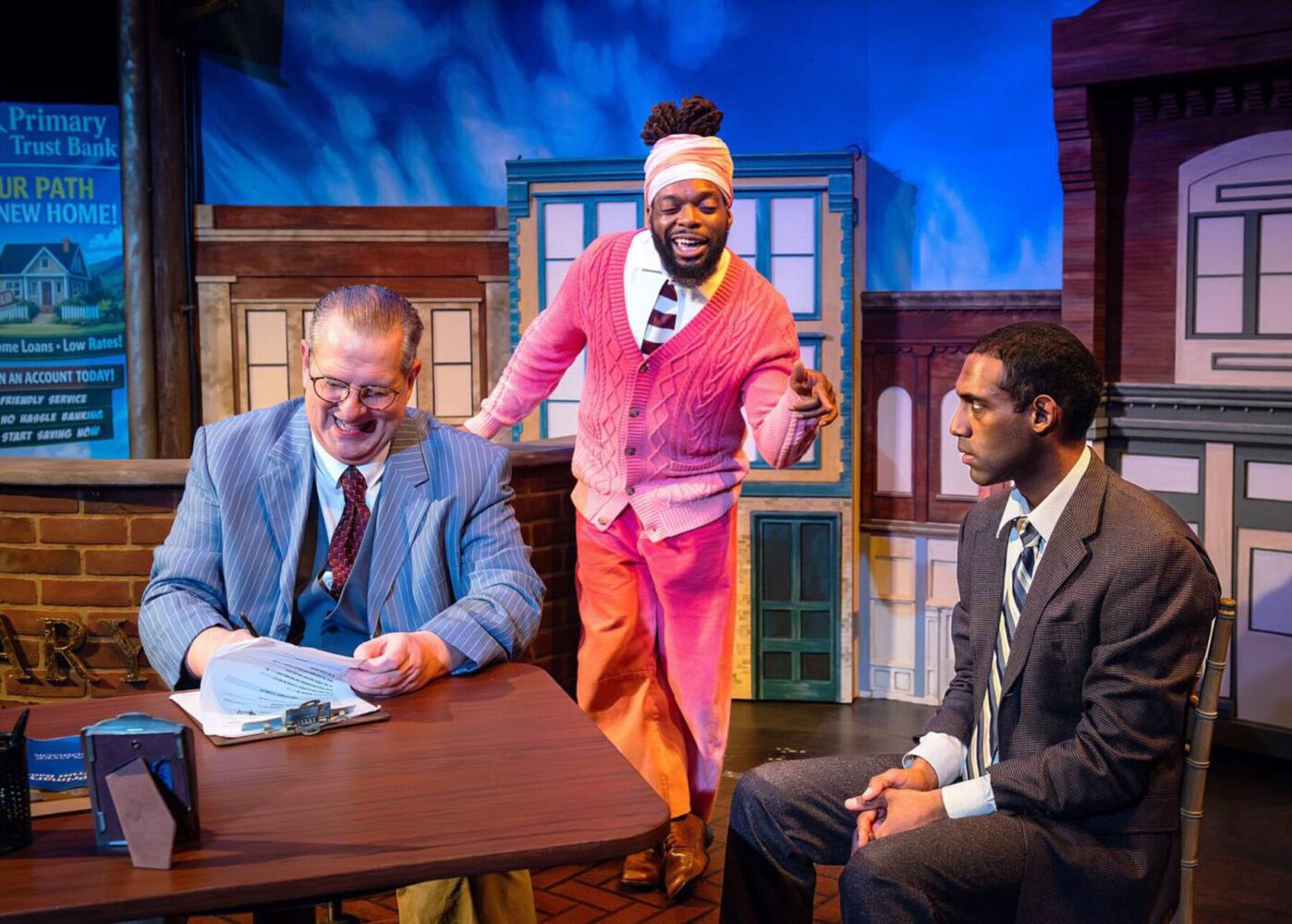
The audience lives on the edge of their seats for his fate, because we grow to love him. Not like him. Love him. It’s not uncommon for an audience to cheer a big moment in a character’s adventure, but there was an investment in the room for Kenneth’s fortunes that I’ve rarely witnessed. Rex Hudson gives his portrayal of Kenneth an open-faced honesty, a blithe vulnerability that comes from knowing he’s different. He chooses loneliness instead of calculated performance that would satisfy social expectations. We see that he understands the boundaries of the general public’s ability to withstand his peculiarity, but plows forward anyway. He doesn’t blame. He doesn’t apologize. He’s survived others’ confusion long enough to ignore it. There’s a strength and a sadness there. Rex Hudson exploits that nexus into a portrayal he melts into completely. He’s truly remarkable.
It helps that Eboni Booth’s Pulitzer Prize-winning play is a masterpiece, but this production doesn’t rely solely on the written work to drive the experience. The supporting characters that populate his life create a rhythm in repetition aligned with the needs of a survivor as well as the beats of a perfectly constructed narrative.
I want to make a note on the spectral diagnosis of autism here, though. Eboni Booth deliberately leaves his medical condition unspoken in the play. We are not given a spreadsheet from which to understand Kenneth clinically, which forces us to see him as an individual. I add the layperson’s shorthand for his affliction only for the purposes of reviewing a show I’m assuming my readers haven’t seen yet. The sensitivity to the colloquial space “autism” inhabits in our culture is appreciated, and I hope, unshattered by my recognition of it here. The intent is obvious; the application nuanced. As much of Rex Hudson’s skill is displayed in presenting the character, Booth is equally responsible for designing him so.
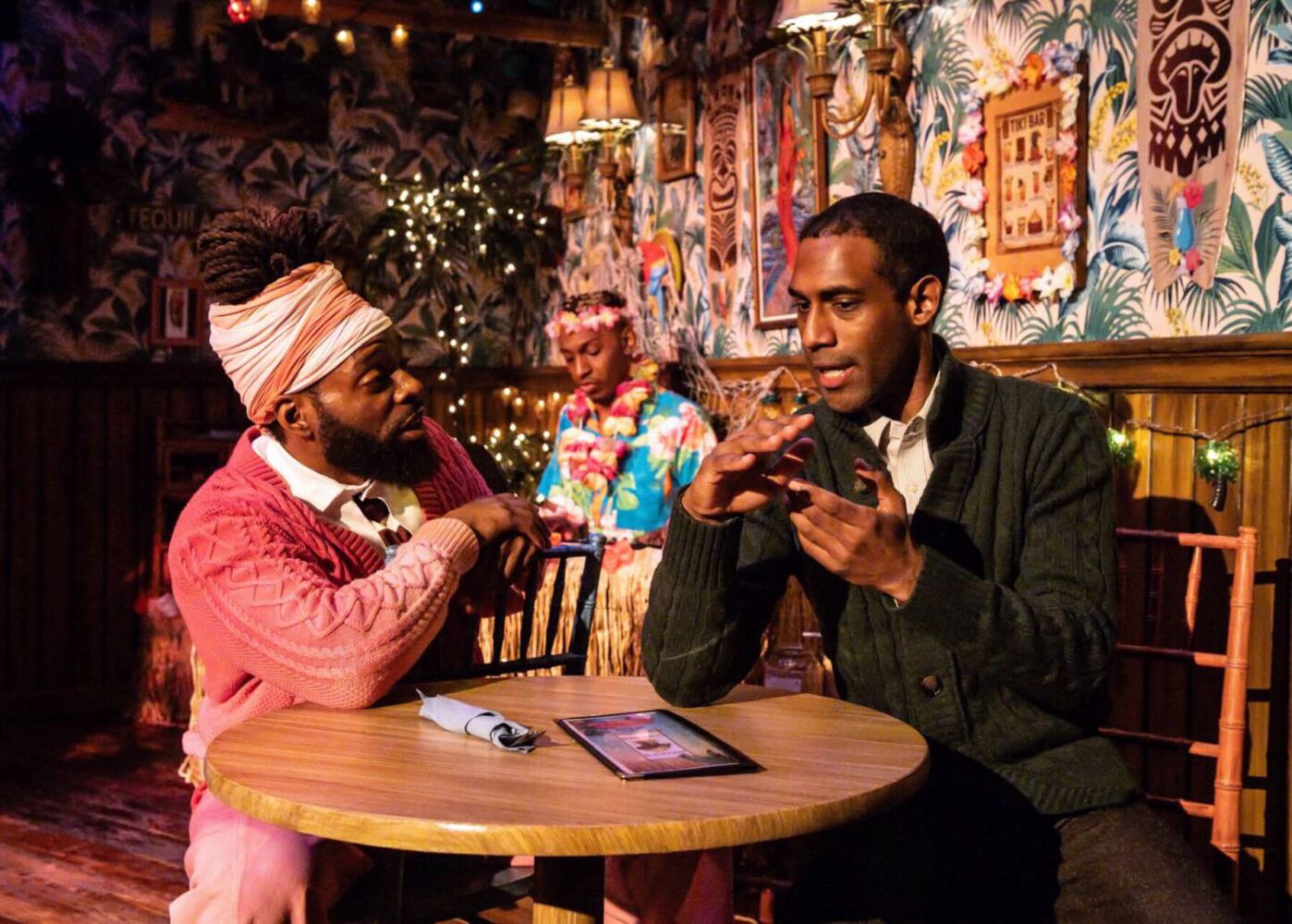
There are more bouquets to hand out here, though. New York-based Brian Anthony Simmons plays Bert, Rex’s crutch and imaginary drinking buddy. From Harvey to A Beautiful Mind and back again to The Sixth Sense and others, there’s a lyrical shorthand of tropes to employ in service of the “unseen companion.” There’s no point in avoiding them, as they convey difficult concepts efficiently. They exist in this work, but Primary Trust finds a way to elevate the genre. So much of the tension that makes this play excellent lies in the “how” this character is handled that I’m not going to elaborate too much and spoil it for you. Suffice to say, Mr. Simmons takes Bert to a height of believability and sensitivity I was not prepared for. Bert’s origin tips the entire work on its axis. Please go see this play.
Zakiyyah Jackson, Joe Pabst, and Tevin Davis round out the cast, playing numerous characters each, sometimes entering stage left as a completely different person than the one they exited stage right seconds before. There are the obligatory audience chuckles that arise from the surprise surrounding such transitions, but every one of these portrayals feels real, in-universe, whole, and significant. Joe Pabst, who had me in tears during his run in Waitress last year, cultivated more lumps in my throat as the bookstore owner and Bank Manager guises here, mere moments away from the laughter induced by his handful of tiki bar waiter portrayals. Zakiyyah turns and burns through several waitress appearances while delivering a beautiful and patient personage in Corrina, Kenneth’s newfound friend. They both also play a half-dozen bank customers with distinct personalities and motivations. Tevin Davis does so much without speaking (as the tiki bar in-house musician) that when he does have something to say, it’s an unforgettable highlight. I cannot praise them enough. I will be going back for seconds.
As I mentioned at the top, performance and writing only take you so far. This show’s management of lights, sound cues, sets, and wardrobe complete a synergy with everything said or done on stage. The effect is immersion, total abandonment to the fiction presented. This is easier to effectuate in film, or something more boisterous as a musical. It’s a feat when accomplished in a small room with a modest stage.
Everyone involved killed it.
Not that she needs my approval, but the lauded and inestimable Dr. Tawnya Pettiford-Wates has directed what I consider the most perfect piece of theatre I’ve seen since Sir Ian McKellan and Sir Patrick Stewart stunned me off-Broadway in Waiting for Godot. I will remember this experience as an event. Thank you so much for that. My applause extends to the VA Rep creative and administrative family for their great taste in bringing this joy to the city. Please take advantage of the opportunity and see this masterwork before it leaves the November Theatre’s Theatre Gym March 29th.
Photos by Aaron Sutten
Get tickets HERE
Support RVA Magazine. Support Independent Media in Richmond.
At a time when media ownership is increasingly concentrated among corporations and the uber wealthy, RVA Magazine has remained one of Richmond’s few independent voices. Since 2005, the magazine has provided grassroots coverage of the city’s artists, musicians, and communities, documenting the culture that defines Richmond beyond the headlines.
But we can’t do this without you. A small donation, even as little as $2, one-time or recurring, helps us continue to produce honest, local coverage free from outside interference. Every dollar makes a difference. Your support keeps us going and keeps RVA’s creative spirit alive. Thank you for standing with independent media. DONATE HERE.
We’ve got merch HERE
Subscribe to the Substack HERE
And Reddit HERE
And YouTube HERE

