

The work of revolutionary Japanese printmaker Kawase Hasui has returned to the Virginia Museum of Fine Arts in an exhibition that highlights his snowy landscapes.
The work of revolutionary Japanese printmaker Kawase Hasui has returned to the Virginia Museum of Fine Arts in an exhibition that highlights his snowy landscapes.
Hasui was a modern woodblock artist and his work was often based in realism with a traditional Japanese style. He’s most known for his iconic scenery compositions.
“He is the most important of the 20th century Japanese printmakers,” said Alex Nyerges, Director of the VMFA. “He was essentially reviving the woodblock tradition in Japan for which they had been famous for for centuries.”
The exhibition shows Hasui’s artistic reflection of what he viewed as Japanese identity via use of iconic images and the classic woodblock technique. Works currently on display highlight Japanese landmarks such as the Heian Shrine in Kyoto and Mount Fuji near Tokyo.
Some of the most recognizable of Hasui’s pieces are his snowy landscapes. The works show a great affirmation of Hasui as an intelligent colorist, especially in the piece, “Snow at the Zojoji Temple” (seen below) which has a beautiful contrast between the blinding, white snow, a vividly red temple and a woman’s pale yellow umbrella. Snow at the Zojoji Temple is one of the 12 pieces curated by Li Jian, E. Rhodes and Leona B. Carpenter currently on display at the VMFA.
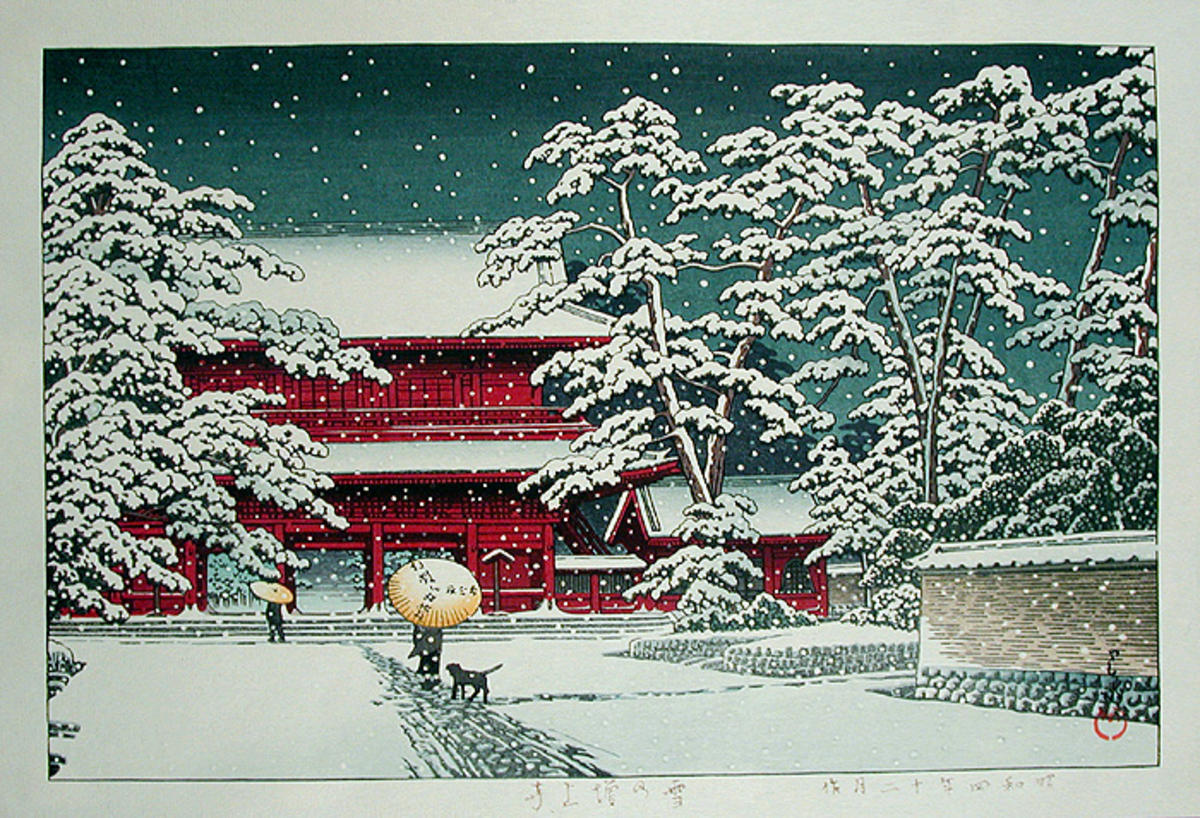
Image via ukiyo-e.org
Though it might seem odd for a collection of snow inspired works to go on display during this time of the year, it can be looked at as a refreshing change of scenery this upcoming summer.
“On a hot a summer day I would invite people to come the VMFA and see the Hasui snowscapes,” Nyerges, said.
The VMFA’s current display is one of the most extensive collections of Hasui art after being gifted nearly 600 pieces from top Hasui collectors René and Carolyn Balcer.
“We both came to the decision that the VMFA was a good home with a great connection. The museum has the best Art Nouveau and Art Deco collection and as we all know those movements were heavily influenced by Japan,” Balcer said in an interview with the VMFA, “I felt that the collection was a really strong compliment.”
Hasui is to be exhibited in the VMFA at least twice a year in their Works on Paper gallery, with about 15 pieces per exhibition. In the past the museum has displayed various incarnations of his work, most recently his cherry blossom prints, and plans to continue putting his various works on display in thematic exhibitions until the collection is exhausted.
“We’re going to be able to do 15 years of exhibitions and never see the same print twice,” said Nyerges.
The VMFA has also been one of the chief loaners of Hasui work in the world with plans to lend pieces to countries such as Canada and China in the coming years.
“Being able to represent one of the most important printmakers of the 20th century from a global standpoint is an imperative,” said Nyerges. “Because we have one of the best collections of Hasui in any museum in the world it becomes our duty to travel works internationally.”
You can view a piece of the VMFA’s coveted Hasui collection, Snowy Landscapes: Japanese Woodblock Prints by Kawase Hasui, in their Works on Paper gallery until Aug. 3.
There is no admission fee.
For more information on the exhibition you can visit the VMFA’s website here.