

Editor’s note: Redfern Hemp Co. is a current sponsor of RVA Magazine. This story was produced independently and without editorial control or influence. RVA Magazine began covering Virginia’s cannabis industry earlier this year, and support from Redfern and several other companies in the industry helps make continued reporting on issues like this possible.
On a late October afternoon in Caroline County, the fields around Redfern Hemp Co. should be heavy with the smell of harvest. Instead, the air hangs thick with black smoke. Rows of mature hemp plants, tall, brown, and nearly ready, will never reach a buyer. I arrive with a recorder and camera as farmer Graham Redfern prepares to till the field under, or burn it down, destroying one of the last remaining hemp crops in Virginia.
By his estimate, it’s a quarter of a million dollars in cash crop going up in smoke.
“You can’t have a viable agricultural commodity if you don’t let us get this thing to full maturity,” Redfern says. “But that’s what they’ve done. They’ve made it impossible to be a hemp farmer in Virginia.”

The issue comes down to a technical rule with devastating impact: Virginia’s 25:1 CBD-to-THC ratio requirement.
Under federal law, hemp must test below 0.3% Delta-9 THC, a limit that most farmers can meet. But Virginia added two more hurdles:
- The crop must stay under 0.3% total THC (including all forms of THC), and
- The CBD content must be at least 25 times higher than the THC.
That ratio is nearly impossible for the plant’s genetics. Most hemp naturally produces around 20% CBD with 1% THC— a 20:1 ratio. To meet Virginia’s rule, Redfern says, “you’d need a perfect genetic that doesn’t exist.”
If farmers harvest early to keep THC levels low, the seeds don’t mature and won’t germinate. Let it grow to full maturity, and the plant crosses the threshold and becomes, by state definition, marijuana. “So either way,” he says, “you lose your crop.”
Even when the plants survive testing, the bureaucracy kills them next.
Farmers are required to pay for testing 30 days before harvest and again before retail sale, often to the same state-approved lab with little flexibility. If it rains, tough luck. If the state email comes late, too bad. Once notified, farmers have five days to harvest or destroy the crop, or risk being labeled noncompliant.
“It’s like cutting watermelons and not being able to take them to the farmers market,” Redfern says.
Each test can cost hundreds of dollars. “This fall, I spent $780 on testing alone, only to have my field destroyed because the inspector picked the wrong plant,” Redfern says. “Most farmers can’t afford that kind of hit.”
When I asked how many hemp farmers are left, he replied “There are maybe ten, or 20, of us left, statewide.”

Once a promising agricultural sector, Virginia’s hemp industry has withered under shifting regulation and market collapse. In 2019, the state recorded more than 1,100 registered hemp growers and over 260 processors, according to the Virginia Department of Agriculture and Consumer Services. By 2024, that number had fallen to fewer than 150 growers and about 100 processors, with reporting from Cardinal News last year describing parts of Southwest Virginia where the market “has slowed to a stand-still as falling prices eventually made harvesting pointless.” Processors have shut down or moved out of state, leaving few options for farmers. “There’s nowhere left in Virginia to take this crop,” Redfern says.
When Redfern started growing hemp in 2017, he wasn’t chasing CBD oil profits, he was chasing sustainability. A former construction worker, he saw hemp as the future of green building. He and his team worked with Idaho National Laboratory on blending hemp fiber with recycled plastics for low-emission waste-to-energy projects. They experimented with hempcrete, insulation, and animal bedding uses that could make the plant a cornerstone of a new, circular economy.
“We wouldn’t be here if it wasn’t for the cannabinoids,” Redfern says. “But the cannabinoids were supposed to fund the industrial side, the building materials, the fiber, the grain. That was the dream.”


That dream is gone. Without access to the cannabinoid market, no one can afford to build the infrastructure for industrial hemp. The few grants that once existed dried up when Virginia changed its hemp laws in 2023 under SB 903 legislation that reclassified many hemp crops as marijuana and drove processors and small farmers out of state. “Everybody left in 2023,” Redfern says. “There’s no one left to process it. Nobody’s investing in machinery. Nobody’s buying Virginia hemp.”

Ask Joe Domino, Redfern’s operations manager, who benefits from all this, and the answer comes fast: corporate cannabis.
They point to the Virginia Cannabis Control Authority (VCCA) and its alignment with large, out-of-state medical cannabis operators like Columbia Care, GLeaf, and Jushi. When Virginia legalized medical marijuana, those companies moved in and, Redfern argues, started pushing lawmakers to regulate hemp out of existence.
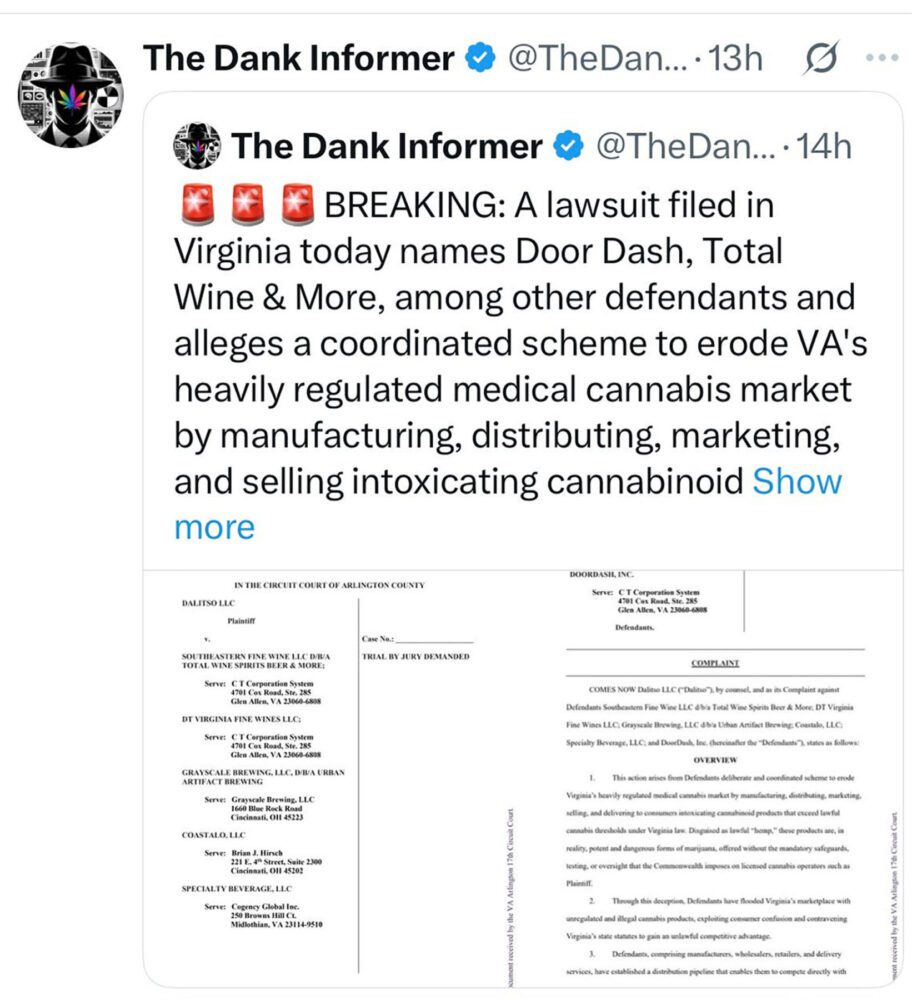
Editor’s Note: According to an industry report and documents posted on X today, Virginia medical operator Dalitso LLC filed a Henrico County lawsuit naming DoorDash, Specialty Beverage, and Total Wine & More, alleging unlawful sales and delivery of intoxicating cannabinoid products. The complaint seeks more than $80 million in total damages, including $20 million in actual or compensatory damages for lost profits and business opportunities. The filing was not yet available on a public court site at press time.
Domino, who follows policy closely, calls it a “plant-toucher problem.”
“You’ve got the people who actually grow and process the plant the farmers, extractors, retailers and then you’ve got the ‘non-plant touchers.’ Those are the corporate consultants, lobbyists, and regulators who profit off the industry without ever handling the plant.”
According to Domino, the regulators’ network, CANNRA is dominated by government agencies, not farmers or processors: ‘They’ve built a wall between people who actually touch the plant and the ones writing the rules,’ Domino says. Indeed, the organization’s membership is restricted to regulatory agencies and excludes individuals or non-government entities.
That structural fact doesn’t necessarily mean it’s actively hostile to hemp agriculture, but many farmers say the result is the same: their voices are largely absent from the table.
Even as the hemp market collapses, the legal fight is heating up. Large, out-of-state medical operators have begun suing a wide range of Virginia businesses (see above), claiming they’re illegally selling hemp-derived products. Those vague lawsuits, Redfern says, could rope in nearly everyone in the industry. “They just say ‘cannabinoids,’” he explains. “That’s us. That’s everybody.”
He expects countersuits and a long legal slog. “People are going to have to sue to stay out of jail,” he says. “That’s how bad it’s gotten.”
For now, his only option is to process everything into non-inhalable oils, destroying his smokable hemp crop to remain compliant. “It’s virtually impossible to make a legal inhalable product in Virginia,” he says. “We just have to comply with whatever changes they make next.”

By late morning, the light hits the tops of the hemp plants just right, giving them a bronze glow. It’s hard not to imagine what could have been, a new Virginia cash crop, a sustainable material for building and textiles, a local supply chain that could’ve revived small farming.
Instead, Redfern will plow it all under. He’s done the math, filed the tests, and written off another season.
“We took the black market off the streets,” he says. “We created a legitimate system that paid taxes, that worked. And now the state’s killing it.”
Main photo of Graham Redfern by R. Anthony Harris
Support RVA Magazine. Support Independent Media in Richmond.
At a time when media ownership is increasingly concentrated among corporations and the wealthy, RVA Magazine has remained one of Richmond’s few independent voices. Since 2005, the magazine has provided grassroots coverage of the city’s artists, musicians, and communities, documenting the culture that defines Richmond beyond the headlines.
But we can’t do this without you. A small donation, even as little as $2, one-time or recurring, helps us continue to produce honest, local coverage free from outside interference. Every dollar makes a difference. Your support keeps us going and keeps RVA’s creative spirit alive. Thank you for standing with independent media. DONATE HERE.
We’ve got merch HERE
Subscribe to the Substack HERE
And Reddit HERE
And YouTube HERE