Editor’s Note: RVA Magazine is proud to partner with Virginia PrideFest, happening this Saturday, September 12, and to produce the annual Pride Guide celebrating Richmond and Virginia’s LGBTQ+ community. You can download the 2026 Pride Guide HERE.
We’d also like to thank the following sponsors who made the 2026 Pride Guide possible: Virginia Museum of History & Culture, Virginia MOCA, Virginia Repertory Theatre, Richmond Triangle Players, Health Brigade, Godfrey’s, Chrysler Museum of Art, and Steve Davis at River Fox Realty.
A 9:50 p.m. film screening on a Thursday night is not quite a midnight movie, but I had the great fortune to do a watch-along with movie reviewer Jerry Williams, aka TVJerry, at a screening of Teenage Sex and Death at Camp Miasma, a future cult classic about the cults of classic films and the culture of consuming and creating these films, and, in the film, quite a bit of concession stand gas station candy.
TVJerry is a mainstay champion of the Richmond media world, filing reports and reviews of stage plays, streaming media, TV shows, and movies for several decades. We last checked in with him on his podcast in 2022.
I first met Jerry well over 20 years ago, sending in press releases on the Project Resolution screening series and dispatches on film projects happening in town to his iconic and needed “Tales From the Grips” website, a news and rumor outlet about the Virginia production community. Starting out at the beginnings of the internet, this moved to Sifter, a podcast and review platform that has been live for close to a decade and a half.
Before we went to Movieland to watch the fake blood splatters and a bizarrely timely Agent Scully doing a Dolly Parton impression, I was able to talk with TVJerry and reflect on his path through media forms, from loving theater and films to the golden years of television, movie, and newspaper reviews, while shining a light on making video in the Virginia production community.
It was amazing to get to compare a bit of then and now through Jerry’s animated anecdotes.
T-Rav: Are you originally from Richmond, or did you transplant here?
TVJerry: I was born and raised all over the state of Florida. My father was a Baptist minister, and my mother was a teacher. We ended up last in Jacksonville. I was already doing theater and putting on puppet shows when I was in elementary school and high school. I knew I wanted to do theater and wanted to be a director.
RPI, as it was called then, was a BFA, no math, no science. I’m like, “Okay, that’s where I want to go!” So I came here to Richmond for RPI in 1967 and graduated from VCU in 1971.
I did a radio show in high school and did radio all four years on the campus radio station as Sandy Night. It was 7 to 9 in the morning because I’m a morning person and nobody else wanted to get up that early. I also did Richmond’s first progressive rock radio show called Veronica Lake in 1970 on what was then WEZS.
When I finally graduated, I ran a record store for a year in Charlottesville and then came back to Richmond and got started with a company called Heilig-Meyers. They aren’t around anymore, but their home office used to be right there in Carytown. They started with 35 and ended up with 60 or 70 furniture stores in the Southeast.
They were very innovative. In 1972, they wanted to start video training, and they bought video equipment for me and three-quarter-inch decks, if you remember those monster things, that were very expensive. They put one in every store, and we had like five in the office. Literally every week, we would produce one or two training videos and send them out to all those stores on these three-quarter-inch machines.
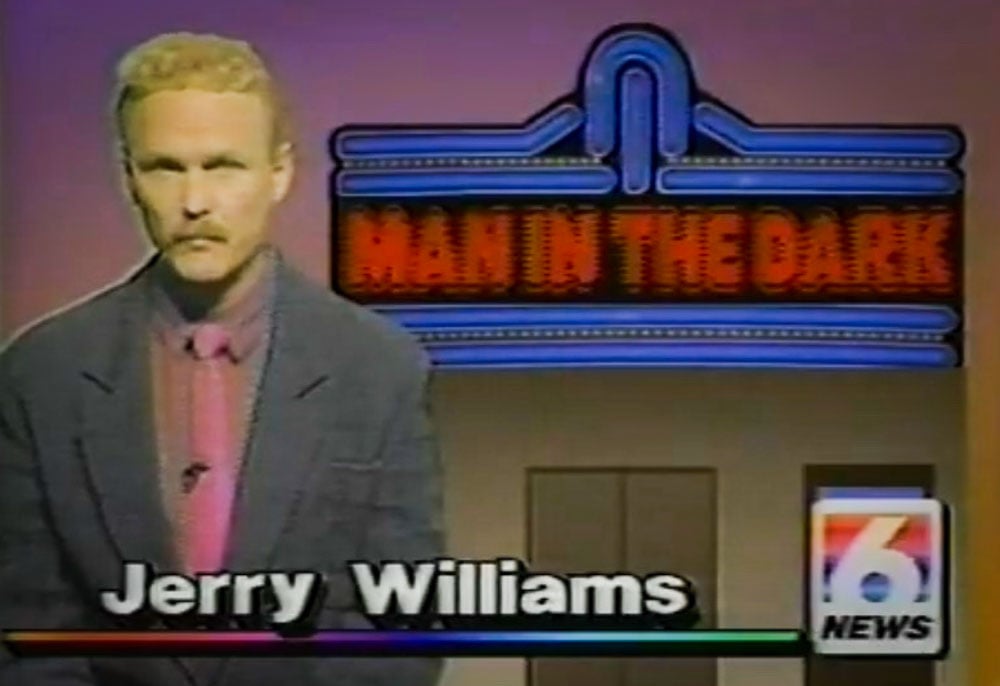
When I was at the radio station WJRB, I think it’s got a new name now, I worked with Fred Whiting. He became a reporter at Channel 6. He said, “We’re looking for a movie reviewer.” I auditioned and got the gig. That was 1972, and I was there for 14 years. It was always part-time, just come in and do my reviews and leave. “The Man in the Dark” was my nickname.
When I started “Tales from the Grips” back in 1989, the internet was still new, and I wanted to have a presence there. Writing in HTML at that point, I didn’t just want to put my resume up because nobody’s ever going to come back after the first visit. Videos, if you put them up, were the size of a postage stamp, so that was pretty useless.
I thought, “I know a lot of people in town. We’ve got to have some way to communicate.” Dave Gau and Mike Reynolds, both at Metro Video at the time, were on the first banner image. One was a grip with a cigarette in his hand, the other had on his work boots with his foot on a C-stand.
If people wanted to send me news, a new movie was coming to town, somebody was casting something, somebody bought a new camera, or somebody’s getting married, whatever, they had to fax it to me. This was pre-email.
I wanted to push to 20 years. By 2013, there was so much social media at that point. There were listservs, all these ways people were getting information, so I thought, “I’m just going to convert it over to Sifter.”
The subhead is, “We sift through the shit.” And the word “shit” is hidden under the R. I had book reviews, theater, movies, food, and some other stuff. A number of people in town were contributing. One by one, they went away, and it was just me, movies and streaming, and of course the podcasts.
T-Rav: Sifter, the podcast, is an outgrowth of that?
TVJerry: Exactly. I’ve been doing a podcast for 12 years and was doing it for eight years for the theater community. When I stopped reviewing and covering theater in town, I said, “I’m still going to do a podcast on film and TV because that’s really my first love.”
Before that, I worked for Richmond Public Schools for 10 years. They had a TV studio in 1979. They wanted to do communications for the whole division. That was in City Hall on the 14th floor. They had a studio with lights and cameras and produced stuff out in the field at the different schools.
When I left Richmond Public Schools in ’89, we had worked our way up to Beta, so the quality looked pretty good. But back in the ’90s, that was the heyday of the big-budget commercials. There were people like Jon Parks, Donald Silverman, Rip Charbonnet, all these people who were doing commercials, and it was nothing to spend $30,000 to $50,000 on a commercial.
I was a video guy. And even though, when I look back at my work, it was just as effective in terms of the content and style, I always kind of felt a little bit less than because I was making videos instead of film. I did shoot two film pieces. One was a commercial with Bunt Young, which is beautiful. I learned years later, my stuff is just as good, just not on film.
T-Rav: When at VCU in 1998, I was able to do a 16mm short film studying with Joan Stromer. The next semester, I got on the Avid and did a project on Hi-8 video. My next project was MiniDV. An amazing overlap of getting to cut on film, splicing a 16mm short, doing a video short, and then jumping to digital video, all in just two years. A crash course in formats at a unique time. There weren’t places to show work initially, but clearly all that’s changed.
TVJerry: Now you just put it on YouTube. I still edit my podcast on Avid Media Composer. The first couple of jobs I did at Circuit City, they had just gotten this new thing called Avid. I learned it there. Lots of phone calls to tech support. I can work fast, use a lot of keyboard shortcuts.
T-Rav: Wow, that’s amazing. I have gone through Avid, Final Cut Pro, iMovie, DaVinci Resolve, Adobe Premiere. I’ve been all over the place. For me, nothing beat the golden years of Final Cut Pro. Avid felt like constructing a video project. Final Cut Pro felt like virtually constructing a film edit.
TVJerry: There is lost media, unfortunately, with me and Richmond Public Schools. We did a lot of really interesting stuff. It’s all gone.
The coolest one I did was called Take a Look at a Book. There were three of them. We took 10 young adult books and did a little trailer for each, starting with science fiction and fantasy. Then we did a comedy, and then mysteries. Sometimes it would be in graphics, it might be animated, different ways to tell the stories. There was a little music video, all very ’80s. The costumes in those videos are hilarious. They were shown in the schools to get kids to read these books from the library.
One of them got banned from Henrico County because the book was called Where Are the Children? A popular book. There was a scene of an abduction of a little child they thought was too outrageous.
T-Rav: In the TV film critic era, did you have any contemporaries you were looking at? Were you doing your own thing, or was there film criticism that you had been inspired by?
TVJerry: I never really watched the other critics. I think it was before Siskel and Ebert. Now locally, I did an interview about a month ago with Marc Weinberg, who went out to LA and had a screenwriting career. He told me that he was actually on Channel 8 doing movie reviews.
Meribeth Brewster, who wrote for Style Magazine way back in the day, was on Channel 12 for years. Never on camera, she always did voiceovers. There was the great local reviewer Carole Kass, who used to teach a film history class at VCU. I was in her class, and we became friends.
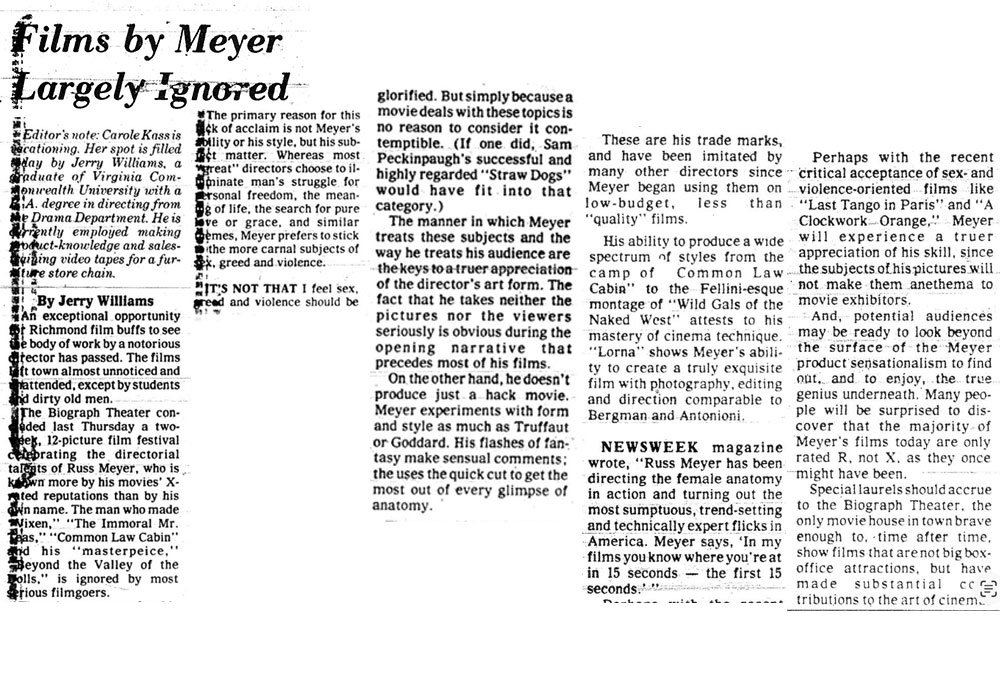
She was on vacation and said, “You want to write a column?” So I wrote this piece on the artistic merits of Russ Meyer because they were having a Russ Meyer Film Festival at the Biograph. I still have it. He was a pretty artistic guy, even though his stuff was pretty outrageous, but that was my first piece of critical writing in the Times-Dispatch.
T-Rav: Russ Meyer’s Beyond the Valley of the Dolls has that screenplay by Roger Ebert. Somehow film critics have always been in that Russ Meyer orbit. I don’t know what it is, “in on the joke,” seeing the merit of exploitation cinema, or the play with films that aren’t too self-serious.
TVJerry: That’s one of those, “What’s a movie that, if you saw it coming on tomorrow, would you watch it again?” Anytime I see that on, it’s still hilarious and outrageous.
In the column about Russ Meyer, I compared how one of his films was echoing Bergman and how he was playing with different styles that referenced other filmmakers. So he was kind of an artist, even though it was all about big boobs. I don’t know if he was conscious of doing it. It may have just seeped into his style, or maybe I was just being a pretentious critic and none of it was really there.
T-Rav: What do we call them, “director hallmarks?” (laughs) That’s one of the things about pattern recognition, particularly post-Cahiers du Cinéma, post-Auteur Theory, all that stuff that the French critics stirred up.
Either for the TV critics or when you got into “Tales from the Grips,” were you ever familiar with the Louella Parsons or Hedda Hopper era of news gossip columnists?
TVJerry: I knew who they were. I’m not that old, Todd! (laughs) I’m kidding.
One of the cool things that happened way back in the ’70s and the early ’80s, we had press junkets, which they don’t do anymore because of Zoom. They would fly me out to LA, San Francisco, or New York to see a movie. Almost every Star Trek, because Paramount was big on junkets.
You’d see the movie that night. The next day, they’d set you up. You’d do interviews, a 10-minute interview with three or four of the stars. They’d give you your tapes. You’d come home and put together your stories for your TV station.
I wrote concurrently for Style Magazine, writing short reviews every week. They had a double-page spread of all of my short reviews. You could open it and see everything in town. That’s why I’ve always written short. I did a piece for Style about junkets. They spent quite a bit of money flying all these people in from all over the country and putting them up in nice hotels. They said, “The fact that it’s you on your station, in your city and your market, has a much more powerful impact than reading about it in Time Magazine.”
I have a great reel of all the people, including Tom Cruise, who had a really great story. It was Top Gun. He wasn’t an enormous star yet. This was a New York junket. I knew my schedule was something like 5:30 to do the interview. I said, “I’m in New York. I’m going to see a matinee.”
Jessica Tandy and Hume Cronyn were doing a classic two-person show, The Gin Game. I went to the matinee and got back about 5, before my time. As the elevator doors opened, there was Tom standing there with maybe two or three people. I said, “No, no, no, don’t leave! I’m just here. I’ve got another 30 minutes!”
We went back in. He put the mics back on. We did the interview. They gave me my tapes. When I came back out to the elevator, he was standing there at the other elevator with his people. I pushed my button. He came over to me and asked me what I saw. We discussed the play a little bit before the elevator came and we left.
He didn’t have to do the interview. He’d already kind of finished for the day, and he didn’t have to come over and say anything to me afterwards, but he was that gracious. I was really impressed.
T-Rav: I would love to see the clip and to see that history.
TVJerry: I do have my final episode, my final report on Channel 6. It shows me through all the years, all the hilarious looks I had.
T-Rav: As a radio DJ, you had different names, and you had the different header during the ’70s and ’80s on TV. When did you take on the moniker of TVJerry?
TVJerry: When I started being self-employed in 1989, I had been on TV for all these years, and people just assumed because I was on camera that I knew how to produce and direct. Luckily, I did.
I made my career as a director. I had a business card, and when I decided to do a website, that was 28 years ago, TVJerry was available. That became my corporation and has been my brand ever since.
T-Rav: It might have been something where people called you that in such a haphazard and consistent fashion that it was bestowed on you. How nicknames choose us, and then we’re like, “I’m going to own it.”
TVJerry: Yeah, okay. (laughs) I’ll buy that. People got to know me by that. TV always had two meanings. It was me on TV, and then obviously the fact that I made TV.
I made my career doing corporate videos. I worked a lot for Circuit City, Capital One, all the banks, all kinds of corporations and government agencies in town and out of town, all over the place. And I never really wanted to make a movie. Because the thing about corporate videos is you work hard for a month, maybe two months, and you’re done, usually doing two or three at a time. With a movie, you spend six months to a year to three years on that one project. And if it sucks, you’ve wasted that much time.
My favorite type of film is narrative. I prefer horror films, comedies, and science fiction. Somehow I made a documentary as my swan song. I’m not even a doc fan, but obviously Dirtwoman became my feature film.
T-Rav: Have there been recent developments with that project?
TVJerry: It came out in 2018. The distributor has it until 2027, then it reverts back to me and I can do whatever I want. It’s still streaming on some of the free services like Tubi, and on some of the paid services, like for three bucks on Amazon. Plan 9 sells about 10 every year at Christmas. It played six festivals. I still get a report from the distributors that people are watching it.
I never did it for money to start with. When it reverts back to me, I’m just going to put it out on YouTube or Vimeo and say, “Watch it if you want to.” It’s not like any documentary that most people have ever seen. It’s got a very different vibe and a very different subject. Did you ever get to see it?
T-Rav: I haven’t since we talked about it. It’s always been on my list!
TVJerry: You son of a bitch! (laughs)
T-Rav: I’ll be one of the buyers in the next round of Plan 9 Christmas sales! My apologies! (laughs)
TVJerry: You can watch it on Tubi for free. You need to see it! When it played Movieland for a month, I would go over many nights and do a Q&A afterwards because I could. A number of VCU students were there, and the most common comment I heard from them was, “Wow, I never knew Richmond had this counterculture in the ’70s and ’80s, even the ’90s!”
And it does expose the days of the Cha Cha Palace. We’re talking the ’70s and all that craziness. It does give an insight into Richmond’s counterculture that a lot of people don’t even know existed.
T-Rav: I was a NOVA transplant coming for VCU. Richmond started for me in 1996. I heard about a patchwork history from mentors and teachers from the area. You said “swan song.” Do you have any interest in sharing any other bits of what you know about that era in documentary long form or short form?
TVJerry: I’m way too tired to do it anymore. I’m enjoying retirement too much. One thing that I considered, and all three of them are on my podcast, is Ray Bentley, who started the midnight movies way back in the ’70s. His sister, Rita Bentley, was on Q94 back in the Zoo days, and she was hilarious as Betty Bodine. And his other sister, Robyn Bentley, works at Diversity. She and Ray Bentley are the two voices that do the voiceover on the introduction for the podcast.
Their father was in radio. They’ve all had these amazing careers in radio, and their other brother, Terry, was actually on Sirius for years doing a radio show. So it’s a fascinating family in that they’re very creative, they’re very unique, and very talented.
But it’s just too much trouble. Dirtwoman was two years and 70 interviews. Since I’d been working in the community for so long, I would call in favors, and I shot some myself because I didn’t have a choice. But I did all the directing, the producing, and the editing of the project. It was a lot of work.
T-Rav: Would you consider continuing to have that be a part of the podcast, and the audio storytelling is surfacing some more of the stories from Richmond’s past?
TVJerry: That’s interesting. The focus of my podcast is film, TV, and streaming, so it would need to be something related to that.
I have interviewed people like Guy Spiller, who started BES Teleproductions. They were the first real serious production company in town, and actually they shot one and edited both of the music videos I did. There was a band here called Single Bullet Theory. They toured with the Pretenders and some other acts, and they had a song on the charts. Their album came out on the same label the same day as Michael Jackson’s Thriller. So needless to say, they disappeared.
But they did two music videos, both of which I directed. One of them we shot at the old big hotel across from the Science Museum. We shot that overnight on one-inch tape. And then the second one we shot on film. The late Jon Parks shot that at the Empire Theater. Both of those were on MTV before the band went away.
T-Rav: Wow! I first became aware of “Tales from the Grips” and part of your story when I was editing with Robert Griffith on his documentaries about the Movie Making in Virginia. While we were working on the project, he would tell me about the film production community timelines. It was always like little fragments of puzzle pieces, all super important to the story. I am thankful that you have shared your parts of it.
TVJerry: And getting harder and harder because people are getting older and/or dying.
T-Rav: The other thing about media, with Dolly Parton’s passing yesterday and then today the announcement of Tim Curry, is the awareness of young people to those before whose impact was massive in the mass communication system we have now. The numbers have extrapolated so much that more people have had more impact on more people. But the way time works is pretty unforgiving.
TVJerry: Speaking of Tim Curry, Mark and I were just in New York back in May, and we went to see the new version of Rocky Horror. We’re coming out of the Hotel Chelsea to go to the show, and the young doorman was probably 22. He said, “What are y’all seeing tonight?” I said, “Rocky Horror.” He said, “What’s that?”
I was blown away, and his friend standing next to him, who was also in his 20s, had no idea what it was. So I just thought that was part of the cultural zeitgeist. But it’s been almost 50 years.
T-Rav: Growing up in New Orleans for the first 12 years of my life, there was a legendary, ongoing, midnight movie, participant-driven Rocky Horror Picture Show uptown. An experience I never got to do. My older brother had done it, but I would hear it announced on the radio.
Before I saw the film, the legacy of the participatory revival screenings, the pop cult, was very apparent and common knowledge. Now there’s just so many fractures, there is nothing that seemingly connects everybody.
TVJerry: You’re right. Interesting thing about Rocky Horror, back when I was at Channel 6, I shot a report for the TV station on Rocky Horror. I went there one night at midnight to the Biograph, and we shot the action and the whole thing.
I posted that on Facebook last year when Rocky was having its 50th anniversary. And Jeff Rathner, who used to live here and is back now, said, “Hey, I shot that for you way back in the ’70s!” So that was pretty wild.
T-Rav: Those video history things are important, particularly, like you were saying earlier, all these smaller markets have their stories too. What was the role of the TV critic when you were starting out? And then what do you see as a content reviewer now?
TVJerry: Well, I never called myself a critic. I always called myself a reviewer, only because, for me, “critic” sounded more like an intellectual discussion of the “cinema.” And I’ve always just been a moviegoer.
It obviously had more power then because there weren’t all the other ways to find out anything. There was no IMDb. There was no Rotten Tomatoes. You either had to read a review or you happened to see it. And now, I don’t even know how much it matters.
I do have people who click and read my reviews regularly on Metacritic. One reason why my reviews have lasted is because they’re short and sweet. They’re never more than probably five or six sentences. And most people don’t want to read 800 words on a movie. That’s an intellectual pursuit. They just want to know, “Do I want to see this movie? What’s it about?”
T-Rav: Do you choose what you go to, or are you invited to review certain titles?
TVJerry: No, I pick what I want. Paul Bruski, who is an engineer at In Your Ear, coined the phrase “jobby,” and I consider my website my jobby. I don’t get paid for it. It’s like a hobby, but it’s a commitment that I pretty much do almost every day.
As you get older, you should stimulate your brain by doing crossword puzzles or something to keep your mind agile. I consider the fact that I get up and write a review almost every day as an exercise for my brain. If people read them, great. If they don’t, it doesn’t matter to me. It’s just for me.
T-Rav: Do you have some special, memorable Sifter episodes you’ve done, conversations you’ve had?
TVJerry: I think the most popular ever was Terry Rea talking about the Biograph. Ray Bentley’s is actually pretty fascinating, about midnight movies. Gene Poe, a Virginia resident who went to VCU with me, made his living as a background actor in Hollywood for years. Do you remember the orange juice commercials where they’d have an orange and then stick a straw in the orange? Those were his hands!
Chris Leary did makeup for Bowen Yang on Saturday Night Live, a theater at VCU graduate. VCU has had a lot of amazing people come out of there. Richard Hankins, who’s going to be on next week, graduated from VCU in set design, and he won two Emmys and was the production designer for NYPD Blue for 10 years.
Constance Wu, who grew up in Richmond, was in a video for me when she was 14. She went on to do Fresh Off the Boatand Crazy Rich Asians. Blair Underwood, Daphne Reid, Caroline Aaron, who people know as Shirley Maisel on Mrs. Maisel. She’s a Richmonder.
There’s over 200 of them. I do try to cover most of the film festivals in the area and the movies from those, to see some of these movies that are coming up that aren’t even out yet.
I did get to interview Françoise Ravaux-Kirkpatrick and Peter Kirkpatrick about the French Film Festival and how they started it, and then why it ended. When it ended, there was really never a discussion of what happened. It just kind of stopped. So that was kind of nice to get the interview with them on that.
T-Rav: I’m glad you were able to capture that. It was such a major part of Virginia, and Richmond specifically, connecting to the world of cinema. I got to meet Bertrand Tavernier one year and Pierre-William Glenn, who was the cinematographer on Day for Night.
TVJerry: I love that movie. Truffaut was an early influence. Richmond is a surprisingly vibrant community for production. It always has been, but I keep discovering these people, like the couple who did Wildcat, which was an Amazon series.
Then there are people like the people who did Futuropolis, which was a fun movie from the ’80s. One of them went to work for Pixar, the other went to work for Pee-wee’s Playhouse. Cryptozoo, Dash and Jane, they’re right here in Richmond doing their kind of animation. You don’t even know who is there, and all of a sudden, wait a minute, they got a movie out.
T-Rav: As you’re checking out these movies now and then, do you see anything about the community experience of going to watch something together?
TVJerry: Absolutely. I go to Movieland at least twice a week, and on Monday nights now the parking lot is half full, which used to never look like that after COVID. A lot of the younger generation are coming out to the movies. That’s what made Obsession and Backrooms so popular.
The biggest hole, that has been discussed more than just by me, is for anything for people over 40. They do have these retirement community comedies, usually a murder mystery, and they’re usually pretty wretched. There’s not a lot in that middle range of maybe an interesting rom-com or a good little comedy. It’s harder and harder to get those things in the theaters.
Obviously, Spider-Man and The Odyssey, people came to see those. If the movie is something people want to see, they will come out and see it. It’s coming back.
T-Rav: Were there a couple of films that, before you got into reviewing, were sort of all-time favorites and have stayed with you?
TVJerry: I loved, way before MTV, I loved musicals. And I don’t mean the classic musicals like Oklahoma!. I mean like Hair, which Miloš Forman directed, Tommy, which was Ken Russell. I like those kinds of movies because they were excessive and over the top, and that’s kind of always been in my work. When you see my documentary, there’s a certain energy level to those pieces.
I can remember as a kid seeing This Is Cinerama. It was three big screens connected. That made a real impression on me because it was so impressive and so big, and then at the end you get to ride a roller coaster on it!
T-Rav: What about now? Is there anything that, in the Sifter era, has been a favorite? Once you’ve seen it, you’re like, this has reached the all-time level?
TVJerry: Wow, I’m trying. The problem is, when you see two movies a week, it just starts to get such a blur. I can’t remember everything.
I do remember when Anora came out, the Sean Baker film that won an Oscar for Best Film. I loved that film, and I thought it was great. A lot of people hated it.
Last year, Frankenstein, I thought it should have won Best Film. If you saw it, especially on the big screen, it was so gorgeous and so grand in its storytelling and its visuals. That movie didn’t get enough love because it pretty quickly went to streaming, and it didn’t have the same effect.
Hopefully, the thing we’re going to see tonight is getting a lot of good press.
T-Rav: And what are we seeing tonight?
TVJerry: Miasma Camp or Camp Miasma is the short version of it. It’s Teenage Sex and Death at Camp Miasma.
You can follow TVJerry on instagram HERE and his website HERE
Support RVA Magazine. Support Independent Media in Richmond.
RVA Magazine has remained one of Richmond’s few independent voices. Since 2005, we have provided grassroots coverage of our artists, musicians, and communities, marginalized or otherwise, documenting the city’s culture that lies right under the surface and beyond the headlines.
But we can’t do this without you. A small donation, even as little as $2, one-time or recurring, helps us continue to produce honest, local coverage free from outside interference. Every dollar makes a difference. Your support helps keep us going and keeps the local creative spirit alive. Thank you for standing with independent media, and thank you for reading.
Show your SUPPORT HERE
Also, subscribe to the newsletter HERE
We’ve got merch HERE
Subscribe to the Substack HERE
And Reddit HERE
And YouTube HERE