
As a creative (and sci-fi influenced) writer myself, I have a magnificent appreciation for Prometheus, for both what it did and didn’t do. Call it Zen, but the omission of directness, the constant open-endedness of the questions asked and the overall work required of the viewer are exactly the methods that I use to spin my own fiction.
You could call this manner of art selective in a self-defensive sort of way. The deliberate uncertainties seem to end up weeding out those unwilling to make a bit of effort on their own.
However, I can and do fault the movie’s execution a bit. As a complete, whole film, it does have its shortcomings, but I see them more as superficial blemishes than egregious failings.
As an earliest-prequel platform for presenting an incredible array of new ideas fostering a reinvigoration and support of elements from the older movies, Prometheus is tremendously exciting and arguably, necessary. And rather than nitpick away at the film’s mistakes, I’m here to catch you up on its merits and ready us for the next installment, Alien Covenant, which opens May 19th.
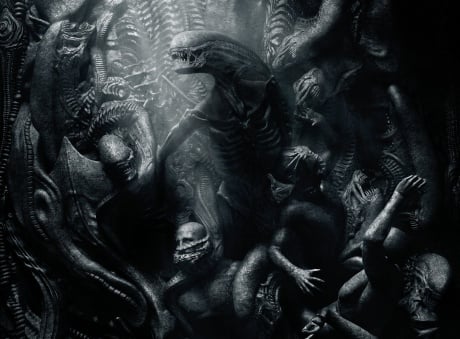
So for those completely uninitiated, the basic premise of Covenant is this: Ten years after the events of Prometheus, a Weyland-Yutani expedition named Covenant is sent to a distant planet, rumored to be a paradise. Comprised of couples, the intention of the groups’ “large-scale colonization mission” is quickly sidetracked with a number of discoveries and interactions.
The first thing encountered is the Juggernaut ship that we saw Dr. Shaw and David fly away from LV-223’s story in Prometheus. That discovery inevitably leads to Shaw’s dog-tags, and somewhere along the way, the crew comes across David, who has definitely been up to things.
Without spoiling anything, the arc of David’s character is the most dynamic and undoubtedly going to be the most pivotal of this pre-franchise. There is a fair amount of information on YouTube and the Internet about what he’s been up to since we last saw him, but I’ll leave it to you to investigate at your own risk.
But from the teasers and official trailer, one might ponder questions such as:
-Who planted the wheat?
No clue.
-What are those things that are seen stepped on and broken apart, and what is it that flew in the guy’s ear?
My guess is that they’re, if not a dried form of it than at least related to, the accelerant. (See below, “What is the black goo?”)
-What do we infer by the apparent lack of wildlife/fauna on this planet?
Either it never had it or something wiped it out. We’ll just have to see.
-What do we infer by David/Walter onlooking as Billy Crudup’s character makes that same fatal John Hurt mistake of 1979?
This is one of those threads that is out there if you want to know it.
-What happened to Dr. Shaw?
No clue, and see below also.
-What happened in that field-sized area filled with dozens upon dozens of those black-charred corpses?
Again, like the Walter/David story, this area has answers for you if you don’t mind encroaching on available spoilers.
In reference to just how unanswered some of these questions remain, let’s hold off on the the movie’s too esoteric argument until we have all the films for the franchise completed.
For now, my suggestion (identical to how I’d instruct people to participate with my own work) would be to enjoy the ocean of possibility that Prometheus left us to float in, and if you’re inclined, get proactive and do a bit of diving.
This is exactly how I was lead to The Report, which immediately provided reward for my extra work, and clarified much of the entry-level doubt that Prometheus is partially, and unfortunately, still mired in.
Please consult Alien: The Weyland-Yutani Report by S.D. Perry. It’s a terrific resource that, without doubt, fills in some of Prometheus’ blanks more than you might’ve ended up trying yourself.
And in the admirably immersive way of citing our insufficient security clearance within the Weyland Corporation, The Report indicates our/the characters’ awarenesses of some of these elements from the film that ask multiple questions, but deftly stops short of full explanation… either using Company-based hypothesising or redacted text.
Here’s a quick rundown of some of the most primary questions from Prometheus.
-Did the Engineers create us and if so, why? And why did they (seem to) decide to want to wipe us out?
Well, it doesn’t necessarily follow that just because the DNA typing matched that they were the ones that created us. It is possible that, although they’re clearly related to us, our creation was not necessarily a voluntary action by the Engineers. This proposal of course only leads to more questions, but given what we saw the Prometheus crew discover upon arrival to the site of the “invitation,” and how terrible the majority of their encounter was thereafter, those depictions could instead have been a warning to stay away from the area.
But without even clarifying whether or not the Engineers did create human life, the question of “why” they would create human life is much more expansive and thought-provoking.
If the Engineers did create us, they might have done it just as Holloway told David in their tete-a-tete about why humans had created him and APs in general… simply because they could.
But given how easily and quickly we move past more speculation on this topic by assigning Holloway’s answer to the question of the Engineers’ motivations, I’ll bet that setup was a temporary diversion and we have a cooler, more practical or philosophical explanation coming our way.
The reasoning could be presented as the growth of human life to strengthen a planet’s resources, and the Engineers either succeeding or failing in their own efforts based on the success or failure of the humans they “planted.” Or it could end up being as experimental as planting human life to see if it grows at all or just destroys itself.
Depending on the recipe, and the quality of the individual ingredients, some batches are better than others. This line of thought certainly allows the bad-turn-taken possibility of extermination being an effort to quell bad results.
But even if this is to say that human life, as shown in Prometheus, is malformed and not what was intended, the question of when/where/how we fell short of expectations still remains.
This inward reflection on human’s histories and behaviors to identify shortcomings that warrant our extermination is something that leads to some quite serious, real-life ruminations. In my opinion, this is very effective and admirable art.
-What is the black goo?
It is formally referred to as “accelerant,” and although Weyland-Yutani appears to know a little more than we do, even their understanding of its nature, purpose and function is admittedly still limited. Obviously, it seems to alter the genetic structure of any living organism that comes into contact with it, and also the speed and nature of the results seem loosely proportional to the amount of accelerant that was contacted and how the accelerant was contacted.
The premise of the accelerant is perhaps my favorite aspect of Prometheus outside of the Engineers themselves. It has only been very cryptically observed, with those examples varied and piecemeal. The “introduction” of the coalescent airborne spores, as seen in the Covenant teaser, entering a crew member’s ear, leads me to believe the spores are at least partially related to the accelerant. This would mean there are now several different methods of interaction of this stuff with hosts.
And to explain why I have introduction in quotes above, I’d like to bring our attention to the beginning of Prometheus. We see the lone Engineer disrobe and drink a concoction of what I believe to be a cupful of properly and correctly cultivated accelerant, and his/its resulting physical disintegration is largely lost downward in the churning of the waterfall’s current. But if you’ll notice carefully, some of this decomposing matter is swept up in the wind and carried into the air.
My peer-in-nerdiness brought this to my attention recently, as he’d noticed it himself. I felt that all-too-familiar moment of incredulity that occurs often with Prometheus: the joy of discovering something so pertinent to the plot that had been shown to us so unassumingly that it was almost entirely overlooked.
These are the film’s silent successes that I adore so dearly.
So after my peer had shown me the waterfall scene in this new light, I discovered something and shared with him. During the Prometheus crews’ first venture into the Engineer’s “pyramid”, David activates a playback of what we’re assuming was the last recording in the place, showing several fully suited and masked Engineers running away from some threat.
What I never noticed until recently was that the little blips seen all over the place amidst the Engineers running are NOT visual static of the holographic recording, but (I think) are actually airborne spores infesting their area. If you notice, none of the other instances of the holographic recordings have these “static” dots, which I feel supports my guess. So although the spore-thing entering the Covenant crewman’s ear seems totally new, we have indeed been shown a little bit of this premise already. That is assuming of course, that these two instances of accelerant-contacted airborne particles are related.
-What happens to Elizabeth Shaw?
This isn’t actually answerable, and I’m personally looking forward to many more aspects of Covenant than the possible reappearance of her character’s Christian faith-based arrogance but I include the question here regardless.
Her character’s presence is at least maintained indirectly by the part in the trailer where (newcomer Katherine Waterston as) Daniels examines the dog-tags that are seen to say “DR E Shaw.”
But without any sort of confirmation that Noomi Rapace has been filming with the Covenant crew, we can only guess. I do hope there is sufficient backstory to tell us what happened to the good doctor in 2094 AD, because having only seen those dog-tags and not her remains, it might be presumptuous to think that she’s dead.
In a short series of TV spots earlier this month, now available on the official Alien Instagram account and YouTube, new footage from a few scenes was shown. Therein, a few frames of a holographic recording inside a Juggernaut’s (Engineers’ airship) flight room show someone seated at the copilot’s chair that is very clearly not an Engineer, if not someone who looks to be female and with shoulder-length hair. Again, perhaps not definitively Shaw, but another clip from that same new mini-teaser shows Dr. Shaw’s dog-tag now up close and clear, so the implication seems authentic.
Don’t get me wrong- I don’t dislike Dr. Shaw, but other than the direct connectivity to Prometheus that her fate and that of David’s do supply for us, I’ve moved on. And I must point out that although I might seem to disregard Elizabeth Shaw, I am certainly not disregarding the religious aspects of Prometheus nor Covenant.
Aside from the names themselves being obvious enough elements from various tales of the divine, we have; Shaw’s faith and belief providing the impetus for Weyland’s own crazed and ill-fated quest for immortality, we have the creation of David- after gods’ hearts, and we have the challenging of notions of God with the introduction of the Engineers.
A few weeks ago, I found a sizeable and chillingly precise YouTube comment (Found here, second from the top, spoilers possibly present, ye be warned!) explaining that the name of the moon of Prometheus, LV-223, is a Biblical reference and that the passage (again, chillingly) corresponds to the Engineers’ imperatives regarding anyone meddlesome or ill-intentioned who was found in their areas.
Further still, this contributor (with seeming infallibility) even mentions the religious beliefs of the Engineers and talks at original-writer’s-level lengths about the rooms with the giant head-statues and the accelerant vases… partial “hows” and “whys” as to that rooms’ arrangements that involve things like “field resonance” and “perfect calibration.”
It’s incredibly fascinating, but technically unsubstantiated. Nonetheless, these ideas do for a gluttonously ample amount of brainstorming make.
I’m so enamored by how brilliantly and deliberately the extent of the film’s open-endedness is being kept. My thoughts on the plot movements, taken with Prometheus and soon with Alien: Covenant, could be just as correct or incorrect as the next persons’, assuming we’re both sure to acknowledge ALL of the pieces of the puzzle provided thus far, is one of the coolest aspects of this universe at this pre-Covenant point.
And as to their finished shape, and even the directions in which these pieces and speculations will be placed are still far from certain.
In cases such as Fassbender’s role as artificial person David, these uncertainties are wide and deep enough to prevent us from definitively defining his role.
And while we’re on the subject of artificial persons(APs)… have you met Walter?
Thanks to Fassbender, in A:C will we now have present the next model of APs from the Weyland Corporation line: Walter. In the ten years between Prometheus and Covenant, the Weyland Corp. acquired the cybernetics company Yutani, and now as Weyland-Yutani Corporation they release their newest model Walter “to serve.”
While we will have to wait at least until May 19 to get a more substantial slice of observing its behavior, we can reasonably infer that the new Walter models might not have any dangerous traces of some of David’s boyish curiosities.
Speaking of older and newer model comparison, I’d dare say that that one of the biggest potentials for errors-of-incongruity will be the necessary devolution in terms of the technology used on-screen. We all remember Mother from the 1979 original, in all her MS-DOS-lookin’, typewriter-soundin’ glory, right?
With a scant 18 years between the events in A:C and the horrors athwart the Nostromo crew, there will just have to be measures taken to explain how what we see in Alien looks the technological age it does when obviously sleeker and more futuristic aesthetics appeared before then chronologically.
I myself would be reasonably content with a cursory, even indirect explanation thrown in a dialogue somewhere in A:C given that we already know this. Yes; the Prometheus (the craft itself, not the movie) looks much cleaner and hi-tech in its aesthetic than the Nostromo, which is kinda-sorta bucket’o’bolts, but consider the socio-economic disparity of the actual crews. The Prometheus was the Company’s flagship scientific exploratory vessel ferrying Sir Peter Weyland himself, despite the crew not knowing this initially, and not to mention his daughter being there voluntarily as well.
I can reasonably trust that the head family of any company would travel comfortably. And conversely, the people on the Nostromo were a bunch of low-level grunts who were on their way home from an ore refinery on a tugboat that was 23 years old and had already once been rebuilt and repurposed.
But before we devote all of our energies to having all the answers with this upcoming release, we should bear in mind that it has been confirmed that the script for a Covenant 2 is already finished; allowing at least one more chance for tying up ends before the events on Alien’s LV-426. So as much as I’d like to promise you that Covenant will have answers to every question raised by Prometheus and still needs to asked to precede Alien, I’ll bet that Sir Ridley Scott is allowing himself another movie for just that.
Also, in the interest of having a clarified and clarifying but *SPOILER-FREE* piece, I’ve chosen to omit a very substantial bit of information from this preview that is publicly available elsewhere.
At the South By Southwest festival this year, lengths of three different scenes amounting to about 19 minutes were shown to an audience. Obviously the footage isn’t accessible, but there are at least several writeups from those in the audience, one or two of which mention the new things that they saw.
Of what I’ve read of the things that were seen, they are of massive interest to any level of fan, in my opinion.
I will leave it to you to check the article(s) at your own risk. I was ready for the next parts of the puzzle to be explained because I had already done all the work myself of fitting together the pieces that I knew we had. I’d spoken to my most Alien-nerd-peer-in-speculation about my newest revelations that occurred during my most recent Prometheus rewatch, and he told me, after listening, that I was at the literal doorstep of the new material in the SXSW footage.
So if you don’t mind knowing a very cool piece of the new story direction, and aren’t worried about the spoiler answering even a quarter of all the questions, I’d give it a gander. There’s still a great deal of points both in Prometheus and in the Covenant trailers that has yet to be concretely addressed. (Link to this *partial-SPOILER* here)
One of the (*NON-SPOILING*) things that I read of the SXSW footage experience was how horrifyingly gruesome two of the scenes were that involved a larval xenomorph breaking out of its host, in whatever fashion. We know about one of these instances from the teaser and the official trailer- the backburster. It was said that this scene (or the one that most of us haven’t seen, the specificity of which is both absent and inconsequential) makes the alien-host break-out scene from Scott’s 1979 original seem like “a Disney film.”
To me, this was a strong indicator that Scott and his teams were out to reset the bar for horror-based intensity in the same way that the 1979 film did. And it only adds to Alien’s timelessness that Scott could, can and would approach that movie’s beginning with multiple prequels.
Credit to the mystery and intrigue of an idea lasting 38 years, due unconditionally.
I’d say that just based on the sheer number of monster-onion layers found in Prometheus, that Covenant is going to start answering our biggest concerns, but still not without further expansion. Question-raising is a hallmark of good science fiction, and I’m now delighting in that more than I am in the hair-raising.
And with the Alien universe’s inclusion of the elements of Prometheus, we have scares and smarts, and in quality. So here’s a toast to Covenant widening them both.