Featuring Jane Fonda at her early-70s best, this atmospheric mystery from Alan J. Pakula shines in its new Criterion Collection reissue.
Successful producer-turned-director Alan J. Pakula hit a hot streak in the 1970s, beginning with his “Paranoia Trilogy” — three films with a visceral sense of atmosphere and a Hitchcock-ian sense of voyeurism, which was conveyed like few others could.
The trilogy began with Klute, followed by The Parallax View, then finally culminated with All The President’s Men, which earned Pakula an Academy Award nomination for best picture. The tough and stylistic Klute was his second film, one that established him as a force to be reckoned with, and proved that some producers can also be good directors.
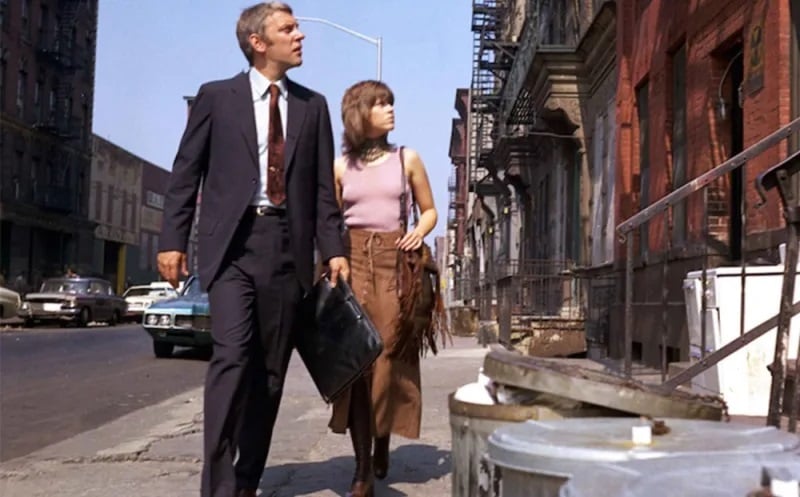
In Klute, Rural Pennsylvania private investigator John Klute (Donald Sutherland) relocates to New York City to investigate the disappearance of his friend Tom Gruneman, a seemingly-ordinary executive. It seems that before his disappearance, Gruneman had been sending lewd letters to Bree Daniels (Jane Fonda), a gamine call girl he had supposedly met before. The enigmatic and persistent Klute tracks Bree down and takes up residence in the basement of her apartment. He quietly observes her and taps her telephone.
When he finally makes contact to question her, Bree claims not to remember Gruneman — but says that perhaps he was the man who assaulted her once. She agrees to take Klute to meet her pimp, Frank (Roy Scheider), who leads them to a former acquaintance of Bree’s named Arlyn Page (Dorothy Tristan). Having burned bridge after bridge in her personal life, Page is now a hopeless junkie.
The parallels between Arlyn and Bree pretty much end with their profession; Arlyn’s seemingly doomed existence has become pitiful, while Bree remains optimistic about transitioning from sex work to acting and modeling. The dichotomy between her daytime struggles for legitimacy and her fruitful night job are evident, and despite her ambition, Bree seems to prefer the control and freedom she has as a prostitute.
Klute thinks that Arlyn may hold the key to the mystery of his missing friend, but any hope of that is lost when she’s found dead in a river. Meanwhile as a romantic relationship starts to blossom, paranoia sets in for Bree as she starts to feel that Klute is not be the only person who has been watching her.
Filming of Klute coincided with Fonda’s newfound politicization, as she became an outspoken activist against the Vietnam War. Indeed, an argument could be made that, even to this day, she is still the most politically-outspoken star Hollywood has ever seen. This “radicalization,” as it was often referred to, was reflected not only her choice of roles but also her outward appearance. Where through most of the 60s Fonda wore her hair long and blonde, typical of what was needed for the ingénue roles she was playing at the time, her hair in Klute was dyed back to her natural brown — and furnished with a bold new shag cut that had never been seen before.
Bree’s situation, caught between two worlds, served as a shadow of Fonda’s own sense of self, and her examination of the world she lived in. Initially, Bree treats Klute as one her customers; passively flirting, manipulating, and being playful, but quickly the relationship transitions into something more genuine.

Acting and role-playing are central themes in Klute, and her “performance” helps Bree examine herself and find her independence. While her profession is at odds with her true self, Bree continues her lifestyle as an attempt to escape her own feelings and desires, numbing her emotions through mutual manipulation.
Throughout the melodrama, this neo-noir presents an earned character study worthy of dissection. Fonda’s reservations about playing a call girl manifested early, as she attempted to drop out of filming and suggested Pakula replace her with Faye Dunaway, which Pakula flatly refused. Ultimately accepting her role, Fonda worked to manifest Bree’s character as closely as possible, achieving truly exceptional results that earned her an Academy Award.
Fonda’s exemplary feminist characterization of Bree still rings true almost fifty years later. Living on set helped Fonda understand the character, while also allowing her to exercise her political ambitions: during downtime on set, she sent letters and made phone calls. Pakula even set up Fonda’s apartment to be functional, complete with working toilet, electricity, and water.
Klute himself remains enigmatic throughout the film, but shows a great deal of sensitivity toward Bree. Sutherland’s understated performance creates a mysterious, static image of a character that never shows a strong moral compass. Instead, while fiercely determined to solve the mystery of Gruneman’s disappearance, Klute works not to save Bree, but ultimately to understand her without judgement. As for Bree, her future is left open-ended; for the purpose of the film, though, her story has come to a close.
Klute comes to the Criterion Collection for the first time on Blu-Ray, newly restored in a fantastic 4K digital transfer supervised by camera operator Michael Chapman with uncompressed monaural soundtrack. Supplemental material features interviews with the one and only Jane Fonda, conducted by actor Illeana Douglas.
There’s also a new program on Pakula by filmmaker Matthew Miele, featuring interviews with filmmaker Steven Soderbergh, film scholar Annette Insdorf, and actor Charles Cioffi, plus archival interviews with Pakula himself. Klute In New York, a short documentary made during filming, is also included, along with a look at the burgeoning fashion of Klute and its early 70s time period by Amy Fine Collins, an essay by critic Mark Harris, and excerpts from a 1972 interview with Pakula.
Long overdue for a Blu-Ray release, and arguably Fonda’s best performance of her career, Klute was considered remarkably innovative upon release and still remains so. It remains a dark and sexy feast for the eyes, with exceptional lighting, use of shadows, color, and use of reflections and glass to illuminate the mysterious aspects of the film. If 70’s cinema means anything to you, this film is required viewing.
Alan J. Pakula
United States
1971
Spine #987
Available on Blu-Ray and DVD