And what a fantastic planet it was. Renè Laloux’s 1973’s Fantastic Planet (or Wild Planet depending on how literal you like your translations) is a positively surreal. Winning the 1973 Cannes Grand Prix Prize, the film is imaginative, engrossing, and original in the most fantastical sense.
And what a fantastic planet it was. Renè Laloux’s 1973’s Fantastic Planet (or Wild Planet depending on how literal you like your translations) is a positively surreal. Winning the 1973 Cannes Grand Prix Prize, the film is imaginative, engrossing, and original in the most fantastical sense.
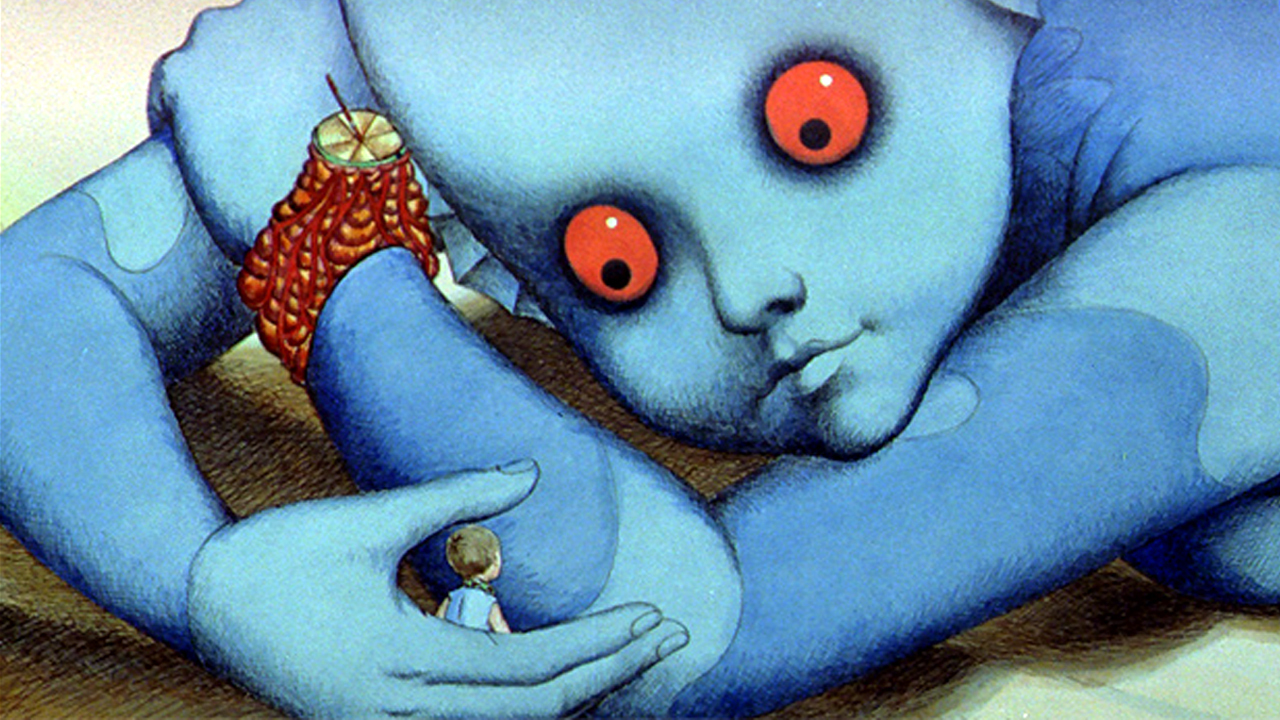
Written by Roland Topor and inspired by the 1957 book Oms en série, the film follows the small humanoid Oms who live on planet Ygam. The Oms are not the dominant species on this planet, as they are either pets or pests by the giant blue Draags who often pity them, scorn them, or worry that they breed too fast and will infest their living spaces. The Draags can shape-shift, have red eyes, webbed ears, and have reptilian-like blue skin. They are not only bigger but are more technologically advanced, intellectual, dominate, and more organized. More importantly, the Draags have sheer visceral strength on their side.
Large portions of the film are dedicated to how easily and horrifically the Draags and planet inhabitants can wipe out the Oms with relative ease. The first scene of the film involves a Draag unsettling toying with a mother and its child as it tries to run up a hill. The Dragg, a child itself, playfully kills the mother and adopts the baby as its new friend and plaything. Even when the Oms are adopted as pets, the Draags are often negligent and bougie caretakers. We see them have hallucinatory bouts of group meditation to learn and spiritually grow, while juxtaposed to them making the Oms fight to the death for entertainment. Not to mention how often the oms are clothed in ridiculous outfits, kept in dollhouses, and taught to perform tricks for amusing the not always benevolent Draags. Frankly, it is a hellish life for the Oms. Despite all their progression, the Draags seem to be unaware or unconcerned of the sadistic pain they can inflict.
As far as actual animation goes, Fantastic Planet values the sui generis artwork coupled with a thought-out story over perfect animated fluid movement. It shows great detail in the design of the world, the characters, and in the pastel matte colors it uses. The film was of a low budget and economically sacrifices and strategically cuts corners, which are admittedly negligible, to shine with it’s creative style, technique, and suggestive content. Despite the financial limitations (the film was actually outsourced to Czechoslovakian animators) the craft and care within still shines bright and delightfully eye catching, often feeling like a storybook come to life. Which with the storytelling as simple as it is, is very complimentary. The camera is often cold and stoic often mirroring that of a wildlife documentary or a static picture book.
There is something ironic about the title Laloux’s underground space odyssey of sorts. Are we not appalled by the brutality of this world, yet it is not that different from our own beside the technology (it’s actually not that far from where we are) and how we treat our own planet? While certainly a sight to behold, it tangibly gives off the worst survival of the fittest vibes even within the first moments of the story until its very end. Big plants eating men and creatures devouring each other, it’s the stuff that haunts your dreams at night. Laloux himself made only two other features (1982’s Time Masters and 1988’s Light Years), but Fantastic Planet remains his most mesmerizingly weird and entertaining.
Arriving a little over a year after the much relished Watership Down, Fantastic Planet is the second animated feature in the Criterion canon and another marvelous entry. Brought over with a 2K digital restoration and along with an uncompressed monaural soundtrack for the Blu-Ray, it’s a strong visual and audio repast. The supplemental materials not only include an alternative English-language soundtrack but a new English subtitle translation, two early short films by Laloux and Tapor, and an episode of the French television program Italiques about Topor’s work. There were some early concerns that a blue hue was added to the transfer, but it seems to be a bit exaggerated and absolutely works for the film. Beefing up the release is also a documentary Laloux sauvage, a 2009 documentary on Laloux and his varied background and life. Rounding it all out is a rousing interview with Topor, the film’s trailer, and an essay by critic Michael Brooke. It’s a fantastic ensemble of fascinating extras to compliment an already trippy film.
Fantastic Planet
France, Czechoslovakia (1973)
Renè Laloux
Spine #820
Available on Blu-Ray, DVD, and Hulu Plus