
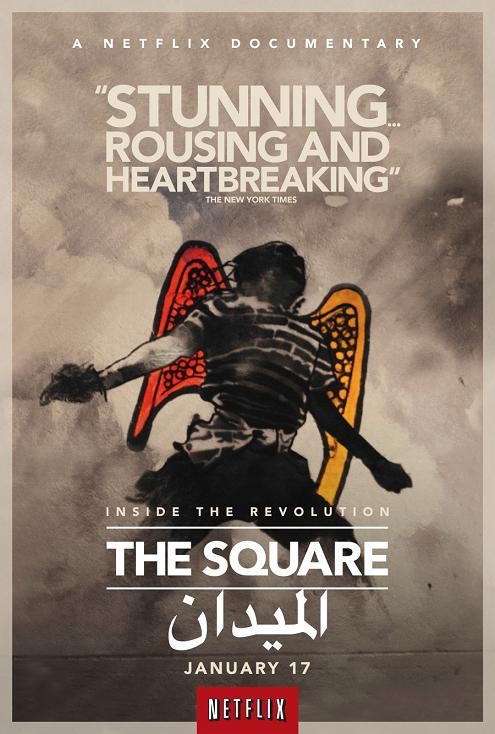
“We don’t need a leader. We need a conscience.”-Ahmed Hassan
Before watching The Square, I had little to no knowledge of the events of the revolution in Egypt over the last few years. I was shocked, and admittedly disappointed in myself, for not even being semi-conscious about the suffering, the fighting, the deaths, and the measures Egypt’s military were taking to silence the young activists who were trying to change their country for the better–and have been paying a high price ever since. Directed by Jehane Noujaim, alongside a positively fearless crew, The Square transports audiences to another country where Franklin D. Roosevelt’s Four Freedoms (freedom of speech, freedom of worship, freedom from want, and freedom from fear) are the hopes and dreams of the struggling activists for the people’s revolution in Egypt. Thanks to Netflix, audiences the world over can get a firsthand account of the horrors of military law in Egypt, the weariness of the activists, the frustration of the citizens, and the bravery, strength, and passion of those who are battling all the odds for a better tomorrow.
Egypt’s political history has cast a dark shadow over the countries inhabitants for many years. The Square begins in Cairo’s Tahrir Square in 2011, where Egypt is in the midst of the Egyptian Revolution, also known as “The Lotus Revolution.” Jehane Noujaim began filming the uprising of millions of Egyptians from various socio-economic and religious backgrounds that gathered in Tahrir Square, demanding that President Mubarak and his regime step down. The reasons for the uprising involved food-price inflation, low wages, emergency law, lack of free speech, and police brutality, all of which was being supported by Mubarak. The development of the film is supported by raw footage from Tahrir square itself, as well as testimonials and exchanges from the activists as they attempt to communicate to each other in the face of extreme polarization. After Mubarak steps down, power is turned over to the Supreme Council of the Armed Forces. From there, the film graphically depicts the violence that was unleashed upon the protestors whose demands had not been met by Mubarak’s fall. The film goes on to cover the infiltration of the Muslim Brotherhood into the political elections and the corruption that ensued as Mohammed Morsi, a leading member of the Muslim Brotherhood, became the 5th president of Egypt. From beginning to end, the people involved in the making of The Square make every attempt to sincerely convey the emotions that ebb and flow with every tide of The Revolution up to its present-day state.
Emotion is the reason this film has struck at the heart of so many audiences all over the world. The powerful effect this film can have on a viewer is indescribable. The voyeuristic filming style puts you on the streets of Cairo, in the rooms with the dead and wounded, behind the walls of the buildings as the bullets fly by, in the homes of the family’s affected, and most importantly in Tahrir Square; amongst the tents, the arguments, the speeches, the protests, and the passion of the people involved in the revolution. The Square highlights some of the faces of the Tahrir Square revolution and their ongoing interactions with one another, which precariously balance between excruciating and extraordinary.
One of the more important voices in the fight is Ramy Essam. Essam is known as “The Musical Voice” of the Revolution, performing for the masses that have gathered in the square, singing of the ideals of the Revolution and keeping hope alive even after he had been captured and beaten for his lyrics. Ahmed Hassan, one activist among many that is featured in this film, also serves as the film’s narrator, giving audiences a more personal viewing experience. He is seen in the film delivering very passionate speeches for social change and democracy until he’s hoarse. His interactions and debates with those he is speaking to, as well as the discussion others have with him, seem undeniably pure in their purpose. They lack the jaded quality so many of our society’s discussions seem to have. They are both tactful and brutally sincere, and are positively inspiring to witness and listen to.
Khalid Abdalla is an Egyptian-born actor who was raised abroad. He comes from a long line of activists, and is best known for his role in the film The Kite Runner. Abdalla has been featured on various news programs in America to speak about the violence in Egypt, and is responsible for most of the raw footage becoming available to the masses through social media outlets. Magdy Ashour is a member of the Muslim Brotherhood. While Ashour supports the fall of Mubarak and an end to the oppression of his people, he begins to become aware of the corrupt methods and tactics of the Muslim Brotherhood when they begin to strike political deals with Egypt’s military. He soon finds himself questioning his own code of ethics.
One specific scene in the film resonated with me. It’s toward the end of the film, before the sit-in of the Muslim Brotherhood. Hassan is speaking to Ashour on the phone. The two have become very close, and consider each other good friends. During their discussion, they express to each other the disdain and helplessness they feel about being on opposite sides of the Revolution. Each repeats the respect they have for the other’s position, while expressing a sincere desire to avoid hurting each other. It’s one of many heartbreaking scenes in The Square. The conversation itself is so beautifully rare. The truth of this conversation, and its foundation in life and death, oppression vs. freedom, definitely makes it one of the film’s more powerful moments.
The Square premiered on January 18th 2013 at the Sundance Film Festival. Since its premiere, The Square has achieved “universal acclaim” amongst reviewers, winning the Audience Award for World Cinema in the documentary category for Sundance and the People’s Choice Award for 2013 at the Toronto International Film Festival in the documentary category. It has been nominated for an Academy Award for the 2014 Oscar Race, giving Netflix its first Oscar nomination.
Documentary films are perhaps the most important genre that exists in cinema today. While it’s nice to escape one’s reality and enter the realm of fictional storylines from time to time, it is vital to our development as human beings, much less American citizens, to be informed about what’s going on in the world. Too often, our society takes the opportunity to zoom in on our own problems. It has become far too easy to view the world with a narrow focus on our own country. We can become blinded to the struggles people in other countries face, and easily take for granted personal freedoms that many are not fortunate enough to enjoy.
While our country has fought, and continues to fight, to maintain our personal freedoms, for other countries, the struggle is just beginning. Cinema is unique in its power to shed light on the truth about events that are happening in other parts of the world. It is known for delivering knowledge about specific events in other countries with intensity and passion, and fostering support and awareness while opening up the lines of communication all over the world, as only film can. In modern society, bringing knowledge about world events to younger generations is more important than ever. Thanks to the advancements that have been made in technology, staying informed has become easier than ever. So make sure you take some time to view The Square. Support these young activists who are keeping the dream alive in Egypt, and never take small freedoms for granted.