
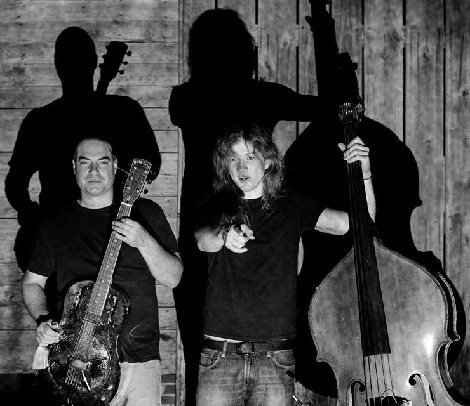
“The whole thing is just to get out and play you’re freakin heart out whether people are engaged or not,” said Swampcandy guitarist Ruben Dobbs.
“The whole thing is just to get out and play you’re freakin heart out whether people are engaged or not,” said Swampcandy guitarist Ruben Dobbs. “It doesn’t matter because at the end of the day it’s not for them, it’s for us. And if we’re not having fun then we shouldn’t be doing it. The day we stop having fun at a consistent level… that’s the day we stop playing.”
Delta blues fans will go wild for the authentic, soul-filled sound of Swampcandy, an American roots duo formed by Dobbs, later accompanied by upright bassist/kick-drummer Joey Mitchell. The band performed at this year’s Floydfest July 22-26 and had a lot to say in a pe-interview about their unique sound.
“I tell people it’s like early American 1930s music on steroids because it’s straight up in your face, for the most part,” said Dobbs. “When people are drunk we play a whole different set from when they’re sober.”
Mitchell began his music career playing electric bass in a female fronted pop country band. After the lead singer, Caitlin Lynn, won a reality television show on CNT, called Can you Duet, she moved to Nashville and the band split up. Luckily, the songwriter of the band is acquaintances with Dobbs and introduced the two.
The Swampcandy frontmen quickly discovered that their playing styles really compliment each others and they soon became the performing duo they are now.
“When we went off to tour in the UK it really seemed to work after that,” said Mitchell. “The band kind of formed over that and that tour, and now we just tour all the time. We just got in from a 50 day run on Monday from the UK.”
The duo was surprised to learn that their fans overseas are just as educated on American roots, if not more, than fans in the states.
“The audiences are a little more subdued than in the United States, for the most par,” Mitchell said. “Very polite…But the thing is, they were super educated about our heritage music, so I will have conversations over there that I will not have here in the United States.”
“Like somebody will say, ‘Oh you covered that Son House tune, but you did the 1936 lyrics.’ ‘Then you rolled the revival period of Son House in with some of the 1968 lyrics version of that song, that’s very clever.’ And you’re like, ‘Yeah, that’s exactly what I did. That’s amazing that you understand that.’ Because in the states they’re like, ‘What do you play, blues? Bluegrass? What do you call that?’ That’s the typical conversation that we get after the shows in the States.”
Swampcandy centralizes it’s music on the sub-genres of delta-blues and Americana, but blues is a term made too vague over the past century and the band has had difficulties voicing that to fans. As a genre established by African Americans in Great Depression era Mississippi, delta-blues is naturally emotion-filled and empowering, originally consisting of a solo guitarist. The addition of members is a more modern modification that has proven successful. A few of Dobbs’ influences include Muddy Waters, Son House, and Robert Johnson.
“Lately, I’ve been going with Americana with a hard delta-blues influence, just because Americana is a genre right now that’s good to be associated with because it’s happening,” said Dobbs. “When you say blues, people have the wrong idea immediately.”
An element of Swampcandy’s music that ties it to original delta-blues and American roots is the song subject matter. Blues music became a serious means of catharsis during the Great Depression with musicians writing about their own grim experiences, later transitioning into lyrics less experience-oriented and with more of a means for entertainment.
“As far as subjects go, I like creating a character and diving into a character and seeing where they’ll go,” said Dobbs. “I used to write songs just about myself and my own experiences and I think it’s rather toxic.” I will say it’s toxic when you write about your own experiences because then you start to create fucked up experiences for yourself to write about. You just do it because you like to write. Because you’re more addicted to writing than living a healthy lifestyle.”
“If you want to have a healthy relationship with other people and you don’t want to just be a drama queen your entire life to create drama you think about other characters, and your empathy gets engaged. It’s actually pretty awesome because it helps you grow as a person because you start to empathize with other people and get into that….like the song “Charlie.” There is a homeless guy in my town who basically has episodes every once in a while and gets really sad and dark and depressed and he’ll just start rambling on about his entire life. Charlie told me basically his entire story one night and I just went home and had to make it rhyme, that was all I had to do.”
Along with their recognizable energy and historical influences, the duo takes into consideration each audience they perform for, which is considerably a basis for their success. While performing another year at FloydFest, Dobbs and Mitchell picked up a thing or two about the nature of their audience. “On the main stage we’ll probably play more of our more subtle, lyric-oriented songs, but at night there is no point in that,” said Dobbs. “Everyone just wants to watch, they don’t have any attention span. So, you’ve gotta just grab ahold of their primal shit because there is no mental left. By the time we play tonight, there is not going to be anybody who is able to absorb a well-crafted song.”
After winning the 2014 ‘On the Rise’ artist, essentially the ‘People’s Choice Award’ at FloydFest, the duo figured that not only their playing helped them gain awareness from the crowd, but outside obstacles were working on their side too. “I think our main advantage is that we did four days in a row on the Ferrum College stage,” said Dobbs. “I think that really helped because everyday it was a consistent thing, every day people knew to show up there. More and more people would come and the last show we played was just a sea of people, so the fanbase grew everyday exponentially.”
“Last year, I think we sold more than anybody,” added Mitchell. “When I dropped the merch off they said that we sold more than Ben Harper and Ziggy Marley combined. It was ridiculous.”
With Mitchell doing most of the booking and Dobbs handling the networking, the duo has the band responsibilities down to a science and has created an effective system that has made their ride a little more organized. “The group has been nothing more than me and Joey for a long time,” said Dobbs. “So I guess those challenges have been, now we’re in a different place so we’re expecting new challenges at this point.”
“The only contrived goal I had in mind when I started this was to feel just as good playing in front of two people as two-thousand people…And we’ve had that experience, we’ve been in Connecticut where we played Lil’ Mo’s and we played to two people and we destroyed it. It was awesome. We had a blast, and those two people were like, ‘Fuck yes!’ At the end of the night, they were like, ‘I can’t believe you did that.’ And we were like, ‘Why not? We would have done it if you weren’t here.’”