
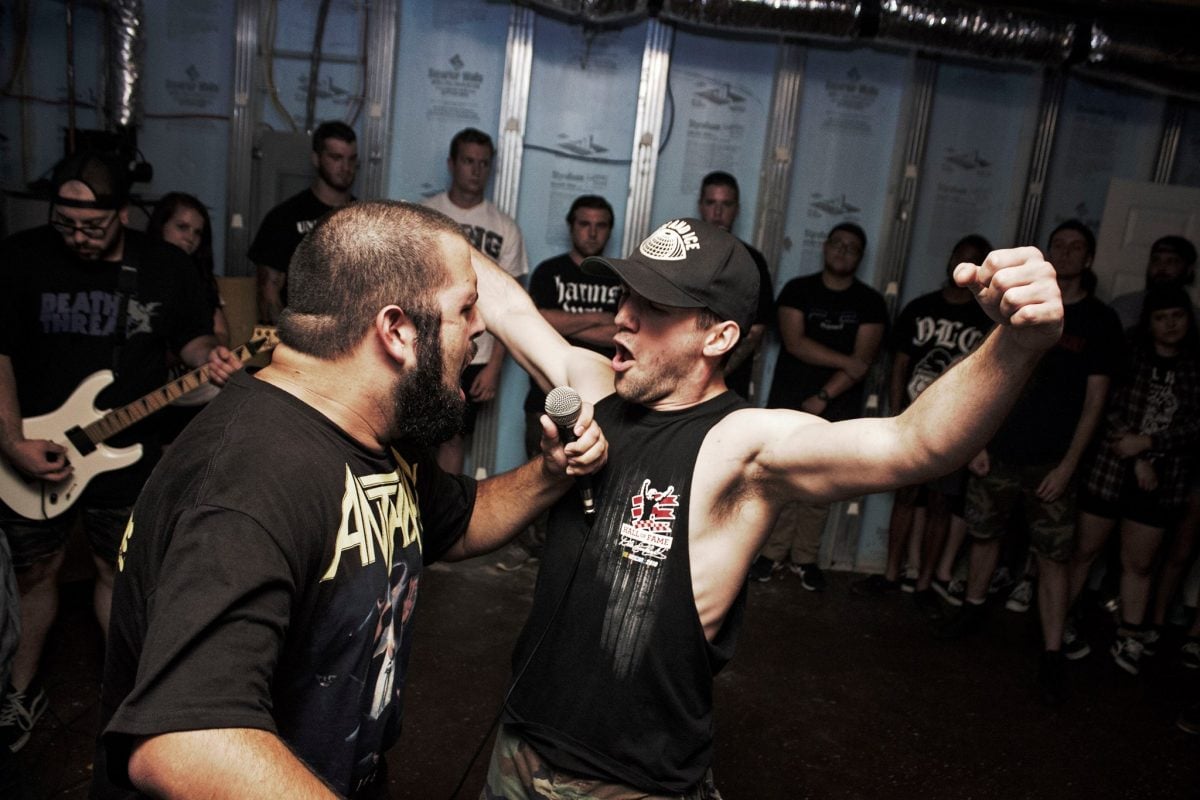
In the underbellies of Virginia’s smallest music communities, DIY scenes preserve hardcore and metal over generations in Roanoke and throughout Appalachia.
Hardcore punk has been burning strong in the fabric of American music for nearly four decades now. What originated in the slums of Manhattan’s Lower East Side, and within the urban sprawl encompassing Los Angeles in the 80s, has now spread to every conceivable corner of the globe. The roots of this youth-centered subculture are widespread; they’ve taken a strong hold in cities across the nation, and emerged as music scenes in the bubbling undergrounds of lesser-known, isolated rural communities throughout the South.
Wherever there are groups of angsty and disaffected youth, you can be certain that a hardcore, metal, or punk-adjacent community also exists.
When looking introspectively at the various music scenes in Virginia, it goes without question that Richmond is the epicenter of hardcore and metal. Its long-established scene has made a lasting impact on heavy music as a whole, from storied venues like Alley Katz and Strange Matter to notable acts like GWAR, Four Walls Falling, Avail, Down to Nothing, Lamb Of God, Municipal Waste, and more. With Richmond’s monopoly on heavy music, it can be hard to imagine another area in the Old Dominon where hardcore DIY (Do It Yourself) music is thriving, and very much alive — but it only takes a look westward, past the banks of the James.
Nestled between the Blue Ridge and Allegheny Mountain ranges, just off Virginia’s I-81 corridor, lies the city of Roanoke. Because of its convenient geographic location, Roanoke has served for ages as a gateway for bands traveling west or north toward the densely-populated urban centers of New England. I’ve been a part of the local music scene here with Josh Sison, guitarist for Dread State and Step Off, for years now. He sees Roanoke’s location as part of the reason underground music has been able to survive here over the decades; legendary hardcore and punk acts like Sick of It All, Avail, Token Entry, and Green Day came through our town and first brought our scene to life in the early 90s.

From the beginning of the region’s hardcore and metal scenes until today, successive generations of locals have passed the metaphorical torch to the scene’s younger participants, designating them as the next custodians of Roanoke’s hardcore and punk scenes. The scene has stayed alive, but the frequent change of hands has made it difficult to establish a scene with longevity and enough name recognition to be on the forefront of people’s minds. The scene’s periodic instability is an unfortunate reality of life in smaller cities — with an underperforming local economy, limited job prospects, and large cities relatively close by, many Appalachian areas struggle to compete with the metro areas’ ability to book large touring bands on a regular basis.
The government’s gradual shift in focus from rural agricultural communities to populous urban centers over the last century has led to a long-standing deprivation across Appalachia. While larger population centers in the region like Roanoke have more opportunity than the most rural areas, Appalachia’s smallest communities face even more challenges. The music scenes in the area tend to come together, creating a united feeling across cities rather than each city operating individually as areas like Richmond do. This style of “teamwork” allows even the smallest areas to grow, and it’s why DIY music is able to thrive here. Bradford Harris of Harlan, Kentucky — a coal mining town in the easternmost part of the state — speaks on the significant turnover rate within his own town’s music scene.
“All those people who were involved in building up the scene here lacked the mentality to keep things going; they went off to get jobs,” he said.

With few job prospects, many young people in Appalachia have chosen to vacate their hometowns to seek out better educational and employment opportunities elsewhere. Over time, this created a cultural and intellectual vacuum in the countryside, stunting the growth of both local communities and their DIY music scenes. As many localities in Appalachia are starved of the necessary resources, they’re unable to grow with new cultural changes and expand the region’s musical palette — but many locals have taken it upon themselves to start heavy music scenes from scratch. In a town known for its annual Bluegrass competitions, Wil Sharpe and Denver Walker of Galax, Virginia are doing just that.
“We want to put the aggressive style of music out there for people to hear, so we can start developing interest in building our own scene,” Sharpe and Walker said of their new powerviolence band, Clot.
“I’d like for Clot to get big enough that they can play [outside of Galax] and bring attention to our town,” Walker said. The mixture of hometown pride and passion for hardcore and metal music drives them to carve out a space of their own, and mutual support from other rural areas helps each scene stay alive.

The same breed of barriers that exist in Galax are also prevalent throughout the Appalachian South; the most challenging being a lack of reliable venues to book shows. Jordan Musick, drummer for Late Night Zero and Choose To Suffer (both formed in Roanoke), discussed the ups and downs that his hometown scene in Bluefield, West Virginia has experienced.
“From roughly 2007 until 2010, our scene was really big,” Musick said. “We had the Princeton Rec Center, which became our go-to spot for touring bands, and then bars like The Rocket Club that let us put on shows. Unfortunately, the Rocket Club closed its doors, and the Rec Center stopped allowing us to book there — nothing was sustainable for a long time after that.” Unpredictable relationships with venues can be detrimental to a scene’s survival, and in this case, caused a multi-year lull where punk and metal nearly died off in the area.
In my own experience booking shows in Roanoke, a majority of the venues and bars in town are apprehensive about booking DIY bands. Most event coordinators and business I’ve spoken with share the same concerns: they worry whether bands will draw enough attendees to make profits from door sales, they’re unsure if they’ll make any bar or food sales during the show, and they fear liability in the event that someone gets injured while moshing or stage diving. The possibility of sustaining damage to their property, or of a patron getting hurt, has stonewalled any chance for the scene to transition from booking basement shows to booking established venues.

These concerns are faced by music scenes everywhere. Even areas like Richmond and in cities like New York and Washington, D.C., local booking agents will share similar experiences. What separates the larger cities from areas like Roanoke and even smaller regions is their lack of venues — where Richmond has a substantial amount of places to host shows, the Roanoke scene has been limited with only a handful of venues for live music. Misunderstandings about hardcore ethics and the DIY mentality, alongside a general lack of faith in the music’s ability to bring in new business, has made it increasingly difficult for the scene to grow and expand heavy music in the region. But despite the hardships we collectively endured (and the grim realities we’ve had to face), many hardcore and metal scenes in Appalachia are beginning to thrive once more.
Shows are happening consistently, new venues are becoming household names, and a genuine sense of scene unity is emerging. Nick Gekoskie, show promoter and guitarist for Brick, spoke with me about the rise of the Golden Pony in Harrisonburg.
“It’s a wonderful place that serves as the music hub for our community,” Gekoskie said. “Paul Somers, the owner and operator of the Pony, is fully invested in the scene. He’s able to bring quality acts of all genres.”
In 2019 alone, Eyehategod, Red Death, Ilsa, Murphy’s Law, and H.R. of Bad Brains came through Harrisonburg and drew huge crowds — and this isn’t the first time Harrisonburg has brought legendary acts to the Shenandoah Valley. Bane, Poison The Well, Converge, Fugazi, and The Bouncing Souls have played MACROCK, an annual festival hosted in downtown Harrisonburg that showcases regional and national DIY acts.

Meanwhile, Roanoke’s hardcore scene is still recovering from its near-death experience after losing the longest running DIY venue in its history, The Shanty. As the birthplace of many local bands, and the only safe space for hardcore/punk shows, The Shanty’s impact on Roanoke’s metal scene over the years is incalculable. To see hardcore bands like Bracewar, Naysayer, Angel Dust, Forced Order, Discourse, Jesus Piece, Break Away, or Modern Pain play in a venue the size of a small carport is mindblowing to those of us who have experienced it. And although many Roanokers are still grieving the loss of this acclaimed institution, the community has survived and adapted in a world without The Shanty. Since the beginning of 2018, the heavy music scene in Roanoke has seen a whirlwind of changes.
A younger generation has started forming bands — like Gravity Kong, Choose to Suffer, and Reality Strikes — and the old heads have formed newer projects showcasing their perfected skillset, like Nailcrown and Dread State.
They’ve started forming working relationships with venues in downtown Roanoke like The Spot On Kirk and VFW Hall 1264, and have hosted shows with bands like One Step Closer, Year Of The Knife, Facewreck, Stepping Stone, Outsider, and Drain.
Bailey Stiltz (of Choose to Suffer, Outsider, and Reality Strikes), Josh Sison, and myself have taken the lead on booking shows. Show attendance numbers may not have returned to their former peak, but the metal scene in Roanoke is on a steady rise.
“The scene has definitely receded a bit, but I see it growing slowly,” said Sison. “Even with attendance at shows being lower than what we’re used to, the kids that do show up put on for every band on the bill. There’s never a dull moment during a Roanoke show, and I think that’s partially the reason why bands continue coming back.”

Roughly ten years ago, I was beginning my assimilation into the hardcore/punk subculture. One person in particular spoke words that struck a chord in me during those formative years, and his name is Aaron Bedard. Bedard is the vocalist for Bane and Antagonize, and in Bane’s song “Superhero,” he talks about the ability inside everyone to make a difference. We’re able to better our own lives, and as Bedard vocalized, “the difference between hard and impossible is a thousand miles wide.”
For those of us who are still actively engaged in the hardcore and metal scenes in Appalachia, the community can attest to the validity of his statement. From an outsider’s perspective, maintaining a heavy music scene in the region may seem like an impossible task — but to myself and those I work with to do it, the preservation of our scene is a worthwhile pursuit.
What has been done in the past can be replicated and improved upon; the evidence is right here in front of us. Despite our lack of resources, networking challenges, and limited visibility, this region continues to find ways to keep our scene alive. Hardcore in Appalachia, and throughout the rest of the world, will survive as it always has: through struggle, persistence, and dedication. We will keep passing the torch, the flame will burn eternal.
Check out Jack’s favorite bands from the area, who are all members of the Appalachian scene or have strong ties to its community. Support local music!
Step Off
The Mirror
Unnerve
Dread State
Grudgeholders
Compulse
BRICK
Reality Check
True Worth
Dbol
Gravity Kong
Force
Wiretap
L.I.P.S.
Clot