
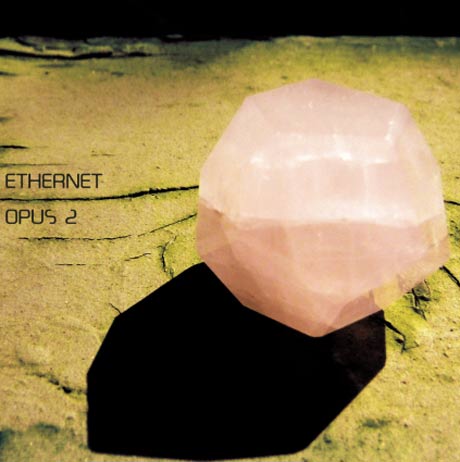
Ethernet – Opus 2 (Kranky Records)
It can be difficult to determine the extent to which Ethernet’s fourth full-length album works. When the circumstances of its creation, its intent, and its actual aesthetic are juxtaposed, they all seem at stark enough contrast that it can be difficult to establish the album’s purpose, let alone whether it’s been achieved.
Ethernet – Opus 2 (Kranky Records)
It can be difficult to determine the extent to which Ethernet’s fourth full-length album works. When the circumstances of its creation, its intent, and its actual aesthetic are juxtaposed, they all seem at stark enough contrast that it can be difficult to establish the album’s purpose, let alone whether it’s been achieved. The recording project of Tim Gray, Ethernet was intended to evoke a meditative sense (and, in point of fact, was recorded while Gray was in a variety of self-induced hypnotic trance states), one in which the listener can harvest his or her own inner solidity and sense of purpose. Which may sound a bit starry-eyed and utopian, had Gray’s MFA thesis not focused on the uses of sound environments for much the same purpose. Though the content of his actual thesis isn’t available, introducing the academic element lends his work the suggestion of something more quantifiable than many of the synth-wielders and button-pushers who have dabbled in hypnagogia. Given those two elements at play within Opus 2, the divide between its shamanistic vs. its pedagogical qualities isn’t always cut and dried.
The first immediately noticeable element about the music itself comes in the choice of instrumentation, typically masses of billowy synth pads that wouldn’t be out of place in any number of escapist New Age recordings – that “Dog Star” begins with what sounds like a synthetic approximation of waves crashing on a beach does little to dispel that sort of preconception. An appreciation of this approach requires a rejection of what Daniel Lopatin termed timbral fascism – dismissal of certain sounds because of the lambasted genres that they evoke. In Gray’s work (as with Lopatin’s with Oneohtrix Point Never), the use of soft-edged electronics could render it easily dismissed as treacly cliche, but instead offers a compelling recontextualization of a largely marginalized aesthetic. Gray isn’t the only artist attempting this sort of thing, but his work seems to function slightly better than that of many of his contemporaries, as his music’s meditative impulse is bolstered by the amorphous layers of sound and the manner in which they contribute to a particular atmosphere.

But even examining the more consciously crafted aspects of the aesthetic with which Ethernet identifies itself can be problematic – the hypnotic states that Gray utilized when recording the album introduced into the equation an emphasis on the spontaneity of subconscious creation that calls into question any idea of intended purpose. At times, the sparse rhythmic touches seem to interfere with the weightless, drifting quality of the music, threatening to nudge it too close to microhouse territory. At other points, shuffling, crackling sounds occasionally distract from the mood of a song, as they can in pieces like “Cubed Suns,” foregrounding its relaxed abstraction into something to which attention must be paid. These moments point out that the circumstances of the album’s creation call into question the extent to which any declaration of intentionality – either conscious or contextually implied – can be taken as explanatory.
None of this, however, is to suggest that Opus 2 is a regurgitation of New Age music, per se – too much tonal variation is present, to say nothing of the opacity of its utilitarian purposes (though I’m no expert, I feel like inducing a hypnotic state might take longer than the thirteen minutes that comprise the album’s longest track, let alone its shorter ones). But it certainly recalls the brand of early electronic space music that led into it; that the project is named after technology that was cutting edge three decades ago further bolsters the current of retro-futurism running through the project. Just as some of the timbral elements present on the album might prove an immediate turn-off to potential listeners, so would the terminology that is most apt to describe it. But if preconceptions are set aside, the album is a solid, enjoyable listen imbued with a noble purpose. Whether or not it successfully achieves its function may be in the ear of the beholder, but anyone with an interest in electronic music’s hazier, more abstract forms could do far worse.