
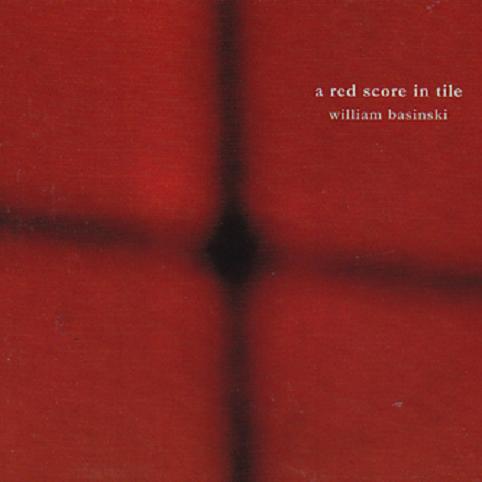
William Basinski – A Red Score In Tile (Streamline)
The idea of movement in music is sometimes taken as a given. The idea that songs have to build, to wane, to rely on some degree of harmonic or rhythmic shifts in order to propel their development or, at the very least, to render them accessible is an idea so taken for granted that most people fail to even consider an alternative. Composer William Basinski, however, has not been one to subscribe to that line of thought. Over the past three decades, he has conceived a body of work based on a fairly extreme form of minimalism where brief tape loops run unaltered and unimpeded for lengthy stretches of time, notes gently rolling over each other in ourobouric repetition that is surprisingly easy on the ears for something so at odds with widespread conceptions of what music is or how it should operate.
William Basinski – A Red Score In Tile (Streamline)
The idea of movement in music is sometimes taken as a given. The idea that songs have to build, to wane, to rely on some degree of harmonic or rhythmic shifts in order to propel their development or, at the very least, to render them accessible is an idea so taken for granted that most people fail to even consider an alternative. Composer William Basinski, however, has not been one to subscribe to that line of thought. Over the past three decades, he has conceived a body of work based on a fairly extreme form of minimalism where brief tape loops run unaltered and unimpeded for lengthy stretches of time, notes gently rolling over each other in ourobouric repetition that is surprisingly easy on the ears for something so at odds with widespread conceptions of what music is or how it should operate.
Over the course of Basinski’s career, his works have evolved with a deliberation befitting the glacial pace of his music. His first works, such as the Watermusic series, took Brian Eno’s early ambient experiments to their logical extreme, focusing on the idea of a slow mass of sounds rather than the cold utilitarianism that much of ambient music had readily embraced within a decade of the genre’s inception–an aesthetic shift that pushed the music towards a sort of sonic architecture rather than an emotionally resonant art form. While the general timbre and tone of his work shifted little as he pushed into more conceptual realms, the circumstances and ideas behind some of his more recent works have brought him a level of acclaim rare for any comparable artist. Most notably, the Disintegration Loops series was created when Basinski was in the process of transferring decades-old tape loops to a digital format. As each played, flecks of ferrite began to detach from the tape itself, and with each successive repetition of the loop, the sound gradually deteriorated, the decay at first manifesting itself as a slight distortion and then ultimately rendering the sound a faint hiss. The albums present a near-total overlapping of creation and destruction, observation and annihilation, and put forth an analysis of the ephemeral nature of creativity that few artists would care to consider.

Like much of the work Basinski has created since the late ’90s when he began archiving decades-old tapes, his recently re-issued A Red Score In Tile is comprised of a twenty second piano loop created in 1979. The result, assembled as a sort of soundtrack to James Elaine’s painting of the same title, is a lugubrious concoction of corroded notes repeating ad infinitum like a moment suspended perpetually outside of linear time. As opposed to the candescent atmospheres of Disintegration Loops or the vague menace of Shortwavemusic, A Red Score In Tile occupies a space removed from many of Basinski’s extremes. While it is a muted, mournful affair that retains much of the grainy distortion characteristic of Basinski’s other albums, there is a degree of stasis which gives the album a more grounded feel. Rather than offering the impression that the act of observing or recording a sound diminishes or destroys it, as his crumbling tapes often do, the two halves of A Red Score In Tile retain the sort of single-minded devotion to an individual, unchanging idea that Basinski’s other work rarely achieves. To say that the album is meditative might call to mind all sorts of New Age preconceptions–none of which are at all applicable–but is really one of the best summations. While there are thousands of songs that celebrate living in the moment, Basinski’s work goes a step further: beyond simply a glorification of living in a particular instant, it captures a brief window of time, valorizes it on its own terms, and raises it on its own artistic pedestal. Like a faded photograph or a half-remembered dream, his music is defined as much by absence as it is by presence–faded remnants of events long past, repeated like a mantra so that they might never be fully subsumed by the fog of time.