
Wormrot, Tombs, D.O.C. (Disciples Of Christ), Grown Ass Men, and Real Talk
Tuesday, March 29 at Gallery 5
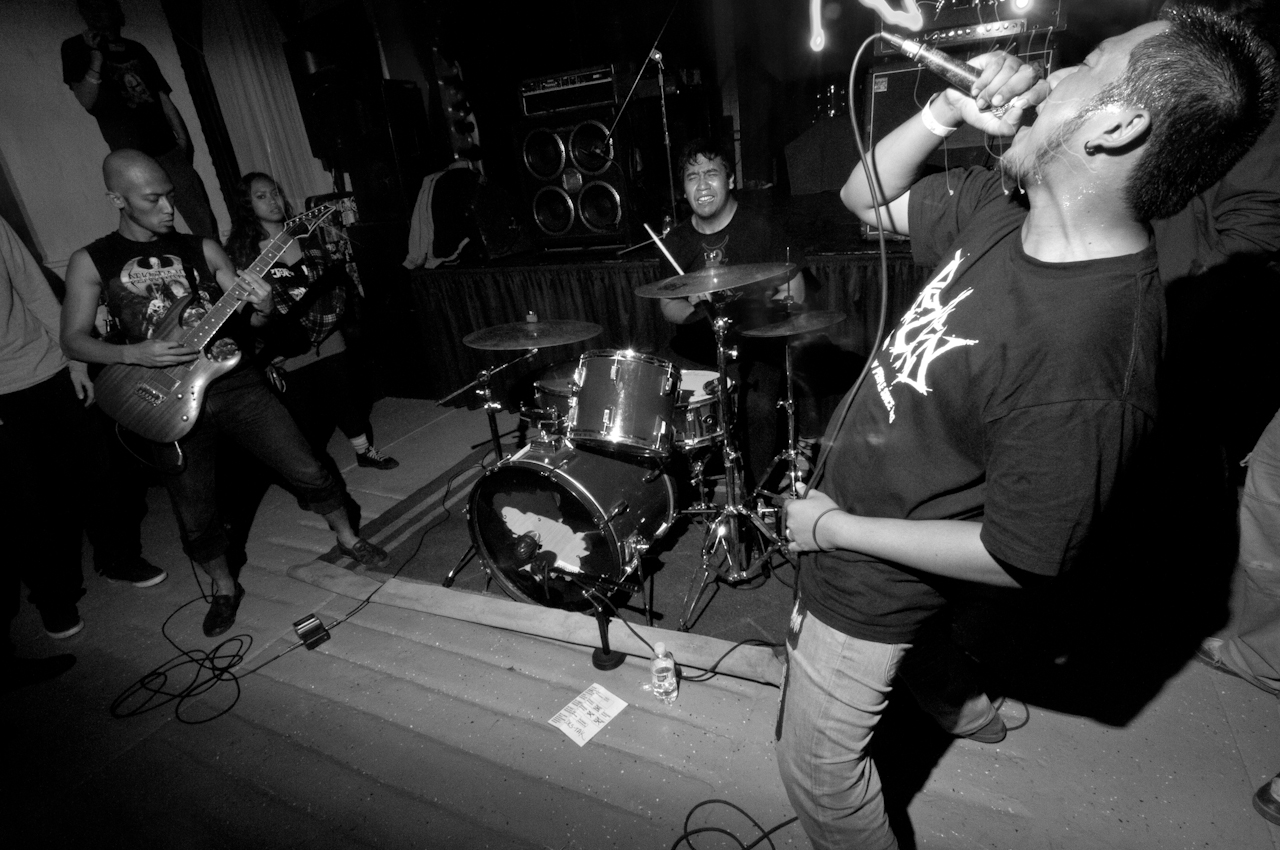
There are a lot of positive aspects of Gallery 5, but one fact that can’t be ignored is that it’s a big concrete cell of a room, with high ceilings and hard floors. It’s strange, therefore, how many of the shows I’ve seen at Gallery 5 over the years in which bands chose to forsake the reasonably nice stage in order to perform on the venue’s uneven concrete floor. At this show, four of the five bands playing made that choice, which would have seemed odd under most circumstances. And yet, perhaps due to the harsh, distorted sound of all of the bands on the bill, this was one show where the choice worked perfectly.
Wormrot, Tombs, D.O.C. (Disciples Of Christ), Grown Ass Men, and Real Talk
Tuesday, March 29 at Gallery 5
There are a lot of positive aspects of Gallery 5, but one fact that can’t be ignored is that it’s a big concrete cell of a room, with high ceilings and hard floors. It’s strange, therefore, how many of the shows I’ve seen at Gallery 5 over the years in which bands chose to forsake the reasonably nice stage in order to perform on the venue’s uneven concrete floor. At this show, four of the five bands playing made that choice, which would have seemed odd under most circumstances. And yet, perhaps due to the harsh, distorted sound of all of the bands on the bill, this was one show where the choice worked perfectly.
The evening began with a stellar performance from Real Talk. If you’ve been keeping up with my writings on this website for a while, then you’ve already heard plenty from me about how great this band is. Let me just assure you that my opinion did not change based upon their set at this show. In fact, if anything they had the best live sound I’ve heard from them since their debut show. This had a lot to do with the fact that the basslines, which drive a lot of Real Talk’s material, were much more audible than they’ve been during some of the other sets I’ve seen by them. Bassist Graham Scala told me that this was entirely due to the bass rig he’d borrowed from Grown Ass Men. Be that as it may, it still really helped put their music across, especially since they had to deal with the ways in which the cavernous room tends to swallow the sound. Regardless of venue and equipment, though, these guys always put on a good show, and I’ll continue to make it out to their shows whenever I’m capable of doing so.
It was my first time seeing Grown Ass Men, who, like Real Talk, are a bit of a Richmond hardcore supergroup. Featuring members of Wheelbite, Phobia, Stop It!! and Rager, Grown Ass Men play exactly the sort of angry, speedy power violence that such an ex-member list would lead one to imagine. And it’s awesome! They raced through a set full of blast beats, precise tempo changes, and short, powerful mosh riffs in just about fifteen minutes, playing at least a dozen songs in that time. There’s nothing too complex or groundbreaking about what Grown Ass Men are doing–I can remember hearing many similar bands a decade or so ago, including the ones that some members of Grown Ass Men were in back then. However, they write good riffs, play them with a lot of energy, and if nothing else, are at least recreating a genre that is relatively neglected these days. For that reason, I dig what they’re doing, and I hope I can see them again soon.

D.O.C. were next. This DC-area band features members of Magrudergrind and Juice Tyme, so it was no surprise to find that they also played fast, metal-influenced hardcore. D.O.C. were more grindcore than power violence, though–while they had plenty of blast beats, they were a lot more likely to throw long slowed-down sections into their songs. Sometimes these parts sounded almost like doom-metal, while at other times they were the sort of midtempo interlude that finds its way into a lot of death metal songs. One thing the slowed-down sections in D.O.C. songs had in common, though, was that they were almost always instrumental. The band members only ever seemed to sing when they were playing fast, which wasn’t really a problem but sometimes made it hard to get into their slower parts. It felt like some of those parts would have hit harder with vocals added to them. Meanwhile, probably the most interesting thing to me during the fast parts with vocals was the way their guitarist stood while he sang. D.O.C. was a trio in which every member sang–they’d trade off lines during fast parts. The guitarist set up his mic stand so that his mic was approximately at waist level, then would get down on one knee and lean way over in order to sing into the mic when his vocal parts came up. If this was his natural stance to play guitar it might make a little more sense, but since he had to go through an elaborate crouching process to get into position, and would quickly return to standing fully upright as soon as he finished singing, the whole thing was a bit bewildering to me. D.O.C.’s fast parts were the most interesting parts of their songs, and I enjoyed those moments well enough, but in the end I felt like they spent too much time on slower interludes, which dulled the power of their faster riffs.
If D.O.C. weren’t perfect, they still came across far better than the next group, Tombs. Tombs are another DC-area trio, and feature singer/guitarist Mike Hill, formerly of Anodyne–a band I really liked and own records by. Tombs, though, didn’t really do it for me. There were a variety of reasons, and some of them may have been specific to this show. First of all, Tombs were the only band of the evening to play onstage instead of on the floor of the venue, which made their set seem like part of a completely different show. Their music set them even further apart from the rest of the bands on the bill. Seeing them on a bill with bands that sounded more like them might have helped them come across better, but even in that situation, I’m not too sure how stoked I would have been about them. Tombs play the sort of ambient, melodic doom metal/post-rock hybrid that Isis made famous seven or so years ago. At rare points, they also do blast beats, and those parts sound more like black metal, but those parts are a tiny minority of Tombs’s sound, and even the blast beats never really felt fast. If the guitars during the blast parts were strummed slightly differently, they’d have been just as slow as all of the other parts of Tombs’s music, and once I noticed that, the whole thing felt extremely sluggish and monotonous. I paid close enough attention through the first half of their set to be sure that I understood what they were doing, but after that I just kind of zoned out. It was hard not to–their songs just washed over me like waves, all but lulling me to sleep. Again, on a different show this may have worked, so I’ll have to see them again before I’m sure that they don’t do it for me, but at this show they just weren’t appropriate at all.

Wormrot returned to the floor for the final set of the evening, and the one that I had been most eagerly anticipating. Their two full-lengths on Earache Records, Abuse and Dirge, had both come to my attention only weeks before the show, and knocked me out with their display of hyperfocused speed and power. I couldn’t wait to see if the Singapore natives could deliver on the promise of their studio recordings in a live setting. Wormrot have the same sort of bassless three-piece lineup that other prominent grindcore bands like Pig Destroyer and Magrudergrind use, and as the set started, one of the guitarist’s two amps was malfunctioning, so from where I was standing the drums and vocals were far louder than the guitar during the first few songs. However, even then, Wormrot were shredding the place in fine fashion. Once the amp was fixed and everything sounded the way it was supposed to, the intensity went up another order of magnitude, and the energy Wormrot put forth from that moment was positively scathing. The vocalist was the only member that really moved around–both guitarist and drummer had to focus in order to play their quick, complicated parts–so the stage show wasn’t all that impressive. But this was more than made up for by the obvious displays of technical ability on the parts of Wormrot’s guitarist and, especially, their drummer. Even on the band’s rare slower parts, he was still doing technically impressive things, and they managed to keep their songwriting interesting and unpredictable even at the blinding speeds at which they played. For example, one (relatively) midtempo riff was played in 7/8 time, which is tough even for musicians that play at normal speed to pull off. Wormrot probably played at least two dozen songs, but it still seemed that their set was over way too quickly, as some of those songs were less than half a minute long, and none stretched very far past the 90-second mark. They left the crowd wanting more, which is the desired result of any live performance, and I’m sure that next time they make it back here from Singapore, they’ll find even more eager fans waiting for them.
Words by Andrew Necci
Images by Tony Lynch