
Richmond Hydroponics brings Virginia’s first commercially available cannabis fertilizer to market. S. Preston Duncan takes a trip behind the scenes.
In a small airplane hangar of a greenhouse on a wide plot of farmland just upriver from the city, Josh Fitzhugh is battling whiteflies on a 9-foot cannabis indica plant. Just by its silhouette against the softly glowing arched roof, you can tell it’s flowering.
Fitzhugh is a hot pepper farmer who studied Applied Mathematics at the Rochester Institute of Technology. One of his companies, Josh’s Jungle, produces infused pepper salts which he has sold at farmer’s markets and festivals around the state. The other – Richmond Hydroponics – produces Virginia’s first commercially available, cannabis-specific nutrient line.
Fitzhugh realized early on that his pepper venture would be much more profitable if he were to make his own fertilizers, cutting out the exorbitant shipping costs that drive up the shelf-price of commercial varieties. As an insatiable consumer of scientific studies and agricultural research, he had a solid base of knowledge upon which to build his recipe.

In 2018, Fitzhugh received a research license for hemp, and began dedicating greenhouse space to cultivation. When COVID hit, the festivals stopped. Fitzhugh, naturally, spent the extra time doing research.
“With COVID, I wasn’t doing anything. I was looking into things to do, that I wanted to do,” Fitzhugh says. “Cannabis legalization just hit at the right time where I was like hey, I have all the expertise. I don’t want to grow it [commercially]. Growing hemp was not the most fun thing. It was a lot of mold, and I just don’t have the revenue for seeds. But I already have some of the supplies for the fertilizer. I can just mock up trials for it.”
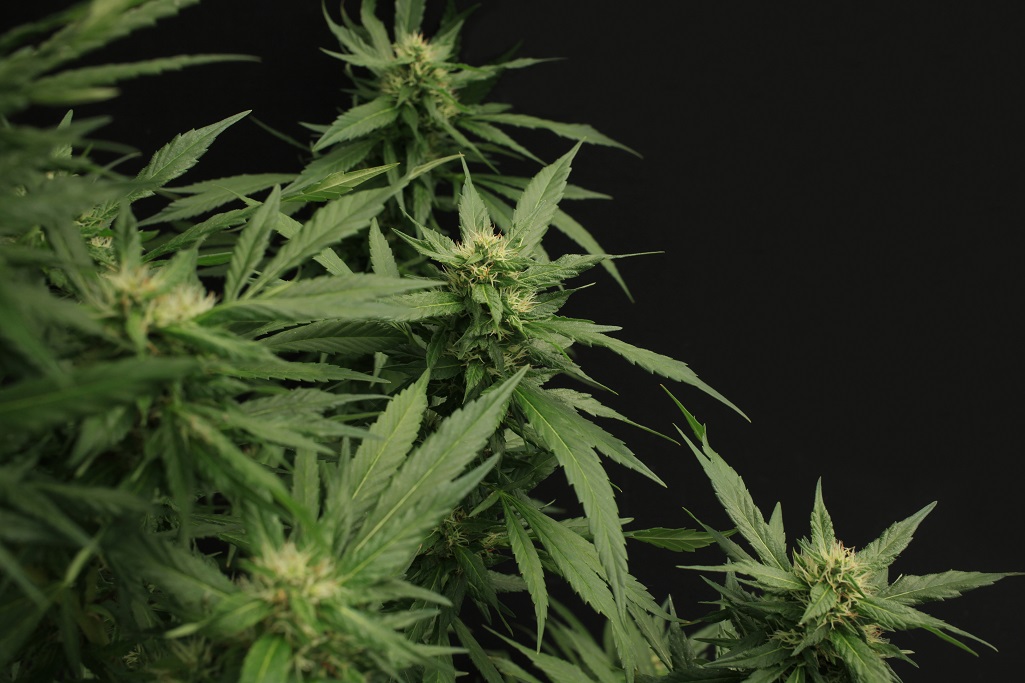
Judging by the towering colas (main flowering parts of the cannabis plant) swaying gently to the industrial fans in the greenhouse, it would appear that the trials have gone well. This might be because his formula is based on the most recent research in the whole-plant science of cannabis.
“We’re realizing that we don’t need the numbers that we used to think we needed,” says Fitzhugh. “We don’t need to pump them with the fertilizer that we have been.” According to recent studies, common fertilization practices in the cannabis industry have been delivering 30- 50% more fertilizer than is necessary. The consequent excess of phosphorus has now been shown to inhibit the density of trichome (cannabinoid-containing resin gland) production, resulting in weaker smoke. “The yield is the same [with less fertilizer]. The flowers look smaller, but the yield ends up being the same,” says Fitzhugh. Established fertilizer companies selling an array of phosphorus-heavy bloom boosters formulated on older research don’t appear to be rushing to embrace these findings.

“During COVID I got into [thinking about] how I could support my friends. All my friends are so specialized and intelligent. And this really motivated me. I want to take care of them,” says Fitzhugh. “We’re at a paradigm shift. I realized this is something that can work; that if I can get started, I can support people that need the support. And it’s really about getting a product out there that I know is equivalent to what the medical industry is planning to go toward.”
As for Fitzhugh’s plans, his vision for Richmond Hydroponics is an ever-evolving one, and it seems unlikely that he’ll stop putting out products that reflect the most cutting edge developments in cannabis plant science. Currently, he’s doing his own research into automating the bottling process. But one thing he won’t do is expand distribution beyond the borders of the state.
“Shipping water is not good. I have no idea how the milk industry does it,” says Fitzhugh, whose business model is dependent upon utilizing the cost advantages of local distribution to accessibly price his products. Richmond Hydroponics’ balanced and complete two-part Green Grow and Green Bloom fertilizers are now available at a widening number of local garden and grow supply stores.

In the months since legalization, a legion of experienced Virginia growers have emerged from their light-proof grow tents, gifting seeds, clones, and wisdom to a groundswell of enthusiastic first-timers who finally feel comfortable enough to give growing a go.
Alongside this burgeoning yet decidedly robust community, a fresh crop of businesses has arisen to meet the demand for home growing supplies. Some are locally owned. Others are east coast branches of west coast companies that have been establishing relationships in the state since long before legalization.
It seems natural to look west for guidance as we open up to the above-ground cannabis industry. But for many involved, the community surrounding cultivation is every bit as important as the harvest. To people like Fitzhugh, the significance of sourcing materials from local purveyors and producers cannot be overstated. Nor can the fact that established practices are often resistant to innovation. Ironically, that very resistance gives companies like Richmond Hydroponics – and, by extension, Virginia growers in general – an opportunity to emerge upon the commercial landscape of cannabis cultivation at the forefront of modernization, and grow some of the best flower in the world.
Top Photo by Adriana Rossi