
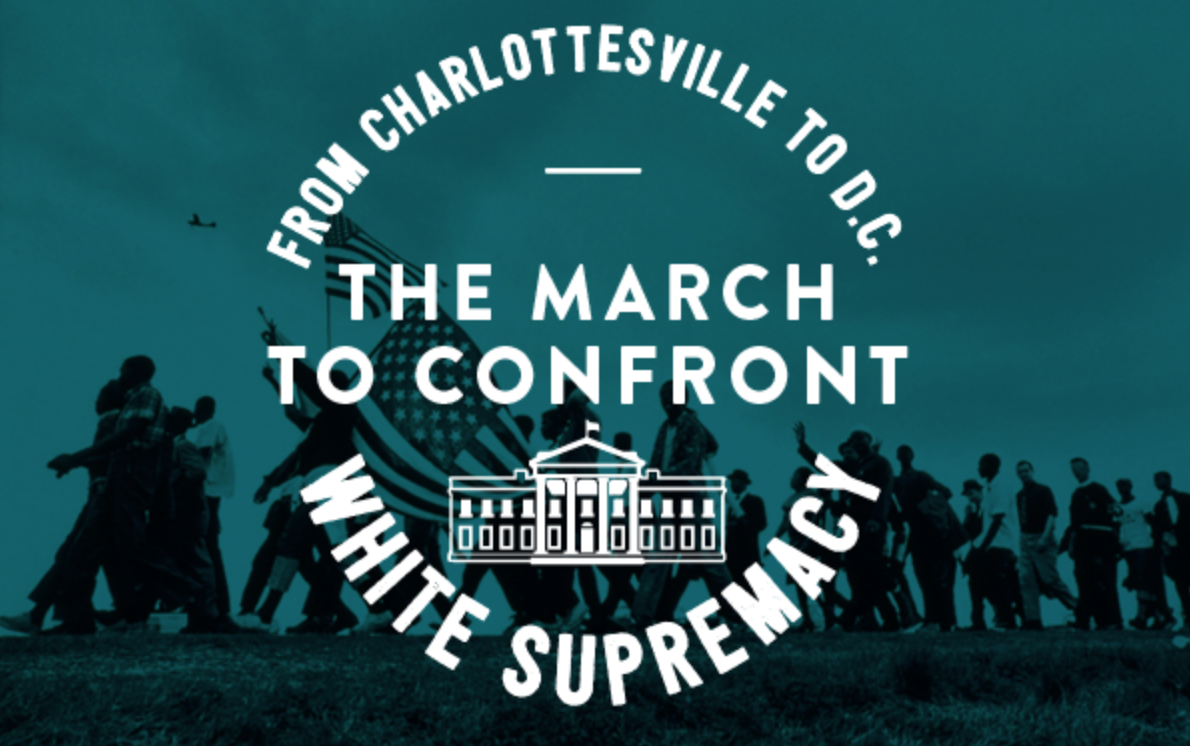
On August 28th a coalition of community activists, faith based groups, and students will embark on a strenuous ten day journey from Charlottesville to Washington DC to protest white supremacy. The March to Confront, including groups like Action Group Network, Color of Change, and The Movement for Black Lives, amongst others, is a response to the events in Charlottesville that left one person dead and up to 30 wounded in a domestic terrorist attack by a white supremacist.

The March to Confront
The march will take place between August 28 and September 6. According to the organizers, “We are marching from Charlottesville to Washington DC to demonstrate our commitment to confronting white supremacy wherever it is found.” The event webpage goes on to say, ” It’s clear that we can no longer wait for Donald Trump or any elected official to face reality and lead. We are coming together to reckon with America’s long history of white supremacy, so that we can begin to heal the wounds of our nation.”
People participating in the march will travel 112 miles with churches providing housing along the way. The route will begin in Charlottesville and pass through towns like Ruckersville, Madison, and Calverton, before entering into the Northern Virginian cities of Manassas, Fairfax, and Falls Church, finally terminating near Catholic University in Washington DC. However, from September 6 onwards the organizers will be offering training in non-violent civil disobedience. “We will hold our ground and launch wave after wave of nonviolent civil disobedience demanding Trump be removed from office and that an agenda be advanced that heals the wounds of white supremacy.” The organizers went on to say, “This is will be a sustained civil disobedience campaign, so bring what you need to stay.“
President Trump’s response to the violence in Charlottesville has been largely condemned by both sides of the political spectrum. Equivocating between white supremacists, nationalists, and the alt-right with those protesting hate and bigotry continues to prove divisive nationally and is driving a new generation of direct action activism. Organizers of March to Confront have insisted that white supremacist violence has escalated since Trump’s campaign for president and “…reach[ed] a boiling point in Charlottesville, as courageous people of moral conscience stood up to an army of white nationalists, neo-Nazis, and members of the KKK.”

Press Release, The March to Confront