
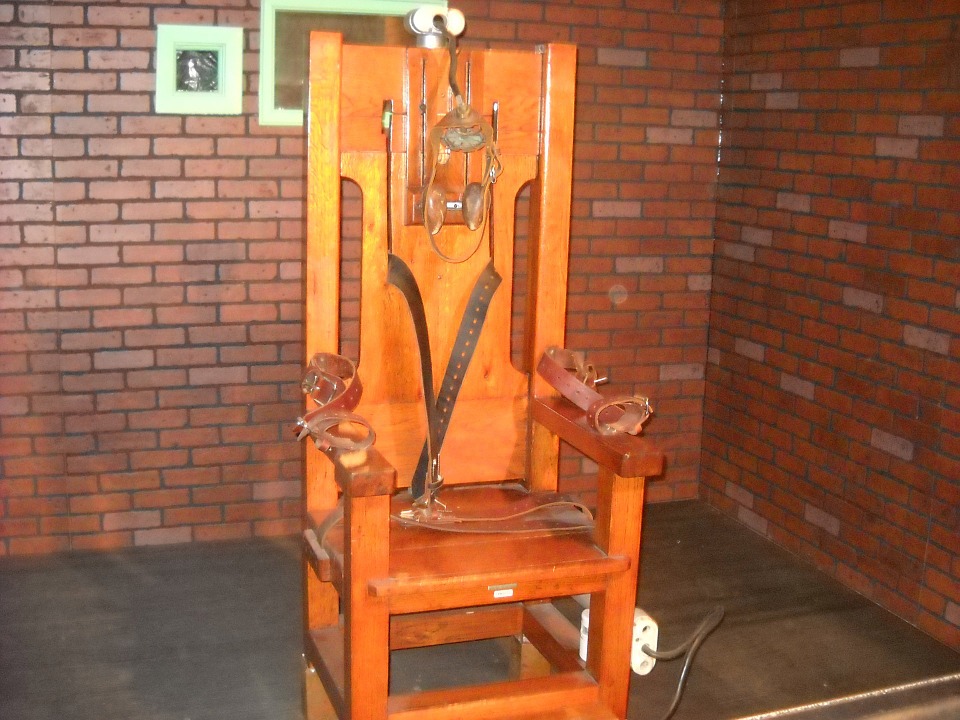
RICHMOND – Death penalty opponents lost a battle this week when a House committee endorsed a bill to make electrocution the default punishment if lethal injection is unavailable.
RICHMOND – Death penalty opponents lost a battle this week when a House committee endorsed a bill to make electrocution the default punishment if lethal injection is unavailable.
The American Civil Liberties Union of Virginia and Virginians for Alternatives to the Death Penalty opposed House Bill 815, which would allow the Virginia Department of Corrections to use the electric chair if lethal injection drugs are unavailable. The House Courts of Justice Committee voted 14-7 in favor of the measure on Wednesday. It is now before the full House of Delegates.
“There is no humane way to kill another human being,” said Michael Stone, the executive director of VADP. His group advocates for life in prison without parole as the maximum penalty for capital murder.
Stone fears that HB 815 will clear the House and go on to pass the Senate. He said it would be a step backward.
“There have been a number of botched electrocutions in Virginia,” Stone said. “In one case, a man caught on fire when he was being executed.”
Historically, the U.S. Supreme Court has supported four methods for carrying out executions: lethal injection, electrocution, firing squad and the gas chamber. The most common method by far is lethal injection.
In recent years, a number of states have adopted laws to designate a default method for execution if there is trouble obtaining lethal drugs. Two years ago, Tennessee passed a bill specifying electrocution as its default. Last year, Utah adopted the firing squad as its default, and Oklahoma passed asphyxiation as its fallback execution method if legal drugs are not available for the injection.
Virginia is one of eight states that have electric chairs available for executions if death-row prisoners choose it.
Inmates who have been sentenced to death in Virginia have a choice between lethal injection and electrocution. If prisoners don’t make a choice at least 15 days before the scheduled execution, they receive the injection.
This is the third year in a row in which a bill has been proposed to make it easier for the Virginia Department of Corrections to carry out executions.
Two years ago, the House passed a similar bill to HB 815 to make electrocution the default, but it was defeated in the Senate. Last year, a bill was proposed to shield from public disclosure the drugs used in lethal injection executions and the drugs’ manufacturers.
On March 16, Virginia is scheduled to execute Ricky Javon Gray, who was convicted of the murders of members of the Harvey family in Richmond in 2006. With that date approaching, more attention may be paid this year to legislation setting a default execution method in the commonwealth.
Stone said the Department of Corrections was asked under a Freedom of Information Act request for information about the drugs to be used in Gray’s execution. The department’s response indicated that it may not have the necessary drugs for the lethal injection, Stone said.
“They said they can’t make any further comment because of potential litigation,” Stone said.
HB 815 cleared the House Courts of Justice Committee this week after most of the Republicans on the panel voted for the bill and most of the Democrats voted against it.
Supporting the bill were Republican Dels. Les Adams from Chatham, David Albo of Springfield, Rob Bell of Charlottesville, Jeffery L. Campbell of Marion, Chris Collins of Winchester, Ben Cline of Amherst, Todd Gilbert of Woodstock, Terry G. Kilgore of Gate City, Manoli Loupassi of Richmond, Jackson Miller of Manassas, Mandell J. Minchew of Leesburg, Jason Miyares of Virginia Beach and Rick Morris of Carrollton, as well as Democratic Del. Vivian Watts of Annandale.
Opposing the bill were Democratic Dels. Patrick Hope of Arlington, Charniele Herring and Paul Krizek of Alexandria, Monty Mason of Williamsburg, Jennifer McClellan of Richmond and David J. Toscano of Charlottesville, as well as Republican Del. Greg Habeeb of Salem.
Del. James Leftwich, R-Chesapeake, did not vote.