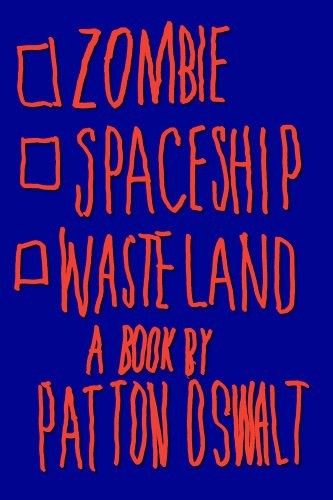
Zombie Spaceship Wasteland, by Patton Oswalt (Scribner)
There is probably a joke to be made at this very moment. As I watch the Dwayne Johnson action flick Faster, I set myself to write my thoughts regarding Patton Oswalt’s Zombie Spaceship Wasteland. I tend to prefer Oswalt to the sort of dimwits that manage to create action extravaganzas such as this one. Oswalt’s sense of humor doesn’t transcend beyond his peers–he has his fair share of dick jokes. At the same time, it’s quite obvious that his years as an adolescent helped shape his unique perspective. By growing up in the small town of Sterling, Virginia, Oswalt discovered outlets in cult cinema, independent record stores and science fiction. There are multiple similarities to be found in my own developing years, which is probably why his first foray in the world of literature felt like a great accomplishment to me.
Zombie Spaceship Wasteland, by Patton Oswalt (Scribner)
There is probably a joke to be made at this very moment. As I watch the Dwayne Johnson action flick Faster, I set myself to write my thoughts regarding Patton Oswalt’s Zombie Spaceship Wasteland. I tend to prefer Oswalt to the sort of dimwits that manage to create action extravaganzas such as this one. Oswalt’s sense of humor doesn’t transcend beyond his peers–he has his fair share of dick jokes. At the same time, it’s quite obvious that his years as an adolescent helped shape his unique perspective. By growing up in the small town of Sterling, Virginia, Oswalt discovered outlets in cult cinema, independent record stores and science fiction. There are multiple similarities to be found in my own developing years, which is probably why his first foray in the world of literature felt like a great accomplishment to me.

In his recollections and essays, Oswalt develops a strong commentary about several topics, including: the different types of comedians and club promoters he has interacted with, the ways in which we behave at jobs we could care less about, and how the awkwardness never really goes away even for someone with celebrity status. In describing different comedic personas, he uncovers an unsettling dynamic in the ways people approach the development of their creative voices. There are those who adhere to the lowest common denominator of humor, the heart of which lies in bigotry. There are those that attempt to be edgy and controversial just for the sake of it. What makes this all fascinating is the way Oswalt follows these personas through the years, and eventually allows us to see where they end up. Whether this involves them still being involved in the comedy circuit or talk radio, they all accomplish something in their mediocrity. In discussing club promoters, there is an immediate correlation between Oswalt’s experiences and those of any traveling artist. There is uncertainty, achievement, betrayal and loneliness. These incidents help shape Oswalt’s perspective. Yet even in his pessimism, there is a light of optimism the shines through in the way he can appreciate the things he has accomplished by comparing them to the truly awful times.

The story that he recounts involving his experiences working at a movie theater is brilliant. I don’t want to spoil any of it, but I think it will take everyone back to a fond moment. I find myself thinking back to the days of working at a video store in Alexandria. It was a job that was frustrating, yet relaxing. These days shaped all of us–the people we interacted with, the life lessons that really don’t mean anything, and the ways these experiences became fodder that we touch upon in barrooms and on first dates. We all have managers from our old jobs that left a lasting impression. This is easily one of the better stories I have encountered regarding these sorts of past memories.
Oswalt is a peculiar sort of celebrity, in that he was the main voice actor in Ratatouille and had a recurring role on The King of Queens. Yet, you may find it rare for anyone to recognize him for his comedy. He discusses celebrity parties and how little anything has changed, as he still remains the one guy in the room that everyone confusingly mutters about–unsure why he is there, or who he even is. It’s refreshing to hear him discuss this world, which seems so glamorous, yet still resembles the real world in many respects.

The title of this collection refers to a concern of Oswalt’s–the creation of a system for categorizing people. He decides that you are either a Zombie, a Spaceship or a Wasteland. Your interests, life experiences, and decisions display an intrinsic value, helping to indicate which category you belong to. These are categories that I imagine anyone reading a book by Oswalt will be very familiar with. I couldn’t tell you where I belong, but when it comes down to it, that really isn’t the point. As Oswalt eventually points out, any system of categorizing will eventually blur and become indecipherable. Oswalt sees this as a profound indication of the elegance of life. His realization makes a statement about Zombie Spaceship Wasteland in general. Oswalt revels in tapestry of the world that surrounds him. It’s as much the morons as it is the awkwardly brilliant that shape the universe into something that stimulates his mind. In addition to his stand-up comedy, I hope that Oswalt will feel compelled to continue releasing material via literature. He is about as wonderful in his laureate persona as he is in his stage persona.