
Among the items in the collection of “The Story of Virginia” exhibit at the Virginia Historical Society, there’s a specific story of the relationship between the history of our state and the power that tobacco had in shaping the development of Virginia.
Among the items in the collection of “The Story of Virginia” exhibit at the Virginia Historical Society, there’s a specific story of the relationship between the history of our state and the power that tobacco had in shaping the development of Virginia.
Bill Obrochta, the VHS’ manager of educational services, led a tour of “The Story of Virginia” in late September focusing on the parts of the exhibit relating to Virginia’s tobacco history. “Smoke If You Got ‘Em: A History of Tobacco in Virginia” was meant to reveal the strong influence that tobacco has in the larger history of Virginia.

“It’s one of the many themes we pick up throughout the exhibit,” Obrochta said. “For me, it is something that runs through the length of Virginia history. It’s something that you can follow from the earliest habitation up to the present time. It is a story, one of the many stories in here that transcends a certain era.”

Starting in the earliest days of American settlement, the colony of Jamestown flourished at the hand of this “cash crop” and become the primary source of income for the English settlement. In the earliest days of tobacco consumption, it was often thought of to have medicinal qualities, which contributed to marketing techniques back in England. Tobacco was often used as a medium of exchange; you could pay your debts or your bills with it.
Tobacco is a labor-intensive crop, requiring a full 13-month cycle from planting to harvesting. The need for increased labor contributed to another industry that would shape the course of American history into the modern era; the market for slaves imported from Africa grew exponentially with the rising tobacco market.
To Obrochta, one of the most important parts of the history of tobacco and Virginia is the relationship between tobacco and slaves.

“I think that’s a story that people need to understand,” he said. “That’s a story that people like George Washington understood at the time. It’s one of the reasons he converted Mount Vernon from growing tobacco to growing wheat. It was an attempt to end our dependence on slavery.”
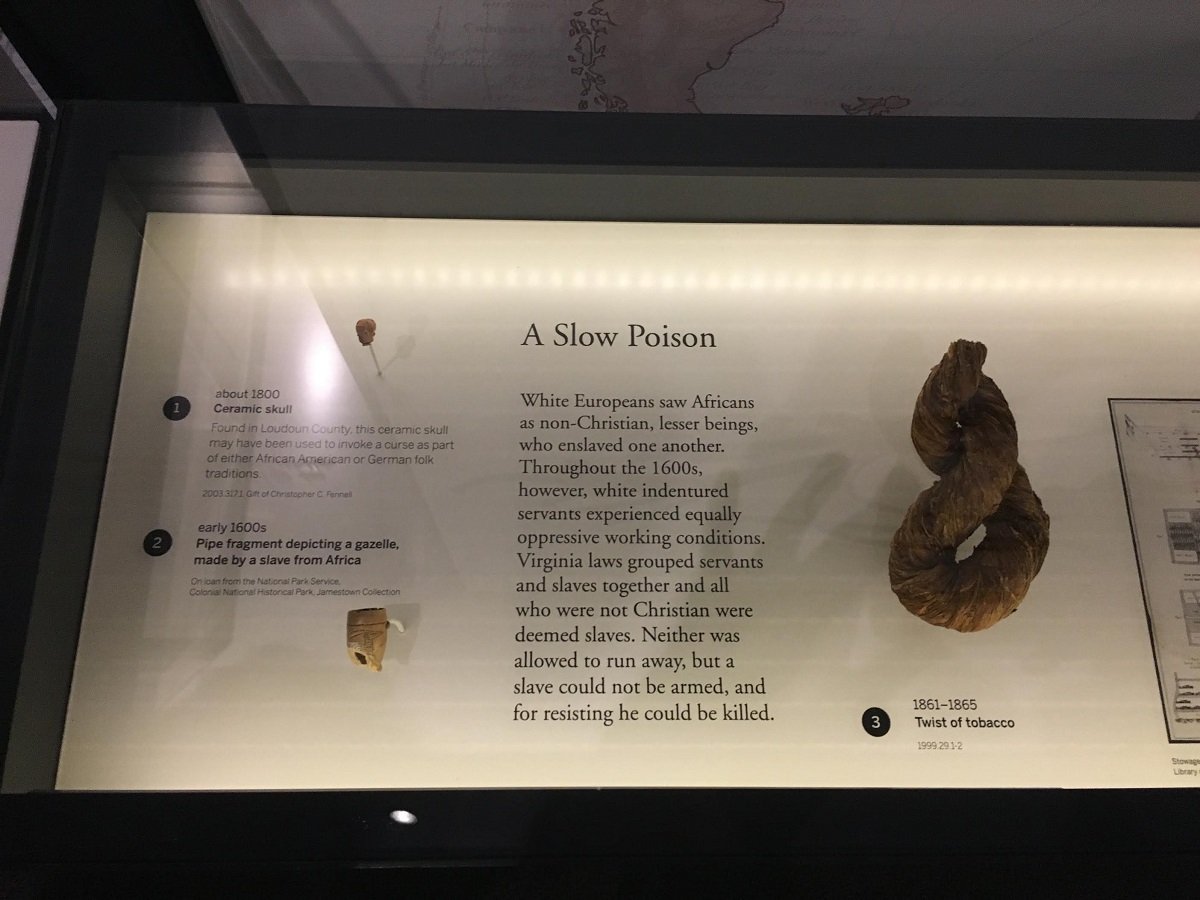
The culture of the imported African slaves mixing with the tobacco market of the colonies is reflected throughout artifacts from this time period, including a tobacco pipe ingrained with an image of a gazelle that the Virginia Historical Society has on display. This pipe is just one of multiple items on display in “The Story of Virginia” that relate back to Virginia’s tobacco culture.

When the nature of the slave trade changed through the leasing of slaves to factory owners, Richmond became one of the main centers of the slave trade on the East Coast. According to Obrochta, by the 1860s there were around 3,400 enslaved people working in Richmond tobacco factories.
As the production of tobacco increased exponentially as a result of factories, warehouses were developed in order to ensure the quality of product being shipped back to England. Through this trend Virginia became associated with quality tobacco, a reputation that still exists today. The evidence of Virginia’s tobacco production can still be seen the quantity of warehouse buildings in the downtown area.
Richmond was eventually solidified as one of the main centers for tobacco production and marketing in the mid-1900s with the development of large corporations like Philip Morris. The 1920s saw a huge increase in cigarettes advertising and by the 1980s Richmond businessman Lewis Ginter was even producing cigarettes.

The “Smoke If You Got ‘Em” gallery walk included a crowd of about 35 people, all interested in learning about tobacco in Virginia as well as sharing their personal stories about how tobacco had shaped their own family histories.
“I think that’s what’s really neat too,” Obrochta said. “People do connect with it. You can see all the people who want to share their stories.”