
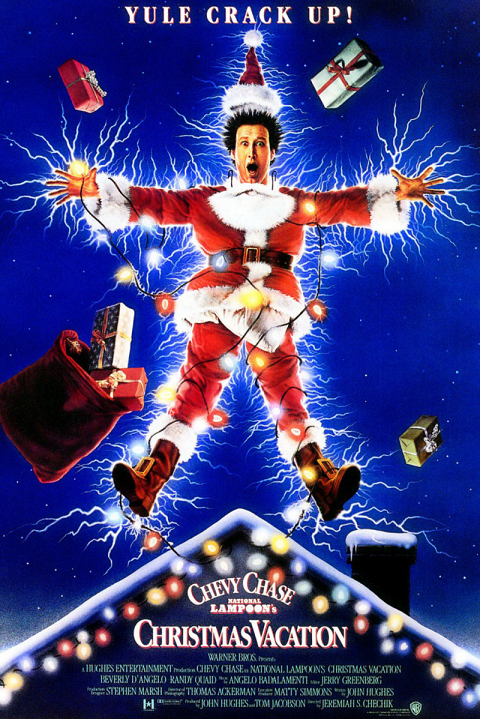
In 1989, National Lampoon’s Christmas Vacation debuted to audiences as the third installment in the National Lampoon Vacation series. Since then, it has been widely recognized as a classic holiday film.
In 1989, National Lampoon’s Christmas Vacation debuted to audiences as the third installment in the National Lampoon Vacation series. Since then, it has been widely recognized as a classic holiday film. This particular “vacation” with the Griswold family was introduced to the big screen by director Jeremiah S. Chechik (Benny & Joon, The Right Kind of Wrong) and was written and produced by John Hughes (The Breakfast Club, Pretty In Pink, Weird Science). The film was inspired by Hughes’s story for National Lampoon magazine, “Christmas ’59,” and presents us with a familiar, modern family whose patriarch, Clark Griswold (Chevy Chase) is doing his best to give the whole family, in-laws included, a traditional old-fashioned Christmas. What happens next is Christmas hilarity at its best.

Clark’s ambitious, over-the-top attempts to deliver on the family Christmas he envisions for his wife and children are endearing, even though they never seem to work out. The film features many different elements of legendary Christmas tradition, contrasting Clark’s impossibly high standards for success with outcomes that unfailingly represent the worst case scenario. At one point, the family picks out the most majestic tree in the forest, only to have to rip it up from the ground because Clark forgot the saw. Then, upon getting it home, the tree is entirely too big for the living room. The in-laws begin arguing as soon as they arrive, and never stop. Meanwhile, the Christmas lights Clark covers every square inch of the house with cause a statewide blackout–but not before Clark loses his mind because they refuse to light up in the first place. Then there’s the unexpected appearance of Clark’s penniless and uncouth cousin-in-law, Eddie (Randy Quaid, reprising his brilliant cameo role in the original Vacation), and his family; the beautiful turkey dinner being completely overcooked and inedible; the family Christmas tree eventually going up in flames; and on and on and on. You can’t help but laugh at the way that everything inevitably goes wrong–and the way the Griswold hijinks unwittingly torment the urbane, childless couple living next door.
It’s worth noting, though, that throughout Clark’s well-meaning attempts to create a perfect family Christmas, his patient wife, Ellen (Beverly D’Angelo), and children, Audrey (Juliette Lewis) and Rusty (Johnny Galecki), humor him at every turn–in spite of grumbling criticism from the in-laws. In their own quirky, bizarre way, the Griswold family comes across as one of the most loving families ever created for the big screen. This stands somewhat in contrast with the way the family dynamic is portrayed in the other Vacation films, but considering that the kids are played by different actors in every film, looking for internal consistency from this series is not a recommended course of action.

By Christmas Eve, Clark has had enough. He loses his temper with the entire extended family, and during his rant, the family learns what the viewer has known the whole time–much of Clark’s anxiety over making the family’s Christmas perfect has been due to his economic struggles to afford the holiday. His Christmas bonus, which he’d been counting on to pay for gifts, was transferred by his boss into a membership in the Jelly-Of-The-Month Club, and on top of all the other disasters that have occurred, the Griswolds are dead broke. Upon hearing this, Cousin Eddie–who has been feeling his own quiet guilt over not being able to buy his family presents–is inspired to kidnap Clark’s boss and deliver him to Clark as a Christmas present. The result of Eddie’s poorly thought-out generosity, which involves the appearance of a S.W.A.T. team, is possibly the most over-the-top scenario the film has to offer–which is really saying something. However, this just reinforces the film’s message–extreme standards can result in extreme consequences. Especially at Christmas.

National Lampoon’s Christmas Vacation is unique amongst holiday family comedy films in its open, mocking exaggerations of many time-honored Christmas traditions. This is highlighted by the end of the film, when Clark congratulates himself on a fun and successful family Christmas experience in spite of the many borderline-disastrous events that have occurred in the process. Over two decades later, Christmas Vacation holds up as one of the best family Christmas stories ever told. Its hilarious illustration of what happens when all the time-honored holiday traditions are removed or destroyed proves that Christmas remains meaningful regardless. In the end, it’s a holiday about love and togetherness, not expensive gifts or perfect light displays, and Clark Griswold’s comical buffoonery gets that point across more effectively than all the sweet, sentimental Christmas stories in the world. Plus, in this era of recession, unemployment, and unstable incomes, its subject matter remains quite topical. National Lampoon’s Christmas Vacation remains a must-see at this time of year, so this holiday season, make sure you celebrate Christmas once again with the Griswolds.