
The VMFA is opening Chuck Close: People Who Matter to Me, a collection of two dozen works by Chuck Close spanning thirty-five years of the artists career from 1974 to present. The show opens July 10th and run through Oct. 17th in the 20th century galleries of the museum.
Local collectors Sydney and Frances Lewis enjoyed a warm friendship with the artist and the works shown are from the permanent collections of both the VMFA and the Lewis estate. This exhibition presents a broad overview of Close’s work. It will feature a spectrum of the media in which Close has worked, and will include portraits of many of his most important subjects with a special focus on composer Philip Glass, for whom the Lewises served as patrons.
HIS LIFE AND WORK
Chuck Close’s father died when he was ten years old. Most of his early works are very large portraits based on photographs (Photorealism or Hyperrealism technique) of family and friends, often other artists. In 1962, he received his B.A. from the University of Washington in Seattle. He then attended graduate school at Yale University, where he received his MFA in 1964. After Yale, he lived in Europe for a while on a Fulbright grant. When he returned to the US, he worked as an art teacher at the University of Massachusetts.
Close had been known for his skillful brushwork as a graduate student at Yale University. As he explained in a 2009 interview with the Akron Ohio Plain Dealer, he made a choice in 1967 to make art hard for himself and force a personal artistic breakthrough by abandoning the paintbrush. “I threw away my tools”, Close said. “I chose to do things I had no facility with. The choice not to do something is in a funny way more positive than the choice to do something. If you impose a limit to not do something you’ve done before, it will push you to where you’ve never gone before.”[2]
Close’s first one-man show was in 1970. His work was first exhibited at the New York Museum of Modern Art in early 1973. In 1979 his work was included in the Whitney Biennial. “One demonstration of the way photography became assimilated into the art world is the success of photorealist painting in the late 1960s and early 1970s. It is also called super-realism or hyper-realism and painters like Richard Estes, Denis Peterson, Audrey Flack, and Chuck Close often worked from photographic stills to create paintings that appeared to be photographs. The everyday nature of the subject matter of the paintings likewise worked to secure the painting as a realist object.”
One photo of Philip Glass was included in his black and white series in 1969, redone with water colors in 1977, again redone with stamp pad and fingerprints in 1978, and also done as gray handmade paper in 1982.
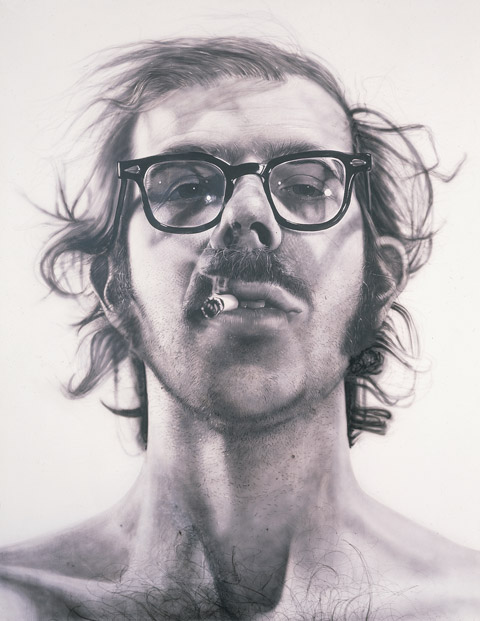
Although his later paintings differ in method from his earlier canvases, the preliminary process remains the same. To create his grid work copies of photos, Close puts a grid on the photo and on the canvas and copies cell by cell. Typically, each square within the grid is filled with roughly executed regions of color (usually consisting of painted rings on a contrasting background) which give the cell a perceived ‘average’ hue which makes sense from a distance. His first tools for this included an airbrush, rags, razor blade, and an eraser mounted on a power drill. His first picture with this method was Big Self Portrait, a black and white enlargement of his face to a 107.5 in by 83.5 in (2.73 m by 2.12 m) canvas, made in over four months in 1968, and acquired by the Walker Art Center in 1969. He made seven more black and white portraits during this period. He has been quoted as saying that he used such diluted paint in the airbrush that all eight of the paintings were made with a single tube of mars black acrylic.
Later work has branched into non-rectangular grids, topographic map style regions of similar colors, CMYK color grid work, and using larger grids to make the cell by cell nature of his work obvious even in small reproductions. The Big Self Portrait is so finely done that even a full page reproduction in an art book is still indistinguishable from a regular photograph. via wikipedia
The VMFA is opening Chuck Close: People Who Matter to Me, a collection of two dozen works by Chuck Close spanning thirty-five years of the artists career from 1974 to present. The show opens July 10th and run through Oct. 17th in the 20th century galleries of the museum.
Local collectors Sydney and Frances Lewis enjoyed a warm friendship with the artist and the works shown are from the permanent collections of both the VMFA and the Lewis estate. This exhibition presents a broad overview of Close’s work. It will feature a spectrum of the media in which Close has worked, and will include portraits of many of his most important subjects with a special focus on composer Philip Glass, for whom the Lewises served as patrons.
HIS LIFE AND WORK
Chuck Close’s father died when he was ten years old. Most of his early works are very large portraits based on photographs (Photorealism or Hyperrealism technique) of family and friends, often other artists. In 1962, he received his B.A. from the University of Washington in Seattle. He then attended graduate school at Yale University, where he received his MFA in 1964. After Yale, he lived in Europe for a while on a Fulbright grant. When he returned to the US, he worked as an art teacher at the University of Massachusetts.
Close had been known for his skillful brushwork as a graduate student at Yale University. As he explained in a 2009 interview with the Akron Ohio Plain Dealer, he made a choice in 1967 to make art hard for himself and force a personal artistic breakthrough by abandoning the paintbrush. “I threw away my tools”, Close said. “I chose to do things I had no facility with. The choice not to do something is in a funny way more positive than the choice to do something. If you impose a limit to not do something you’ve done before, it will push you to where you’ve never gone before.”[2]
Close’s first one-man show was in 1970. His work was first exhibited at the New York Museum of Modern Art in early 1973. In 1979 his work was included in the Whitney Biennial. “One demonstration of the way photography became assimilated into the art world is the success of photorealist painting in the late 1960s and early 1970s. It is also called super-realism or hyper-realism and painters like Richard Estes, Denis Peterson, Audrey Flack, and Chuck Close often worked from photographic stills to create paintings that appeared to be photographs. The everyday nature of the subject matter of the paintings likewise worked to secure the painting as a realist object.”
One photo of Philip Glass was included in his black and white series in 1969, redone with water colors in 1977, again redone with stamp pad and fingerprints in 1978, and also done as gray handmade paper in 1982.
Although his later paintings differ in method from his earlier canvases, the preliminary process remains the same. To create his grid work copies of photos, Close puts a grid on the photo and on the canvas and copies cell by cell. Typically, each square within the grid is filled with roughly executed regions of color (usually consisting of painted rings on a contrasting background) which give the cell a perceived ‘average’ hue which makes sense from a distance. His first tools for this included an airbrush, rags, razor blade, and an eraser mounted on a power drill. His first picture with this method was Big Self Portrait, a black and white enlargement of his face to a 107.5 in by 83.5 in (2.73 m by 2.12 m) canvas, made in over four months in 1968, and acquired by the Walker Art Center in 1969. He made seven more black and white portraits during this period. He has been quoted as saying that he used such diluted paint in the airbrush that all eight of the paintings were made with a single tube of mars black acrylic.
Later work has branched into non-rectangular grids, topographic map style regions of similar colors, CMYK color grid work, and using larger grids to make the cell by cell nature of his work obvious even in small reproductions. The Big Self Portrait is so finely done that even a full page reproduction in an art book is still indistinguishable from a regular photograph. via wikipedia