
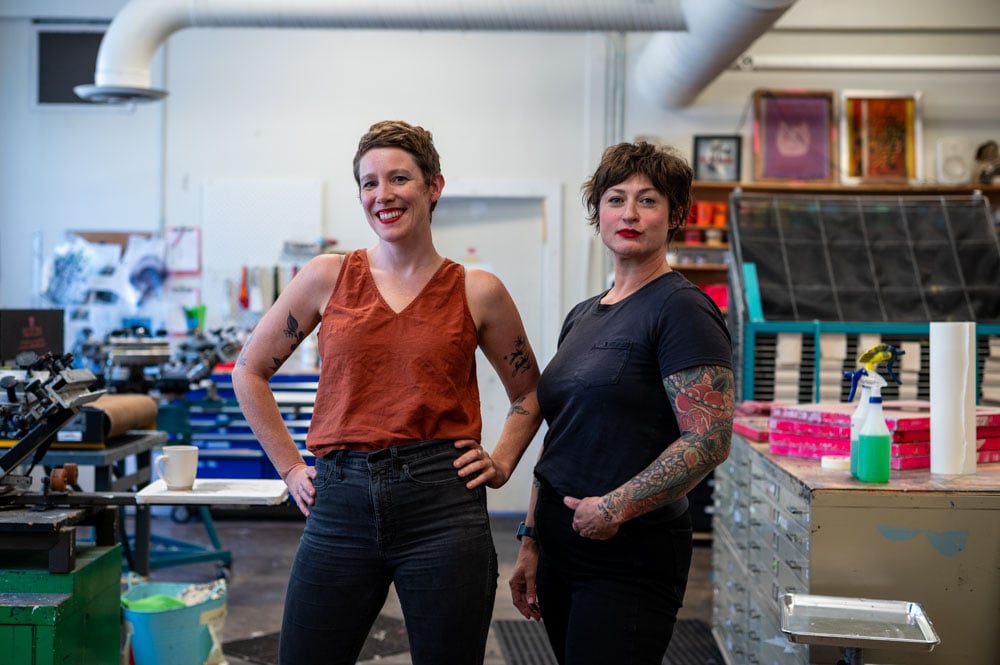
Studio Two Three has been around long enough to forget how likely it was to fail.
Sixteen years ago, a small group of friends wanted to keep making art in Richmond. They pooled money from working in local restaurants to pay rent, borrowed equipment and built an organization one piece at a time.
Today, Studio Two Three has 150 artist members, a 24-hour workspace and a community space that is home to film screenings, art shows, live music, union organizing, political conversations and, sometimes, square dancing.
Somewhere along the way, Studio Two Three also became more comfortable saying what needs to be said. Navigating that is an ongoing process.
I sat down with Studio Two Three co-founder and Executive Director Ashley Hawkins and Director of Community Partnerships and Development Kate Fowler and started with a basic question.
What is Studio Two Three?
R. Anthony Harris: What role does Studio Two Three play within the community in your mind?
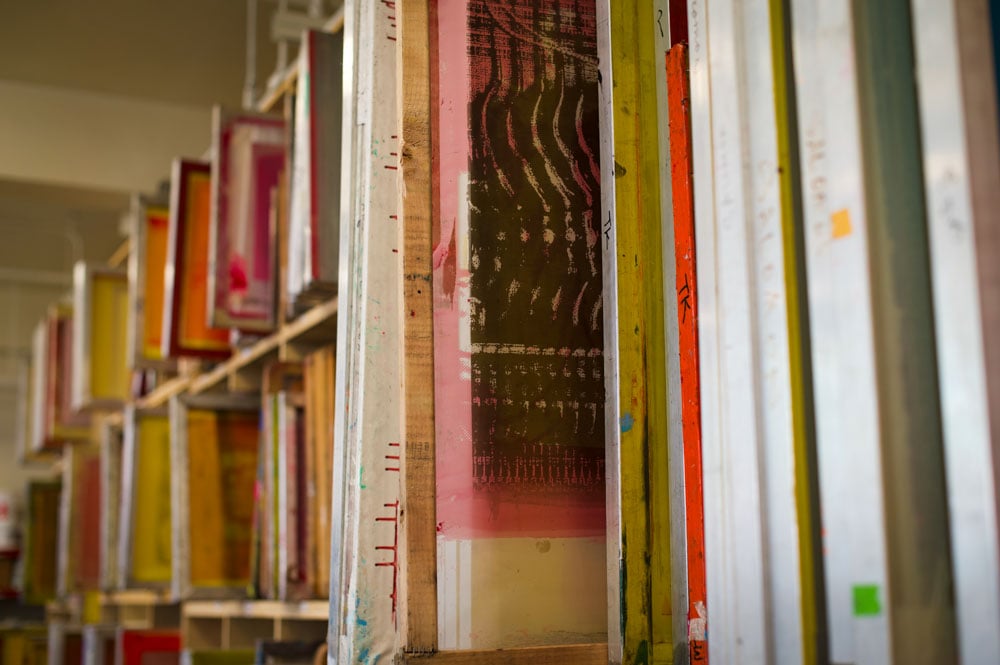
Ashley Hawkins: We’re in our 16th year now. We’d started really small with a 400 sq foot room as four women so we could continue making our artwork and from the beginning, there was always an overlay of media creation and propaganda because that’s the nature of printmaking. But at its core, it was about carving out a space for artists like ourselves to be able to keep making work in Richmond in a way that was accessible and not cost prohibitive.
Sixteen years later, there’s 150 artist members in the space, so clearly that was a need.
Before the interview, you mentioned physical space and the creation of physical media, and I think that’s a huge role that we’re filling right now. Within our print shops, providing a space for artist members to make their own work, to make our own work as an organization and as individual artists, and then above and beyond that, the community event space, where people are coming together.
We’re able to make that available to folks who are mission aligned, that are doing good work in the community that wouldn’t otherwise have resources to do it. It’s been really meaningful to watch things grow and blossom and either thrive within our space or then go on to get spaces of their own.
We operate on a “more the merrier” mentality for people in our community who are doing good work and doing important things. If we have the resources to give, then it’s our goal to give them.
Anthony: Did it always have an activist element to it? You said it started with female artists and that, in my mind, automatically already lends itself to some form of activism. Sixteen years later, I would say you and a few other organizations are kind of at the center of this conversation around activism in Richmond.
But you also mix in really fun things.
Kate Fowler: [laughs] As it should be.
Anthony: You have to have the fun to relieve some of that stress, but the fun brings in people who might feel like there’s a barrier to walking into a situation where everybody is so serious.
Ashley: There’s the notion of the seriousness of play, right? If you’re walking into something where there’s a lot of self-seriousness, nobody wants to go there. [laughs]
Kate: The four founding women were just buddies. It wasn’t a political statement to have all women in the space; those were just the people who were there.
This is something we’ve been talking a lot about recently. We’re reaching our 40s and one day we’re going to be gone. And what’s going to happen to the organization when new leadership comes in and says, “Well, we’re not going to do the free event space anymore”?
At first we thought, okay, how do we write these values into our bylaws to try to force future leadership into holding them?
And then, at some point, we realized that organizations aren’t made to stay static. They exist in a place and time with the people who lead it. There’s been this moment of realization for us both, “this is now. This is what we get to do and what we get to shape, and it exists in this moment”.
And at some point when we step away, whoever comes next could shut it down, or do X, Y, or Z, and we have very little control over it. So we are focusing on using the tools we have right to to build the community that we want to be a part of and to have the type of programming we’d always dreamed of having.
There are a lot of people organizing in this space, whether it’s union organizing or film screenings, who are younger than us. It’s meaningful to have a space where they can get their chops that’s free, where they can take risks and fail without hemorrhaging money.
So part of our responsibility is also recognizing that they could be the next people to lead Studio Two Three, and to help nurture that relationship.
But I think the whole staff happens to be political and creative, and so we just kind of bring our personal selves into the work. And it’s really changed over time.
There was a time where the organization was more scared about making its stance known for fear of blowback, but it’s also when the organization was more vulnerable. If funding was lost, then Studio Two Three could have shut down.
But we spent a long time figuring out how we can not have corporations paying for us to exist and how we can say yes or no.
We’ve had funders pull back publicly and demand that their name go off of our website. One local foundation director, after we wrote something for Style about VCU and Palestine, tried to organize donors and foundations in Richmond to boycott Studio Two Three.
She was calling people on the phone and asking them to pull their support. Rather than pulling, some of our donors called and said, “Hey, do you know that this person is trying to organize a boycott?”.
What can you do? You just have to put one foot in front of the other.
Ashley: You know, thinking about the seasonality of an organization; when we started we had no money. We were sharing bartending and serving tips to pay rent at Plant Zero and borrowing equipment.
At the time, and for many years, it felt like, “Oh God, there are so many organizations that have so much more than us. We wish we had that big grant. We wish we had a singular funder to make this happen.”
In retrospect, I’m so glad that we didn’t.
We’ve always had a lot of our own earned income through memberships and classes and retail sales. And when folks invest, we don’t ever assume that it’s permanent or that the strings attached are going to be able to control what we do as an organization.
We really try to act with integrity because there are stakes. It’s our job to ensure that the organization is healthy and is able to be here for our community. But it’s also our job to tell the truth.
Kate: That’s right. And there are a lot of other big-tent organizations that play really valuable roles for everyone in our community. But not every arts organization needs to be big-tent, you know? There need to be some spaces that are really clear eyed about what’s happening in our place and time.
Studio Two Three is so specifically a Richmond-made organization, so we feel like it’s important to speak honestly about what’s happening here and to push back on the institutions that helped to form us.
Anthony: Yeah, I feel all that. When you’re in a vulnerable financial situation, it’s hard to speak out. I mean, the mag also went through the same process, and I still deal with that, but try to add another voice because when I see stories that are not told, it’s kind of, “Oh yeah, we should try to tell that story.”
And then, I’m also kind of in that phase of getting new voices in and allowing them to have space without being overly judgmental or, trying to be like, “Don’t do that!” [laughs] Just try to understand what they’re going through and maybe what they need to gain some confidence because they’re the ones that are going to lead the next phase of the city someday.
Kate: Yeah, and for young folks the risk is so much higher these days when you put yourself out there. The level of scrutiny and demand for perfection is so high. I look at the film groups who are organizing in our space and am amazed to see them paying licensing fees–– for so long we just hosted free screenings and didn’t pay those fees. But they have this incredible integrity. There’s a lot of rigor.
They’re also hiring artists to design these incredible flyers. And so the amount of work that is going into organizing these screenings and the amount of scrutiny that everyone is facing, like, “Where did your poster come from? How was it made?” There’s just a high level of expectation that they’re operating within that we didn’t face in our 20s.
My hope is that these younger organizers don’t burn out in the process of perfection and that some space for errors and mistakes are made. That they can hold the value of what they’re doing without the demand of everything being exactly right.
Anthony: Maybe give themselves some grace. Give yourself some grace.
Kate: And people give them grace.
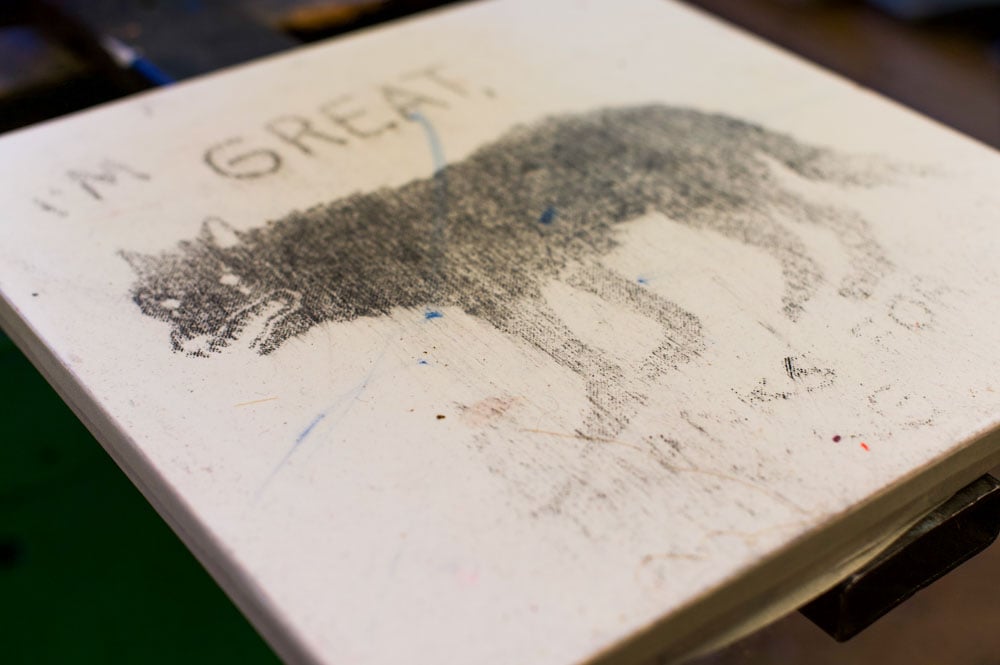
WE HAD ROOM TO FAIL
That independence matters because the Richmond Studio Two Three was created in isn’t really the Richmond young artists are inheriting today.
We had room to fail. I’m not sure Richmond still does.
Anthony: Maybe it’s becoming so unaffordable that organizations like ours aren’t as possible anymore. I was paying something like $275 in rent. I lived with four other people. I was rolling sushi. I could kind of do whatever I wanted because I could afford to. I could take a chance by starting the mag. I don’t know if that is possible now.
Ashley: Totally. I was funding my rent with two-dollar Tuesdays at Starlite and that meant I could put 300 bucks into the print shop and buy paper and ink.
If you have no pennies to rub together, you can’t throw them at the thing that you care about.
Thinking about offering the event space free of charge and even doing free memberships for artists, we really believe that people should have the ability to follow things that they’re passionate about and to build the world that they want to see. It’s really hard to do if you are in desperate financial straits.
Anthony: And paying $2,000 in rent versus $300 is a huge deal. Everything else is more expensive too. So what worries you the most about Richmond right now?
Kate: Front of mind for me, we’re really worried about Code Refresh passing. We want to see more housing that’s affordable in the city so that people are able to stay and live.
I’m also worried about VCU. We’ve been really lucky to have an art school in the middle of our city. It anchors a lot of creativity and has kept the city young and vital.
But seeing VCU’s recent consolidation of their art departments into an amorphous department of “fine arts”, and to see the way they’re treating their adjunct professors is really distressing. We interact with a lot of students! Many of our interns are students and to learn about the quality of their experience compared to what they’re being charged is shocking. There is an overall shift in Richmond where things cost more and people are receiving less. It’s distressing to me because I know that affordability is what keeps spaces like this vibrant.
Richmond is a really culturally unique place and I want it to stay that way. But it’s going to take some real intentionality about affordability and holding our institutions accountable, including all of us, making sure that we continue to be rigorous and engaged and open-hearted. And making sure that these places aren’t just consolidating, taking money and providing less while exploiting their educators.
So that’s front and center in my mind. How are our institutions aging, and what are we doing with the power that we get as we get a little bit older and further into the game?
We’re still young and right in the middle of our work. But we’re putting our eye out there to see what other organizations are popping up, who’s doing cool shit, and how can we start showing up for their organizations and helping to move them forward?
Ashley: What you’re speaking to around affordability is the constriction of possibility that goes with that.
We started Studio Two Three because we wanted people to stay in Richmond. We love this city, and there wasn’t a resource like it for artists. We were seeing people graduate from VCU and leave for bigger cities because there were more options available to them.
When we started the studio, It felt like there was an expansiveness of possibility. People could see an opening and they could build something meaningful, and they could do it within the scope of their lives without losing everything in order to do it. How do we hold that expansiveness of possibility for folks who are coming after us? And how do we play a role in that? Because it’s obviously going to be a huge collective effort.
BEEFING WITH BOTS
Affordability is one thing that has changed since Studio Two Three started. Social media is another. For organizations like the studio and the mag, it’s how we distribute our work, find audiences and maintain community connections every day.
It has also created a public space where disagreements can turn ugly.
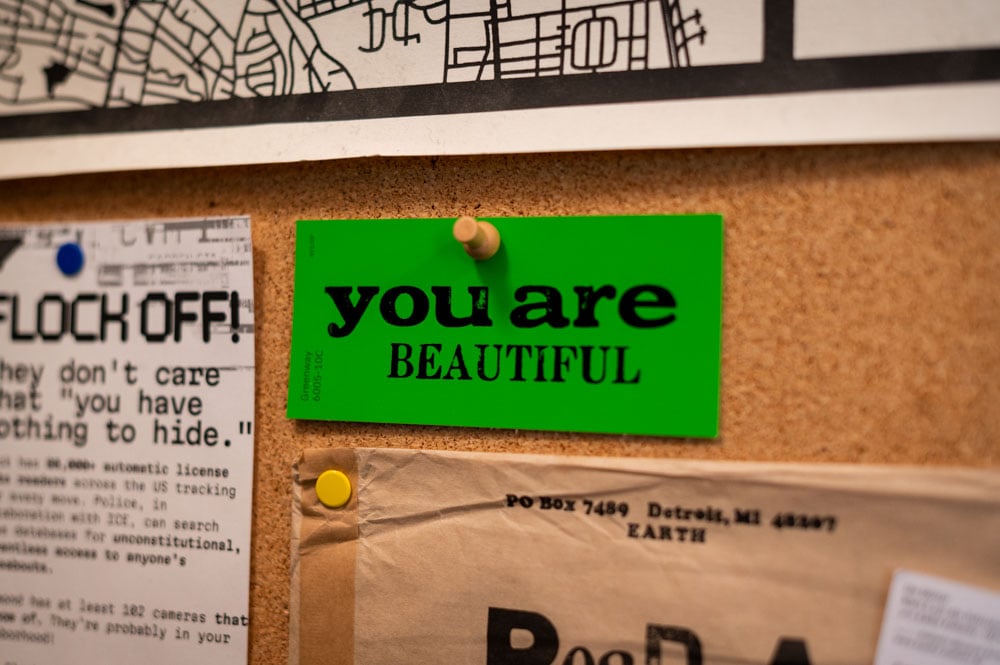
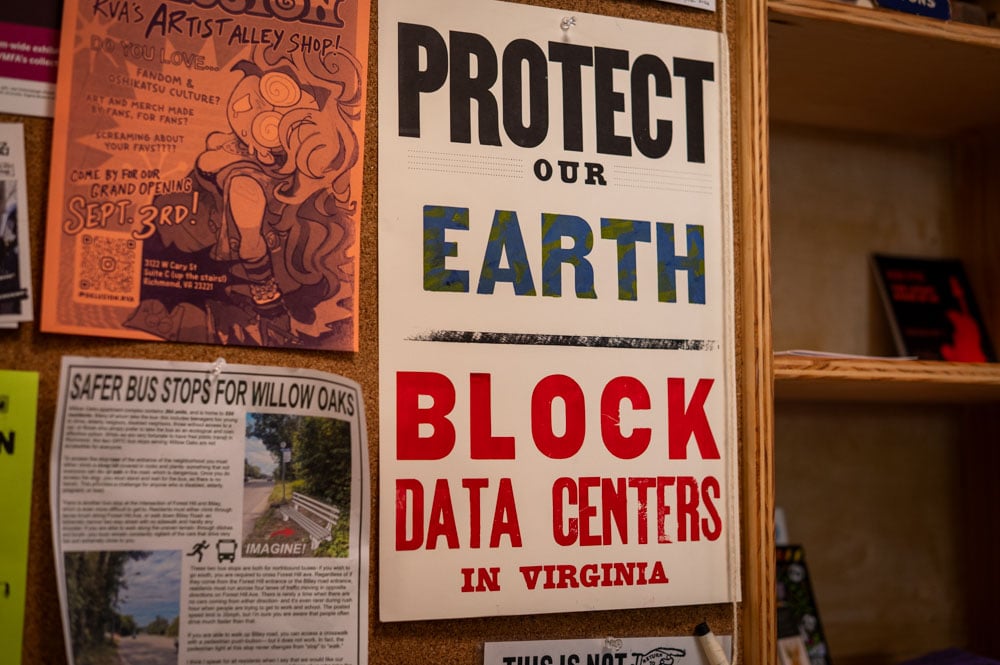
The studio’s willingness to provide space for and take positions on issues including housing, VCU, Palestine, data centers and Flock cameras has occasionally made it a target. They’ve also seen hot-button issues draw outside commenters who seem less interested in the conversation than in fueling the conflict.
Anthony: That leads into why I wanted to talk with you both. I saw a post, and you were going back and forth with these comment bots. You were joking about …
Kate: [laughs] beefing.
Anthony: Beefing with these bots! Which should be…
Kate: [laughs] That’s a great title for this story, Studio Two Three Beefing with Bots!
Anthony: How do you deal with that on the day to day of knowing that you are highlighting and allowing these conversations to happen in the space, and then having to deal with the negativity that happens on social media? Like, how do you keep your mental health in that?
Kate: We haven’t always been really good at it.
We really believe that people have a lot of online literacy.
So the thing that I always say to Ashley when we’re feeling anxious is that most people can see when other people are behaving badly, even if they don’t say it. When you witness bad behavior it just doesn’t fully sit right.
So I believe in letting people say their worst-impulse thing or to go on the attack because I know that it’s transparent to anyone willing to view what’s happening with an open heart. People can see what someone is trying to gain clout by shaming or humiliating another person. They’re showing up in bad faith and even if people don’t point that out, they know it deep down.
There’s an ick test that we follow when we’re looking at social media -we might be drawn to conflict and we want to read the comments- but we kind of know when somebody is being awful. Does it make us feel bad or uncomfortable around that person? If so, we don’t engage.
And so I stand behind that. If we truly believe in what we’re saying, if we’re operating with internal clarity and we’re trying to come from a values-based place, people can get as angry as they want. So long as we believe in what we’re saying, that should be obvious. And if somebody is trying to humiliate us for personal gain, that should also be obvious.
It’s taken a lot of work to learn how to shake off the fear of the online takedown. At this point, we know in our hearts that we are genuinely trying to show up and to operate with integrity. So if we fail, we try to step forward into that failure and talk about it openly. Anything shy of that is drama.
Years ago, we had a map that we commissioned that excluded core parts of Richmond. Those neighborhoods were primarily Black and low-income. Friends started to send messages questioning this map’s representation of Richmond and there were two ways we could go: we could try to hide and obfuscate this stupid mistake or we could just step forward is say, hey, “This is where we were, this is where we are today, and here’s how we’re going to move forward.”
And so I think we’ve really tried to operate with openness. Rather than hiding we want to step into the fullness of what we see or believe or what we’ve been called on, rightfully, if there’s a gap.
And we’ve also been really lucky that when we fuck up, a lot of people just pick up the phone or talk to us in person and tell us how they’re feeling.
I’m not sure if you’ve witnessed our tone change but over the last few years we’ve stopped simply apologizing if someone has a hot take. We used to do the “oh no, we’re so sorry” dance. We’ve really shifted to a position of pushing back when we feel clearly about something, without fear of cancellation.
Part of the reason we’re doing this is because people are just eating each other up. They’re shutting down progressive organizing efforts and pushing each other’s cultural efforts into the ground. It’s happening in our community and we think it’s dysfunctional.
And so part of it is, like, we all need to collectively be able to step forward and assess when somebody is actually really bad versus when they’ve just annoyed somebody; when somebody has actually harmed somebody else, or if they’ve just been a normal community member, you know, existing in the world.
We actually had something happen about a year ago. There was a huge online callout of another local organization and a small group of people started tagging us in an effort to get us to use our online presence to call that organization out. Like, literally, we had nothing to do with this organization. We weren’t organizing with them. We’d hardly ever worked with them.
This group was prodding us and it snowballed into a callout of Studio Two three for not calling out the other organization. As mindbending as that sounds.
And we just absolutely refused to do it, and the pressure continued mounting.
Finally, what we decided to do was to pick up the phone and call the people who were leading the online callout and to ask, “What are you doing? Why are you pressuring us? But also, we don’t agree with your tactics. We don’t like what you’re doing.”
And so we ended up calling, like, five different people involved with it, and they were literally shocked to receive a phone call. It was as though we were being the aggressors for calling.
Our feeling was that if you can publicly pressure people online to agree with your tactics, but you can’t sit on a phone call and defend why you’re telling people to be violent or why you’re using racist language to describe somebody, then we don’t know how to work with you.
So we’ve tried to be really clear. And when shit like this happens, we just pick up the phone and call the person.
Ashley: It’s extremely illuminating when somebody is very comfortable in a comment section or behind an Instagram post, but they’re cowering on a phone call when you’re saying, “Hey, what’s going on?”
Kate: Call people.
Yeah, and the other groups that were glomming on to the callout. We called them too and said, “Why are you doing this? How did this person affect you?” Rather than hiding and worrying about Studio Two Three losing some kind of social clout we questioned the nature of that social power and if it was something worth having.
As we get a little bit older, we’re more confident in just saying no. Call us out. Let the people in the fishbowl go around one time and then they’ll move on to the next outrage.
We just let it play out now.
Ashley: It’s conflict-based. It’s attention-seeking, and when that happens, we do the lateral punch thing and we feel good because we’ve asserted some degree of power over somebody who’s in an equal or a lesser position of power than us.
And it’s like, ah, we should be punching up, you know? Like, why are we not punching up? Why are we doing this?
And I think that’s a lens for me when we get into these imbroglios. It’s like, oh, are they actually trying to build something meaningful in the world? Like, what is the end goal here?
THE RADICAL IDEA
Studio Two Three isn’t simply providing a building where people make art. The way the place itself operates is part of the philosophy.
Members have 24-hour access, people share equipment and they take responsibility for the space. When something goes wrong, the first instinct isn’t necessarily to find an authority to fix it for them. They take that on themselves as a group.
It’s built around a fairly radical proposition: give people some ownership over a community and, most of the time, they’ll take care of it.
Anthony: Last question for you. It’s been 16 years. Is Studio Two Three what you imagined it would be when you started?
Ashley: At first all we could envision was not getting kicked out of our 400-square-foot studio because we couldn’t pay the rent.
Anthony: But when you were drafting a mission, when you went to grad school, what did you envision when you actually said, “This will become an organization?”
Ashley: I think the artist studio element of it, yes. Like, it’s that on steroids. I think having this space has really been transformative, but the idea of people coming in 24/7 and making work in the middle of the night and learning from each other and getting into arguments over, you know, who all the ink on the sink, that dynamic was the dream.
And then I think the overlay of building community power and using artistic voices within a civic environment has been kind of a thread that was not clearly expressed initially. It was like a gut feeling of a bunch of dirty little punk kids that were like, “Yeah, we have something to say.” We weren’t sure what the thing was that we were saying, but over time I think that has come.
I think just one foot in front of the other, and with you [looking at Kate] coming on when you did, I think having somebody in a co-leadership position who has real vision has been hugely transformative.
Kate: I also think that your vision of starting a place that was 24/7 right from the very beginning is actually the radical thing that has made all of this possible. Still to this day, that’s the thing that shocks people the post, that everybody gets a key code and can be here any time. People also want us to call the cops when things go wrong and I think we both share a value of working shit out.
To have these core values is what has guided the growth of the entire organization. You have to start from a position of radical trust in humanity to say, “We’re all going to co-own this thing and try to do the right thing by each other.”
Ashley: It’s a collective product of what we make of it.
Kate: When people have failed to meet the expectations, we’ve had to sit down and have really awkward conversations. That’s an ongoing process. But overall, most people are good, and they want to do the right thing and take care of the space. Over 16 years, we’ve asked fewer than 5 people to leave. That’s remarkable to me.
Ashley: And to hold each other accountable. And I think about getting off-screen and in real life. It’s a lot easier when you know somebody as a human being to be like, “Hey, dude, you took my T-shirts,” or whatever that is.
It’s like you can have a real conversation because you’ve interacted in a physical space. You’re sharing resources, and there is a real shared sense of ownership of the space. People care about it, and they’re here late at night, and when something goes wrong, they call us. Or, if somebody’s here doing weird shit, they tell them to skedaddle.
So, in essence, we’re a staff of four, but there are 25 additional people who are here pretty much all the time, caring for the space and building that community.
And, you know, thinking of seasonality, that’s been a different group over the years. But I do think the 24/7 nature of it is core to the organization, and it actually allows it to be the product of the people that are in it.
Anthony: [sarcastically] Wait. Are you saying that if people have an investment in something collectively, they’ll figure out how to self-police and govern effectively?
Kate: Totally. We’ve had maybe five events where it was like, “What the fuck are you doing?” But we’ve had hundreds.
Ashley: We had 278 events last year. People clean the space. They message us. They let us know when things are broken. Our projector broke, and the Hard Light folks held a fundraiser to buy us a new one.
There’s an incentive for the space to continue functioning for people. There’s a self-interest there, and then there’s the shared community of working within it.
People tend to it and care for it.
Anthony: I hadn’t really thought about it this way until you said that, but the way this space functions feels a little like the way you would like the city to function. We’re all invested in it. Everybody should benefit from it in some way. And maybe benefiting at the expense of everybody else isn’t what we want as a community.
Is that the radical idea?
Kate: Yeah. Put your sweat equity into it. Care about it. Show up. Earn it. If you’re unsure about things like Code Refresh or whatever big issue is facing us, actually take the time to understand it. And then if you still feel some sort of way, you know you really believe it.
We’ve got to get out from behind the phones and show up in a place.
Ashley: The purity, perfect-alignment expectation has to go. If we agree about 90 percent of things and 10 percent I want to fistfight you over, I’ve got to set the 10 percent away and work with you on the 90 percent.
Where can we be aligned? What can we drive forward together?
And then where do I know that you’re going to have to do your own thing and I’m going to be over here?
When we expect people to be in perfect alignment with us all the time, we’re destined to fail. Because it’s absolutely not going to happen.
Photos by R. Anthony Harris
Support RVA Magazine. Support Independent Media in Richmond.
RVA Magazine has remained one of Richmond’s few independent voices. Since 2005, we have provided grassroots coverage of our artists, musicians, and communities, marginalized or otherwise, documenting the city’s culture that lies right under the surface and beyond the headlines.
But we can’t do this without you. A small amount, even as little as $2, one-time or recurring, helps us continue to produce honest, local coverage free from outside interference. Every dollar makes a difference. Your support helps keep us going and keeps the local creative spirit alive. Thank you for standing with independent media, and thank you for reading.
Show your SUPPORT HERE
Also, subscribe to the newsletter HERE
We’ve got merch HERE
Subscribe to the Substack HERE
And Reddit HERE
And YouTube HERE