
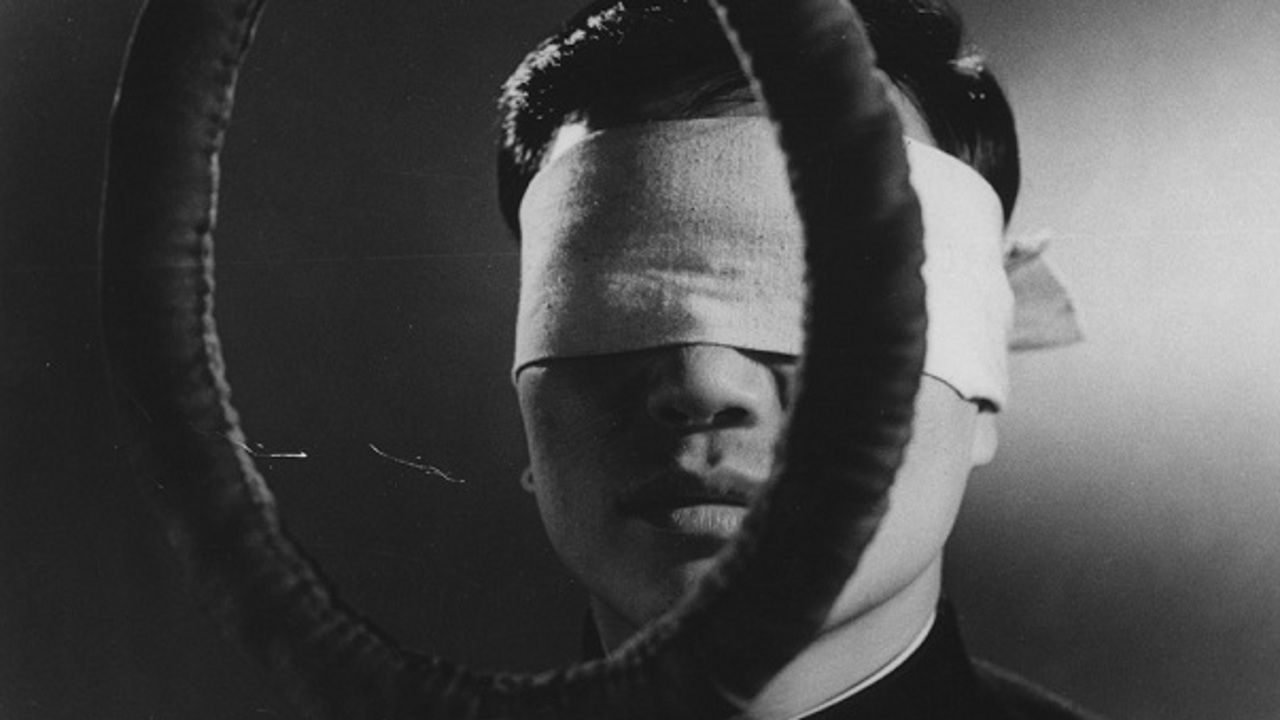
The opening query of provocateur Nagasa Oshima’s political Death by Hanging is the question of “…have you actually seen an execution or an execution chamber”?
The opening query of provocateur Nagasa Oshima’s political Death by Hanging is the question of “…have you actually seen an execution or an execution chamber”? Beginning like a documentary of sorts, the film escalates in bureaucratic form as it evolves into utter frenzy full of madness, silliness, and even ghosts.
We first travel the pristine corridors of the execution chamber to find a group of uniformed men who methodically and systematically follow their routine to vanquish the evil that supposedly needs to be punished. “R”, a trembling man convicted of multiple murders and rapes is presented in stark black and white, ready for his meticulous procedure of swift demise.
The blindfolded R is lead to a platform as the floor drops out from below him. The man falls violently without a pitch of sound to distract from the sudden and harrowing fall. After he has stopped moving, the man is then lowered to the ground as they check his pulse. He is not dead, but in fact still very alive. What to do now? This routine hanging has been disrupted and nobody knows exactly what to do. Debate ensues. Hang him again? Send him back? The men start to argue about the proper, rational procedure.
Adding more problems is that R, a Korean immigrant, doesn’t know who he is, what he is, or what consciousness may even be. He is an almost blank vessel who knows nothing of what he has done. The men are all respected in Japanese culture, complete with policemen, a priest, and medical officers, offer the only solution is to re-enact the unpleasant events that lead them there that day. So how does one instill the right amount of guilt to properly dispose of him? These educational exercises only confuse R more who has lost his cursed identity along with his memory.
The second act of Death by Hanging features a ghostly woman who humanizes R and creates the suggestion that these men are maybe just as reprehensible as the man destined for hanging. Departing the social-realist message of the first half, the film starts to get philosophical and strangely sensual in the efforts to create the right amount of remorse for R who is comically hapless and weirdly philosophical. While confirming R’s guilt, the woman takes part of the farcical reenactments (which are becoming more bizarre, compromising, and incriminating) with the men but comes out against his punishment. To her it is neither comforting nor logical in her spectral estimation. Ultimately the conclusion of R is inevitable but hard to forget.
Death by Hanging is an essential addition to Oshima’s long list of titles already in the Criterion canon and nearly 50 years old. The director’s ever-changing style is confidently on display with this title and provides a unique adventure with something to ponder after it is over. This release features not only a new 4K restoration but new English subtitles with an uncompressed monaural soundtrack for the Blu-ray soundtrack. The supplements feature a high-definition digital transfer of director Nagisa Oshima’s 1965 experimental short documentary Diary of Yunbogi, a new interview with critic Tony Rayns, a trailer, an essay by critic Howard Hampton along with a director’s statement by Oshima himself. The transfer is quite strong and allows for a beautifully stark contrast in the black and white.
Death by Hanging’s opening plainly states that in a 1967 Justice Ministry of Japan poll, 71% of the Japanese questioned about it were in supported of the death penalty while 16% were against it. Oshima simply theorizes that his audience would have a very different opinion if he were to present the events as meaningless and obtuse as he views them. Why murder somebody to correct a wrong? Even if they were conscious and accepting of it, what exactly does it prove or what does it redeem? These are valuable questions worth exploring in any context or culture as Oshima makes a great case against the death penalty and our understanding of this punishment. Oshima’s provocative filmmaking continued throughout his career to be more or less a reaction piece to the time that it’s in. An outsider even by his filmmaker peer standards, Oshima never shied from offering something subversive and thoughtful.
The film is not only experimental in its tone and storytelling, but explores Japanese cultural identity, racism and nationalism, discrimination, capital punishment, and the hypocrisy is still remnant today. Wonderfully perhaps, is that this is still an issue for not only the Japanese but also western audiences as well. It’s also a satire of sorts that confronts the bureaucratic nature of the Japanese political system and capital punishment by flaunting the hypocrisy in this curious story. While perhaps dated in its execution, the film is jarring and a somber self-examination of a practice that continues to be an imperative moral question.
Death by Hanging
1968 (Japan)
Nagasa Oshima
Spine #798
Available On DVD & Blu-Ray