
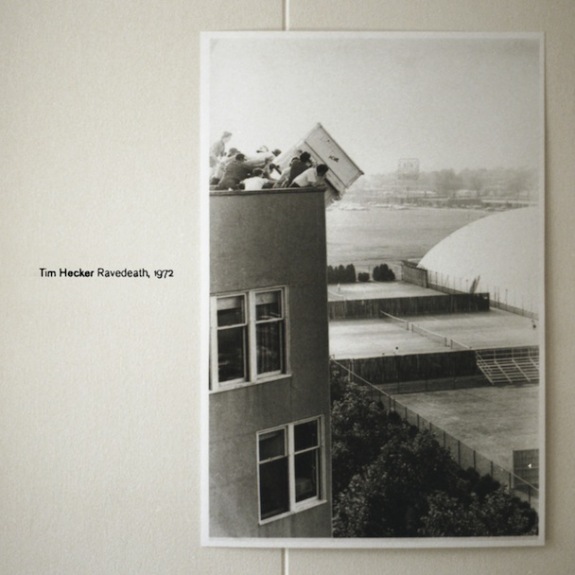
Tim Hecker – Ravedeath 1972 (Kranky Records)
Tim Hecker’s newest album offers few surprises for anybody familiar with any of his previous work. The Canadian composer has spent the past decade and a half creating what is often tagged as ambient music, but has little in common with the hushed whisper of the genre’s pioneers, instead opting for a distinctive interweaving of harsh distorted textures and eerie placidity. Some are heavier on the buzz and hum than others, but ultimately the listener will be subject to some spacey, beatless drone that may not be surprising, but is certainly more visceral and satisfying than pretty much any other electronic music made in recent years.
Tim Hecker – Ravedeath 1972 (Kranky Records)
Tim Hecker’s newest album offers few surprises for anybody familiar with any of his previous work. The Canadian composer has spent the past decade and a half creating what is often tagged as ambient music, but has little in common with the hushed whisper of the genre’s pioneers, instead opting for a distinctive interweaving of harsh distorted textures and eerie placidity. Some are heavier on the buzz and hum than others, but ultimately the listener will be subject to some spacey, beatless drone that may not be surprising, but is certainly more visceral and satisfying than pretty much any other electronic music made in recent years.

That said, Hecker still has it in him to throw a curveball from time to time. Though the actual sonics may vary only minutely from his larger body of work, the occasional Isis remix or album created solely from Van Halen samples help steer Hecker away from the stodgy academic trap that so many of his contemporaries fall victim to. Ravedeath 1972 may not veer quite as widely from Hecker’s typical aesthetic path, but it possesses a sense of blunt literalism rarely found on this type of album. Song titles like “No Drums” might be some sort of dry Canadian humor (since none of his songs have any sort of percussion. Har har), just as songs like “Hatred Of Music” or “Studio Suicide” come off like a sort of grim joke, referencing the seemingly paradoxical combination of soul-crushing tedium and blinding frustration that often comes part and parcel with the recording process. Other songs, however, possess a literalism that is more informed by imagery and evocation than any sort of didactic commentary regarding the Hecker’s work.

The three-part “In The Fog” is one of the most aptly-titled pieces Hecker has created, and could reasonably be applied to anything he’s written, as Hecker has rarely relied on anything but the haziest sonic environments. While Ravedeath 1972 lacks a title track, the fact that the opening song is called “Piano Drop,” and the album’s cover art features a photograph taken in 1972 of MIT students pushing a piano from a building’s roof, seems an appropriate stand-in. The photograph documents the first annual Piano Drop, a ritual in which, as the name suggests, students pit a grand piano against the forces of gravity–with a predictable end result. Aside from the reference to a particular year, how this image ties to the music is somewhat less explicit. Hecker explained that the album was inspired by an obsession with “digital garbage,” offering the example of “the Kazakhstan government crack[ing] down on piracy and there’s pictures of 10 million DVDs and CD-Rs being pushed by bulldozers”–an explanation which may or may not actually illuminate anything. Both the concept and the image pertain to a wanton disregard for the implements by which creativity is facilitated and disseminated, brought about by a culture so oversaturated with information that the products of ingenuity and inventiveness are seen as disposable. But any further meaning can only be inferred by the individual listener, a shift of impetus more in line with Hecker’s previous albums than with his most recent.

Much has also been made of the circumstances surrounding the creation of the album. Abetted by fellow electronic deconstructionist Ben Frost (whose own work echoes Hecker’s in its ability to bridge the divide between the rapturous and the malevolent), the bulk of Ravedeath 1972 was recorded in a cathedral, using the building’s pipe organ as the album’s primary instrument. And while the focus on this information might seem like a press release-worthy attempt to offer the listener a readymade context–as if simply by casting even the faintest of spiritual aspersions upon the album, the listener will hear some sort of glowing angelic aura–Hecker uses the space to great effect, letting the distortion ebb and flow over tranquil organ drones and pulsating arpeggios. There is a readily apparent reverence for sound itself, the way notes work with and against each other, the way a performer’s physical environment affects the sounds created. His veneration of such an aesthetic can sometimes seem like an anachronism. Whereas a great many electronic artists attempt to remain cutting edge in an era where novelty evolves so rapidly that envelope-pushing is a near-impossible ideal, Hecker draws his music out. Its evolution is a slow as its pace, ambling ponderously into a future with which it is out of step in all the best possible ways.