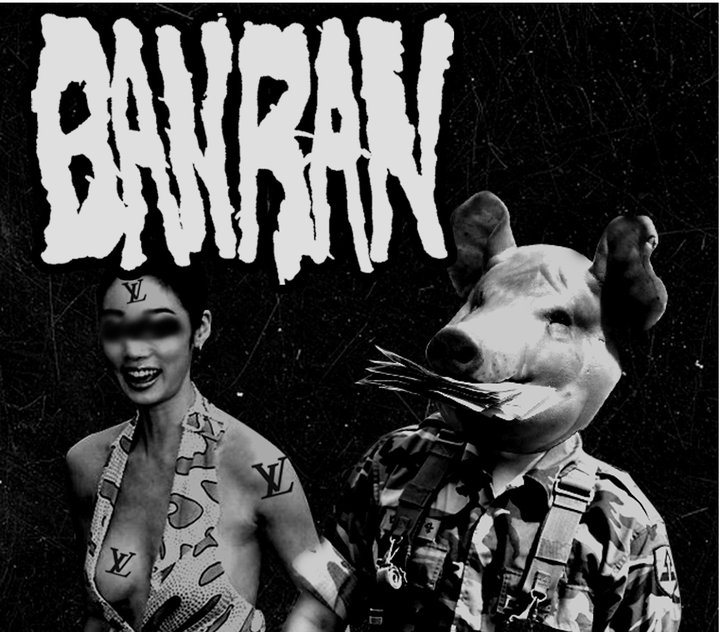
Ban Ran – Stop Kor (Way Back When/Even Worse Records)
One of the best things about record stores run by knowledgeable, conscientious employees is the sort of personalized understanding that can be ascertained about a particular customer’s tastes and interests, however mundane or arcane they might seem to anybody else. So when I happened to be in Vinyl Conflict the other day and was told of a South Korean hardcore band called Ban Ran–described to me as being “like Japanese hardcore on crack”–I was more or less completely sold before even giving it a listen, and I’m still not sure how somebody could hear a description like that and not feel the same way.
Ban Ran – Stop Kor (Way Back When/Even Worse Records)
One of the best things about record stores run by knowledgeable, conscientious employees is the sort of personalized understanding that can be ascertained about a particular customer’s tastes and interests, however mundane or arcane they might seem to anybody else. So when I happened to be in Vinyl Conflict the other day and was told of a South Korean hardcore band called Ban Ran–described to me as being “like Japanese hardcore on crack”–I was more or less completely sold before even giving it a listen, and I’m still not sure how somebody could hear a description like that and not feel the same way.
The description was fairly accurate. It certainly bore more than a passing resemblance to Japanese heavyweights like Gauze and Systematic Death, a comparison the band even plays up with the record’s title, a reference to Stop Jap, the debut album by early Japanese punk band The Stalin (though Ban Ran shares little in common with that band, other than a similarity in titles). The material is frantic but performed with a precision and a facility with stop-on-a-dime structural dynamics leagues beyond many comparable bands. It might be a stretch to consider any of these songs catchy, and only an infinitesimal percentage of music listeners would consider it at all accessible. But in the narrow spectrum of violent, thrashy hardcore, it’s actually fairly listener-friendly, albeit in an extremely relative, subjective manner–the same way that, say, Dropdead is catchier than Lärm. They don’t really tamper with a well-established formula, instead cranking out eleven songs in a little over nine minutes with speeds varying from fast to faster.

Lyrically, it gets into some odd territory, and this could be another facet of the comparison to Japanese hardcore. The lyrics provided are in what might charitably be referred to as broken English, which can be off-putting to some, and charming to those more inclined towards a condescending, orientalist view of culture. Three of the eleven songs are sung in Korean, with no translations provided, so as a non-Korean speaker I really can only guess what “Breeded Like Animal” and “Gag” are about. The English lyrics are a good reminder of the trap bands can fall into when they try to make their music more universally accessible by using a tongue with which they don’t seem entirely familiar–while the intention to spread their message may be noble, the end result often comes across as awkwardly phrased and somewhat confusing. The lyrics seem admirable enough, railing against fairly standard punk rock nemeses, primarily the racism, nationalism, and misogyny of Korean culture. Which isn’t to say they’re overbearingly politically correct or worried about coming off as mature statesmen–songs like “Being Retarded” nip that pretty firmly in the bud.
On the whole though, Stop Kor is definitely a worthwhile addition to the collection of anybody who likes their music to come in short, sharp shocks. I don’t want to sound patronizing when I say that it’s great to hear bands like this from locations outside of the standard punk rock hotbeds. However, it can be gratifying to hear something that stands as a reminder of the way that the unbridled aggression of music like this can reach across borders and cultures, disseminating ideas and bringing people to a better understanding of each other’s experiences and modes of thinking. Punk rock predicated itself on an ability to create its own semi-autonomous networks in an attempt to forge art and culture on an individual human level. Records like this reaffirm that, for all the watering-down the genre has endured, there are still inspired individuals willing to cast their creation out into a world, whether it’s receptive or not.
Banran – We Gotta Fight from Soeultari D.I.Y. on Vimeo.